Supreme Court Directives on Electoral Rights after Demolitions
Source:The Hindu ↗
Why It Matters
The case highlights the intersection of environmental governance (NGT mandates to clear riverbeds) and fundamental democratic rights, illustrating how displacement and lack of a permanent address can lead to disenfranchisement. It is highly relevant for GS-2 (Representation of People Act, Vulnerable Sections) and GS-3 (Environmental Conservation).
Summary
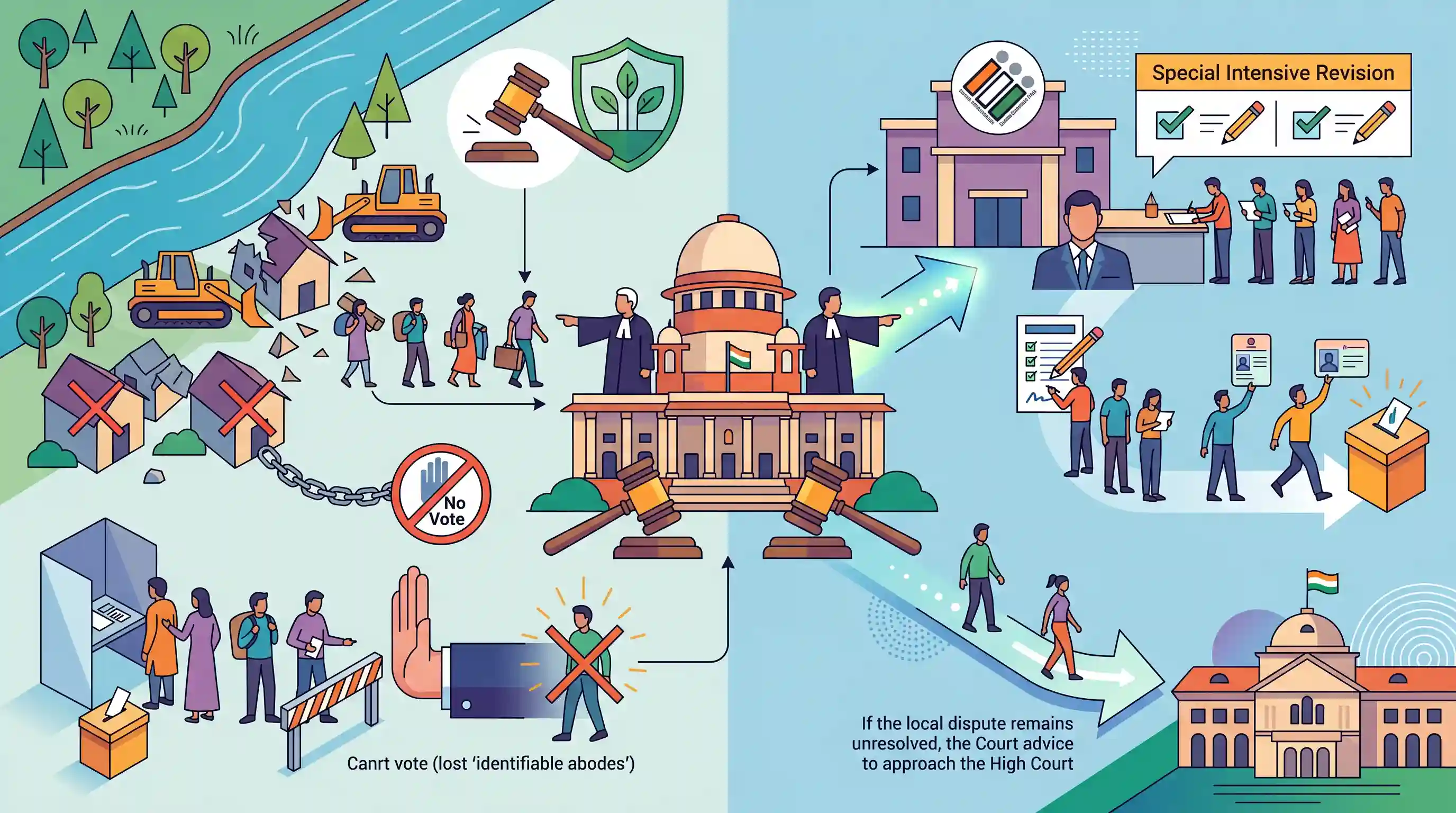
The Supreme Court has directed individuals affected by a recent demolition drive in Akbar Nagar, Lucknow, to approach the District Election Officer to ensure their inclusion in the electoral roll during the Special Intensive Revision (SIR). The residents lost their homes—and consequently their \'identifiable abodes\'—after authorities razed structures along the Kukrail river following a National Green Tribunal (NGT) order declaring the settlement illegal. The residents argued that this displacement unfairly disenfranchised them. The Court asked the election authorities to examine the issue and advised the petitioners to approach the Allahabad High Court if their grievances remain unresolved, framing it as a local dispute rather than a pan-India issue.
Key Points
- Residents of Akbar Nagar in Lucknow were excluded from the electoral roll after their homes were demolished, leaving them without an \'identifiable abode\'.
- The demolition drive was conducted along the Kukrail river after the National Green Tribunal (NGT) ruled the settlement illegal as part of an environmental and beautification initiative.
- The Supreme Court directed the affected residents to approach the District Election Officer for inclusion during the Special Intensive Revision (SIR) of electoral rolls.
- The Court noted the issue was localized and granted the petitioners liberty to approach the Allahabad High Court if the election authority fails to intervene effectively.
Important Terms
Special Intensive Revision (SIR)

A large-scale, house-to-house verification drive by the Election Commission to comprehensively update electoral rolls, ensuring accuracy by adding eligible voters and removing duplicates or deceased entries.
UPSC context
GS Paper 2: Electoral reforms; tests knowledge of ECI\'s constitutional/statutory powers under Article 324 and Representation of the People Act, 1950.
National Green Tribunal (NGT)
A specialized statutory body established under the NGT Act 2010 for the effective and expeditious disposal of cases relating to environmental protection and conservation of forests.
UPSC context
GS Paper 2 & 3: Statutory bodies and environmental conservation; tests understanding of quasi-judicial mechanisms and environmental jurisprudence.
District Election Officer (DEO)
An officer nominated by the Election Commission (ECI) to coordinate and supervise all election-related work in a district, including the preparation and revision of electoral rolls.
UPSC context
GS Paper 2: Election machinery; tests awareness of local administrative roles in ensuring free and fair elections at the ground level.
Election Commission of India (ECI)
The autonomous constitutional authority established under Article 324, responsible for administering election processes in India for Parliament, State Legislatures, and the President/Vice-President offices.
UPSC context
GS Paper 2: Constitutional bodies; fundamental topic for understanding the independence of the electoral process and institutional safeguards.
Supreme Court of India
The highest judicial forum and final court of appeal under the Constitution of India, possessing original, appellate, and advisory jurisdictions.
UPSC context
GS Paper 2: Judiciary; tests understanding of the court\'s role in protecting fundamental rights (like voting) and its discretionary power to redirect cases.
Allahabad High Court
The High Court with jurisdiction over the state of Uttar Pradesh; it acts as the primary judicial body for addressing local factual and legal disputes within the state.
UPSC context
GS Paper 2: State Judiciary; relevant for understanding the hierarchical grievance redressal mechanism and the power of High Courts under Article 226.
Prelims Trap
Loss of a permanent identifiable dwelling automatically disqualifies a citizen from being registered in the electoral roll.
Loss of property does not extinguish voting rights. ECI rules allow homeless citizens to vote if Booth Level Officers verify they routinely sleep at a specific localized place.
Static Concepts Connected
How does the RPA 1950 define and protect the "ordinarily resident" criterion?
- Statutory Requirement: Section 19 of the Representation of the People Act, 1950, makes being an 'ordinarily resident' a strict pre-condition for electoral roll inclusion.
- Homeless Provisions: ECI guidelines permit homeless individuals to be enrolled if an officer verifies they habitually sleep at a designated place, unlinking voting rights from property ownership.
- Service Exemptions: MPs, MLAs, and armed forces personnel enjoy special exemptions, retaining residency status in their home constituencies regardless of their current physical deployment.
What is the mandate of the National Green Tribunal (NGT) in urban clearances?
- Statutory Jurisdiction: The NGT exercises civil jurisdiction over cases involving substantial questions of environment arising under seven specific environmental enactments (e.g., Water Act, EPA 1986).
- Restitution Powers: It has powers to order the restitution of the environment, which includes clearing illegal encroachments from ecologically sensitive zones like river floodplains.
- Guiding Principles: It is not bound by the Code of Civil Procedure but is guided by principles of natural justice, sustainable development, and the polluter pays principle.
Cross-Topic Patterns
Floodplain Conservation vs Right to Shelter
Demolition drives authorized by NGT for river rejuvenation often pit statutory ecological restoration against Article 21 rights (shelter and livelihood), creating friction between GS3 environment and GS2 social justice.
Exhaustion of Statutory Remedies
The SC\'s refusal to intervene directly highlights judicial restraint, enforcing the exhaustion of statutory administrative remedies (approaching the District Election Officer) before invoking constitutional writ jurisdictions.

Expect a 2026 Prelims question on RPA 1950 testing ECI rules for "ordinarily resident" status and the voting rights of homeless citizens.
Linked PYQs · 5
Linked PYQs · 5
- 2022MainsGS2
Discuss the procedures to decide the disputes arising out of the election of a Member of the Parliament or State Legislature under The Representation of the People Act, 1951. What are the grounds on which the election of any returned candidate may be declared void ? What remedy is available to the aggrieved party against the decision ? Refer to the case laws.
- 2024MainsGS2
Examine the need for electoral reforms as suggested by various committees with particular reference to "one nation one election" principle.
- 2020MainsGS2
There is a need for simplification of procedure for disqualification of persons found guilty of corrupt practices under the Representation of Peoples Act". Comment.
- 2024MainsGS3
Industrial pollution of river water is a significant environmental issue in India. Discuss the various mitigation measures to deal with this problem and also the government's initiatives in this regard.
- 2019MainsGS3
Coastal sand mining, whether legal or illegal, poses one of the biggest threats to our environment. Analyze the impact of sand mining along the Indian coasts, citing specific examples.
