Solar Energy Generation and Battery Energy Storage Systems in India
Source:The Hindu ↗
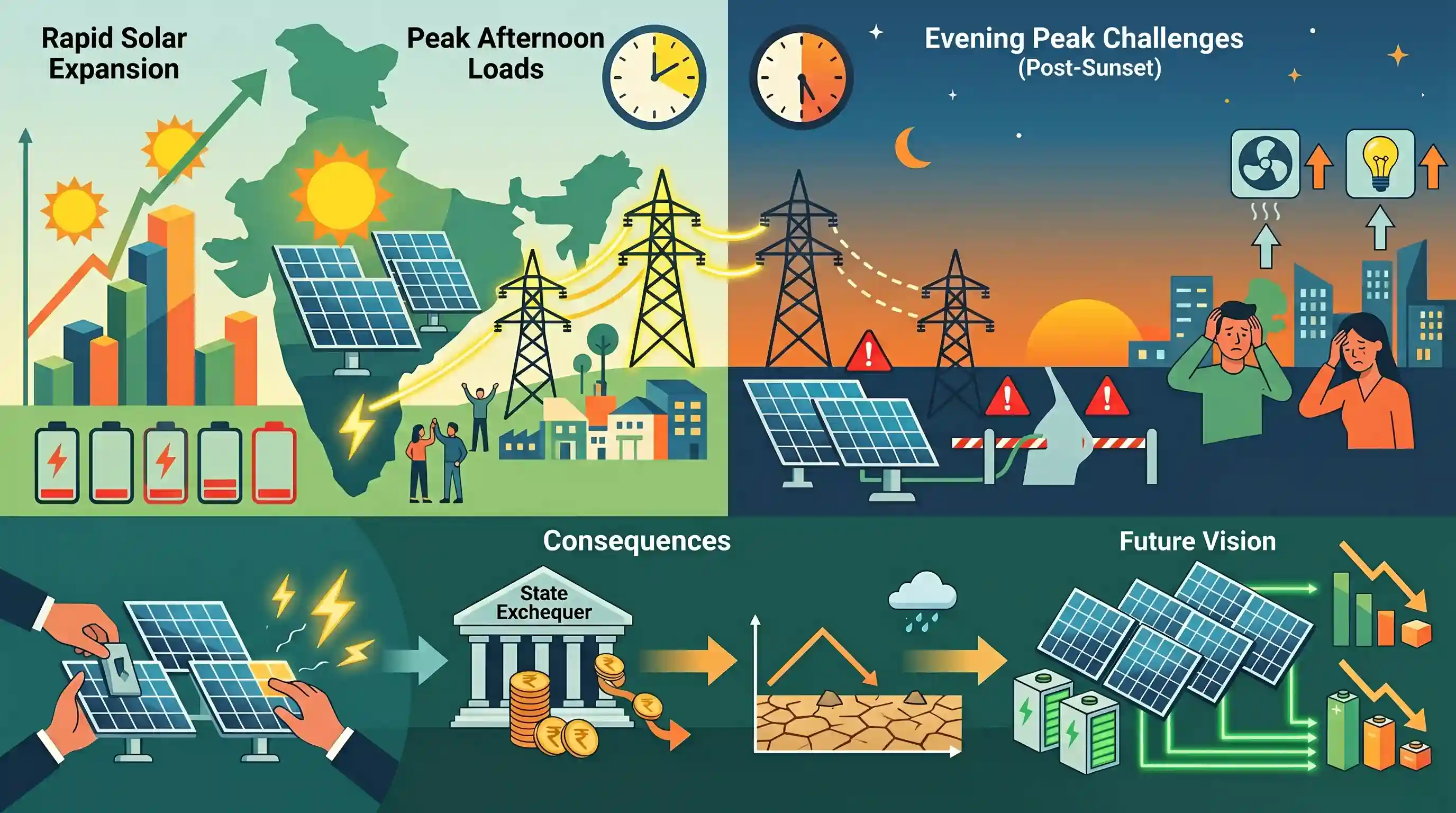
Why It Matters
Highlights the critical 'duck curve' challenge in India's renewable energy adoption, demonstrating that scaling up solar capacity is insufficient without matching Battery Energy Storage Systems (BESS) to ensure grid stability and peak load management.
Summary
The article highlights a critical disconnect in India's energy transition: the rapid expansion of solar power generation capacity without a commensurate increase in battery storage. While solar energy reached a record contribution during peak afternoon loads, its absence during post-sunset evening peaks creates major grid management challenges. Due to insufficient storage, state producers are frequently ordered to halt supply, resulting in significant solar curtailment (e.g., 2.3 TWh lost between May and December 2025) and financial compensation burdens for the exchequer. With battery storage costs declining but operational capacity lagging, the piece argues that future solar auctions must mandate co-located storage to fully harness renewable energy and ensure grid stability, especially as below-normal monsoons exacerbate summer power demands.
Key Points
- India hit a peak power demand of 256.1 GW on April 25, 2026, with solar supplying a record 21.5% of the afternoon load.
- Solar power's share of India's installed energy capacity nearly doubled from ~15% in 2022 to ~28% in 2026.
- Due to a lack of grid-scale battery storage, solar met only 10.8% of total daily generation and a mere 0.1% of post-sunset evening demand.
- Grid instability and excess daytime supply forced the curtailment of 2.3 TWh of solar power between May and December 2025, triggering compensation payouts to producers.
- Anticipated hotter, drier summers due to a forecasted below-normal monsoon (92% of LPA) increase the urgency of securing round-the-clock power.
- Despite two-hour battery storage tariffs falling significantly from ₹2.21 lakh to ₹1.48 lakh/MW/month in 2025, operational capacity remains critically low at just 0.7 GWh.
- The article recommends that the Centre and States mandate co-located battery storage in all fresh solar capacity auctions to avoid a 'half-built bridge' in India's energy transition.
Prelims Trap
"Solar energy accounts for over a quarter of India's total daily electricity generation."
This conflates installed capacity with actual generation. While solar forms ~28% of India's installed capacity, it only contributes ~10% to daily generation due to its intermittency.
Static Concepts Connected
What is the 'Duck Curve' in power grid management?
- Timing Imbalance: A graphical representation showing the timing mismatch between peak solar energy production (midday) and peak electricity demand (post-sunset evenings).
- Grid Stress: Forces conventional thermal plants to rapidly ramp up generation exactly when the sun sets, straining grid stability and infrastructure.
- Mitigation Tools: Requires grid-scale Battery Energy Storage Systems (BESS) or pumped hydro storage to capture daytime surplus for evening deployment.
What is 'Solar Curtailment' and how is it regulated?
- Definition: The deliberate reduction in renewable energy output below potential generation, ordered by load dispatch centres to prevent grid overloading during excess supply.
- Must-Run Status: Renewables hold "must-run" status under the Indian Electricity Grid Code; they cannot be curtailed for commercial reasons, only for grid security.
- Compensation Rules: If curtailed for reasons other than grid security, solar power generators are legally entitled to financial compensation.
Cross-Topic Patterns
Grid Storage + Critical Minerals
Scaling BESS directly links to the recent MMDR Act amendments opening critical minerals (lithium, vanadium) for private mining to reduce import dependency for storage tech.
BESS + Pumped Hydro Storage
Due to lagging chemical battery capacity, Pumped Storage Projects (PSP) are re-emerging as the crucial mechanical alternative to stabilize the grid under the National Electricity Plan.

Expect a 2026 Prelims statement contrasting India's high solar installed capacity with low actual generation and 'Duck Curve' impacts.
Linked PYQs · 5
Linked PYQs · 5
- 2024PrelimsGS1
Consider the following: 1. Battery storage 2. Biomass generators 3. Fuel cells 4. Rooftop solar photovoltaic units How many of the above are considered "Distributed Energy Resources"?
- 2024PrelimsGS1
Recently, the term "pumped-storage hydropower" is actually and appropriately discussed in the context of which one of the following?
- 2022MainsGS3
Do you think India will meet 50 percent of its energy needs from renewable energy by 2030 ? Justify your answer. How will the shift of subsidies from fossil fuels to renewables help achieve the above objective ? Explain.
- 2021MainsGS3
Explain the purpose of the Green Grid Initiative launched at World Leaders Summit of the COP26 UN Climate Change Conference in Glasgow in November, 2021. When was this idea first floated in the International Solar Alliance (ISA)?
- 2020MainsGS3
Describe the benefits of deriving electric energy from sunlight in contrast to the conventional energy generation. What are the initiatives offered by our Government for this purpose?
