Primary Healthcare Transition to Preventive Models
Source:The Hindu ↗
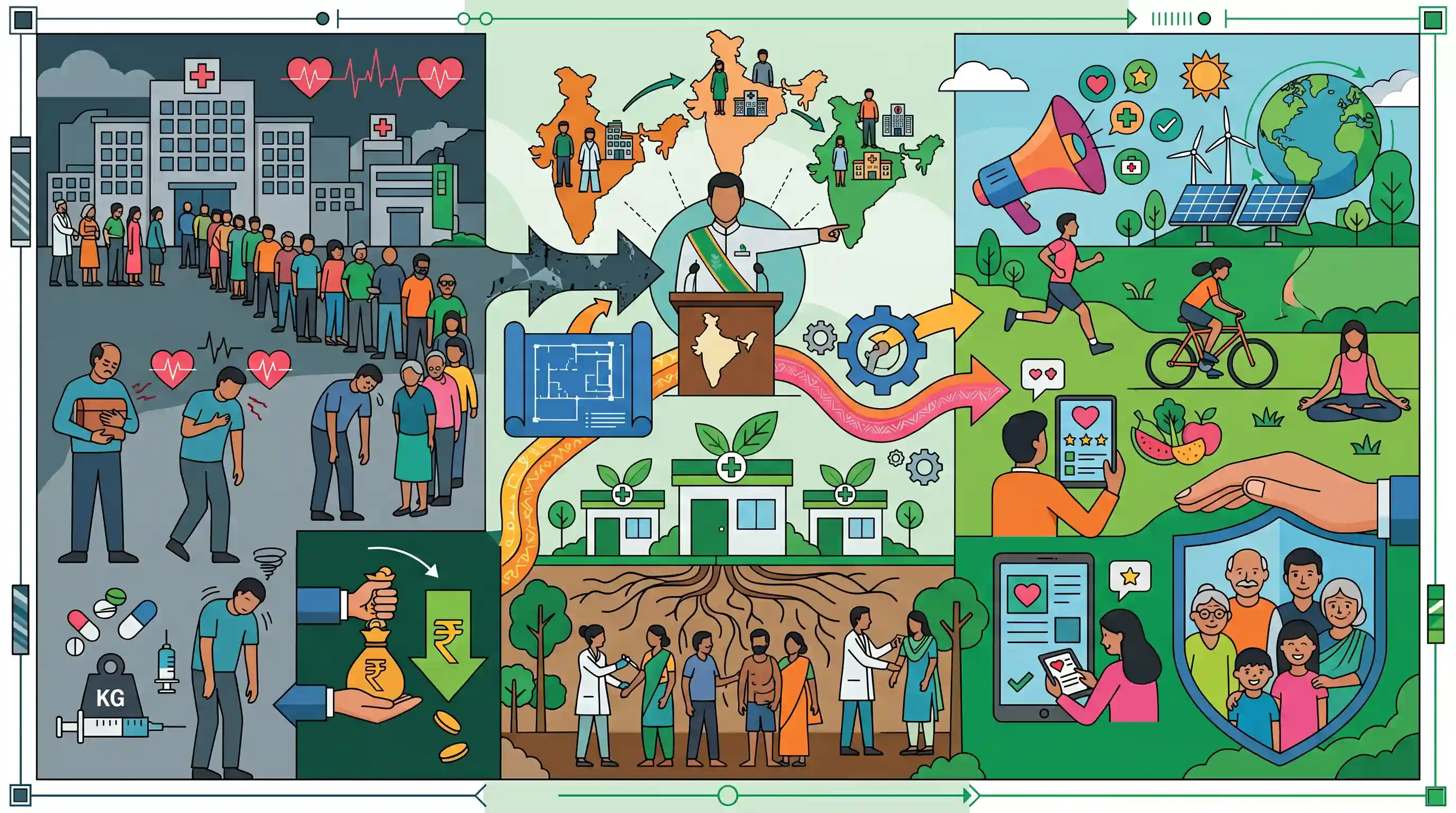
Why It Matters
The shift from curative to preventive healthcare is central to India's public health policy and essential for sustainable development. It is directly tested by UPSC (e.g., 2023 Prelims) and forms a core argument for Mains answers regarding primary healthcare infrastructure, NCD management, and reducing the economic burden of disease.
Summary
The article emphasizes the necessity of fostering a preventive health culture in India to counteract the rising incidence of non-communicable diseases and reduce out-of-pocket health expenditures. It highlights that the existing public health infrastructure heavily prioritizes curative care, often neglecting primary and preventive measures. To achieve universal health coverage and sustainable development, the focus must shift toward grassroots primary healthcare, leveraging initiatives like Ayushman Bharat Health and Wellness Centres. Furthermore, public awareness, lifestyle changes, and robust health policies at the decentralized state level are critical in building a resilient, preventive-first healthcare system.
Key Points
- India's public healthcare system is traditionally skewed towards curative treatments, with inadequate attention to preventive, promotive, and rehabilitative care.
- The growing burden of Non-Communicable Diseases (NCDs) like diabetes and hypertension highlights the urgent need to transition to a preventive healthcare model.
- Initiatives such as Ayushman Bharat Health and Wellness Centres (AB-HWCs) aim to strengthen primary healthcare by expanding the scope of preventive screening and wellness at the grassroots.
- A multi-sectoral approach involving sanitation, proper nutrition, lifestyle modifications, and community awareness is vital to establishing a preventive health culture.
- Leveraging digital health tools and decentralized state-level interventions can optimize resource allocation and enhance public health outcomes.
Important Terms
Ayushman Bharat

A flagship scheme providing a continuum of care through two pillars: Ayushman Arogya Mandirs (primary care) and PM-JAY (insurance for secondary/tertiary hospitalization).
UPSC context
GS II (Health/Welfare Schemes); tests primary healthcare shifts and financial protection for vulnerable sections.
Universal Health Coverage (UHC)
A central initiative aimed at ensuring all citizens access quality healthcare without financial hardship, aligning with Sustainable Development Goal 3.8.
UPSC context
GS II (Health); core concept for evaluating health equity and India's progress toward SDGs.
Out-of-pocket health expenditures (OOPE)
Direct payments made by individuals at the point of service, frequently cited as a major driver of poverty and financial instability in India.
UPSC context
GS II (Health); critical for discussing health affordability and the impact of medical costs.
National Health Mission (NHM)
A framework subsuming rural and urban health missions to provide accessible, affordable healthcare, focusing on maternal/child health and disease control.
UPSC context
GS II (Social Justice/Health); relevant for analyzing public health infrastructure and decentralized delivery.
Ayushman Bharat Digital Mission (ABDM)
An initiative creating a digital health ecosystem using ABHA IDs to link medical records across providers for better transparency and portability.
UPSC context
GS II (Governance) & GS III (S&T); tests knowledge of digital public infrastructure in healthcare.
Swachh Bharat Abhiyan
A massive sanitation campaign that acts as a preventive health intervention by reducing waterborne diseases through improved hygiene and waste management.
UPSC context
GS II (Social Sector); tests understanding of the link between sanitation and public health outcomes.
Prelims Trap
"Ayushman Bharat scheme solely focuses on secondary and tertiary hospitalization insurance."
Ayushman Bharat has two pillars: PM-JAY for secondary/tertiary hospitalization, and Health & Wellness Centres (AB-HWCs) which specifically deliver comprehensive primary and preventive care.
Static Concepts Connected
What are the core components of the Ayushman Bharat initiative?
- PM-JAY: Health insurance cover of ₹5 lakhs per family per year for secondary and tertiary care hospitalization for vulnerable families.
- Health & Wellness Centres: Upgrading 1.5 lakh Sub-Health Centres and Primary Health Centres to deliver Comprehensive Primary Health Care (CPHC), including preventive screenings.
What defines India's epidemiological transition?
- Shift to NCDs: The shifting of the disease burden from infectious and deficiency diseases (like cholera or malnutrition) to chronic, lifestyle-related diseases.
- Mortality burden: NCDs such as cardiovascular diseases, chronic respiratory diseases, and diabetes now account for over 60% of all mortality in India.
Cross-Topic Patterns
Urban planning and NCD mitigation
The rise in NCDs is closely linked to unplanned urbanization. Integrating active mobility infrastructure (walkability) and green spaces directly reduces the preventive healthcare burden, linking GS1 urbanization with GS2 health.
DPI expanding into preventive health
The Ayushman Bharat Digital Mission (ABDM) integrates health registries, enabling predictive analytics for early NCD screening. This mirrors India's DPI success in financial inclusion (UPI) applied to social sectors.

Mains 2026: Expect a question linking India's demographic dividend with the economic drain of rising NCDs and out-of-pocket expenditures.
Linked PYQs · 5
Linked PYQs · 5
- 2023PrelimsGS1
Consider the following statements: Statement-I: India's public sector health care system largely focuses on curative care with limited preventive, promotive and rehabilitative care. Statement-II: Under India's decentralized approach to health care delivery, the States are primarily responsible for organizing health services. Which one of the following is correct in respect of the above statements?
- 2021MainsGS2
“Besides being a moral imperative of a Welfare State, primary health structure is a necessary precondition for sustainable development.” Analyze.
- 2024MainsGS2
In a crucial domain like the public healthcare system the Indian State should play a vital role to contain the adverse impact of marketisation of the system. Suggest some measures through which the State can enhance the reach of public healthcare at the grassroots level.
- 2022PrelimsGS1
With reference to Ayushman Bharat Digital Mission, consider the following statements: 1. Private and public hospitals must adopt it. 2. As it aims to achieve universal health coverage, every citizen of India should be part of it ultimately. 3. It has seamless portability across the country. Which of the statements given above is/are correct?
- 2020MainsGS2
In order to enhance the prospects of social development, sound and adequate health care policies are needed particularly in the fields of geriatric and maternal health care. Discuss.
