Union Budget Fiscal Policy and Income Inequality Critique
Source:Indian Express ↗
Why It Matters
It provides critical arguments for Mains answers on the trade-offs between growth-oriented capital expenditure and welfare-oriented social spending. This debate is central to GS2 (Social Justice) and GS3 (Inclusive Growth, Government Budgeting).
Summary
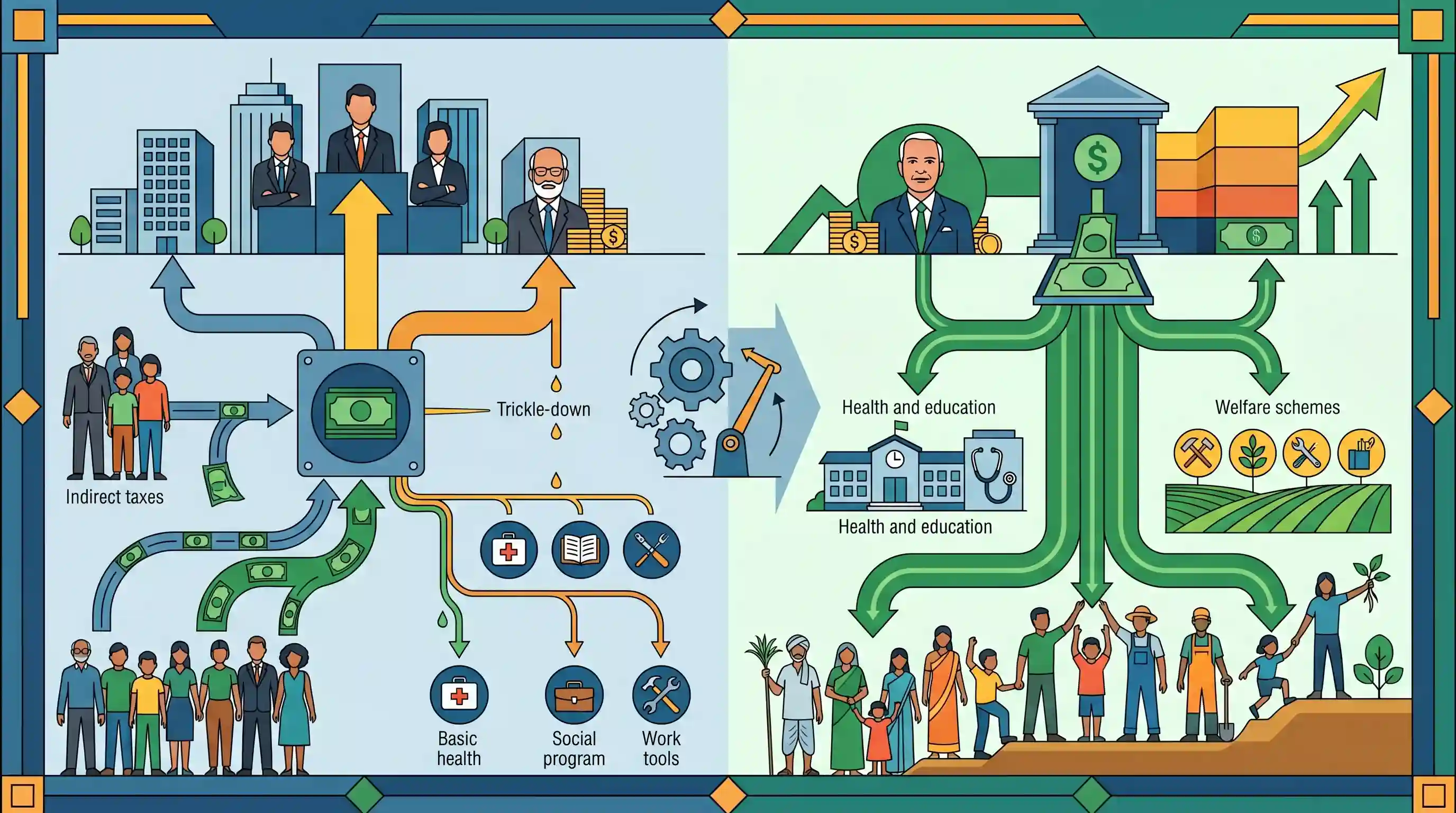
The article critiques the Union Budget, arguing that its fiscal architecture will exacerbate rather than alleviate economic inequality in India. It points out that a reliance on regressive indirect taxes, coupled with insufficient allocations for vital social sector programs like MGNREGA, disproportionately burdens the poor. Meanwhile, the budget’s emphasis on capital expenditure and corporate tax relief benefits the affluent under the assumption of trickle-down economics. The author contends that achieving genuine inclusive growth requires a pivot towards progressive direct taxation, robust investments in health and education, and direct support for vulnerable sections to bridge the widening wealth gap.
Key Points
- The budget's heavy reliance on indirect taxation places a disproportionate, regressive burden on lower-income households compared to wealthier segments.
- Crucial social safety nets, including allocations for rural employment (MGNREGA), health, and education, face stagnation or cuts in real terms.
- The focus on capital expenditure and corporate tax rationalization assumes a 'trickle-down' effect, which frequently fails to bridge the income divide.
- Lack of progressive taxation measures (such as wealth or inheritance taxes) allows wealth concentration at the top to continue unchecked.
- Meaningful poverty alleviation requires an integrated approach combining targeted welfare schemes with the deft management of inflation and unemployment.
Important Terms
Union Budget

Constitutional document under Article 112 detailing the Union Government’s estimated receipts and expenditures for a financial year (April–March).
UPSC context
GS Paper 3: Government Budgeting. Tests fiscal policy, resource allocation, and constitutional financial administration.
MGNREGA
2005 social security law guaranteeing 100 days of unskilled manual work annually to rural households, providing a legal "right to work."
UPSC context
GS Paper 2: Welfare Schemes. Evaluates poverty alleviation, rural safety nets, and demand-driven social security effectiveness.
Indirect Taxes
Taxes on goods/services (e.g., GST) where the tax burden is shifted to consumers; often considered regressive as they tax the poor and wealthy equally.
UPSC context
GS Paper 3: Indian Economy (Taxation). Tests knowledge of tax incidence and its impact on income inequality.
Capital Expenditure
Government spending that creates long-term physical assets (infrastructure, schools) or reduces debt, intended to enhance the economy's productive capacity.
UPSC context
GS Paper 3: Budgeting. Focuses on the multiplier effect and asset-creation vs. consumption-based spending.
Inclusive Growth
Broad-based economic growth that ensures fair distribution of benefits and creates opportunities for all segments of society, reducing poverty and inequality.
UPSC context
GS Paper 3: Inclusive Growth. A core syllabus topic testing development strategies and social equity outcomes.
Progressive Taxation
A tax system where the tax rate increases as income rises, primarily used in direct taxes to ensure equitable wealth redistribution.
UPSC context
GS Paper 3: Fiscal Policy. Central to discussions on social justice and narrowing wealth disparities.
Prelims Trap
Higher indirect tax collections indicate a highly progressive tax regime that reduces economic inequality.
Indirect taxes are regressive. Because everyone pays the same tax on goods, the poor spend a larger proportion of their total income on consumption than the rich.
Static Concepts Connected
What is the difference between progressive and regressive taxation?
- Progressive Tax: The tax rate increases as the taxable amount increases, shifting the burden to the wealthy (e.g., Income Tax).
- Regressive Tax: Takes a larger percentage of income from low-income earners than from high-income earners, as flat consumption taxes disproportionately hit the poor (e.g., GST).
- Proportional Tax: Imposes the exact same percentage rate of taxation on everyone, regardless of their income level.
How do Capital and Revenue Expenditures differ in the Union Budget?
- Capital Expenditure: Money spent on creating physical or financial assets, or reducing liabilities (e.g., infrastructure building, loan repayment). Has a high economic multiplier effect.
- Revenue Expenditure: Routine operational spending that neither creates assets nor reduces liabilities (e.g., salaries, subsidies, MGNREGA wages). Crucial for immediate welfare.
Cross-Topic Patterns
K-shaped recovery & informal sector wages
The debate over 'trickle-down' capex vs. MGNREGA funding directly ties into India's post-pandemic K-shaped recovery, where formal corporate profits outpace informal rural wage growth.
Capex push vs. Demographic Dividend
Slashing health and education budgets to fund infrastructure risks India's demographic dividend, bridging GS-3 economic growth with GS-2 human development issues.

GS-3 Mains 2026 will likely feature a direct critique of 'trickle-down' Capex-led growth versus revenue-led welfare spending.
Linked PYQs · 5
Linked PYQs · 5
- 2025MainsGS2
Inequality in the ownership pattern of resources is one of the major causes of poverty. Discuss in the context of 'paradox of poverty'.
- 2022MainsGS3
Is inclusive growth possible under market economy ? State the significance of financial inclusion in achieving economic growth in India.
- 2022MainsGS2
Besides the welfare schemes, India needs deft management of inflation and unemployment to serve the poor and the underprivileged sections of the society. Discuss.
- 2020MainsGS2
The incedence and intensity of poverty are more important in determining poverty based on income alone". In this context analyse the latest United Nations Multidimensional Poverty Index Report.
- 2019MainsGS3
Enumerate the indirect taxes which have been subsumed in the Goods and Services Tax (GST) in India. Also, comment on the revenue implications of the GST introduced in India since July 2017.
