Parliamentary Disruptions Mark Budget Session on Waqf and Tariffs
Source:Indian Express ↗
Why It Matters
The article highlights critical issues in the functioning of the Indian Parliament, specifically the role and impartiality of the Speaker, the use of Parliamentary Committees (like JPCs) to resolve legislative deadlocks, and the challenges of managing contentious bills (like the Waqf Amendment). These are fundamental to GS2 Polity and Governance.
Summary
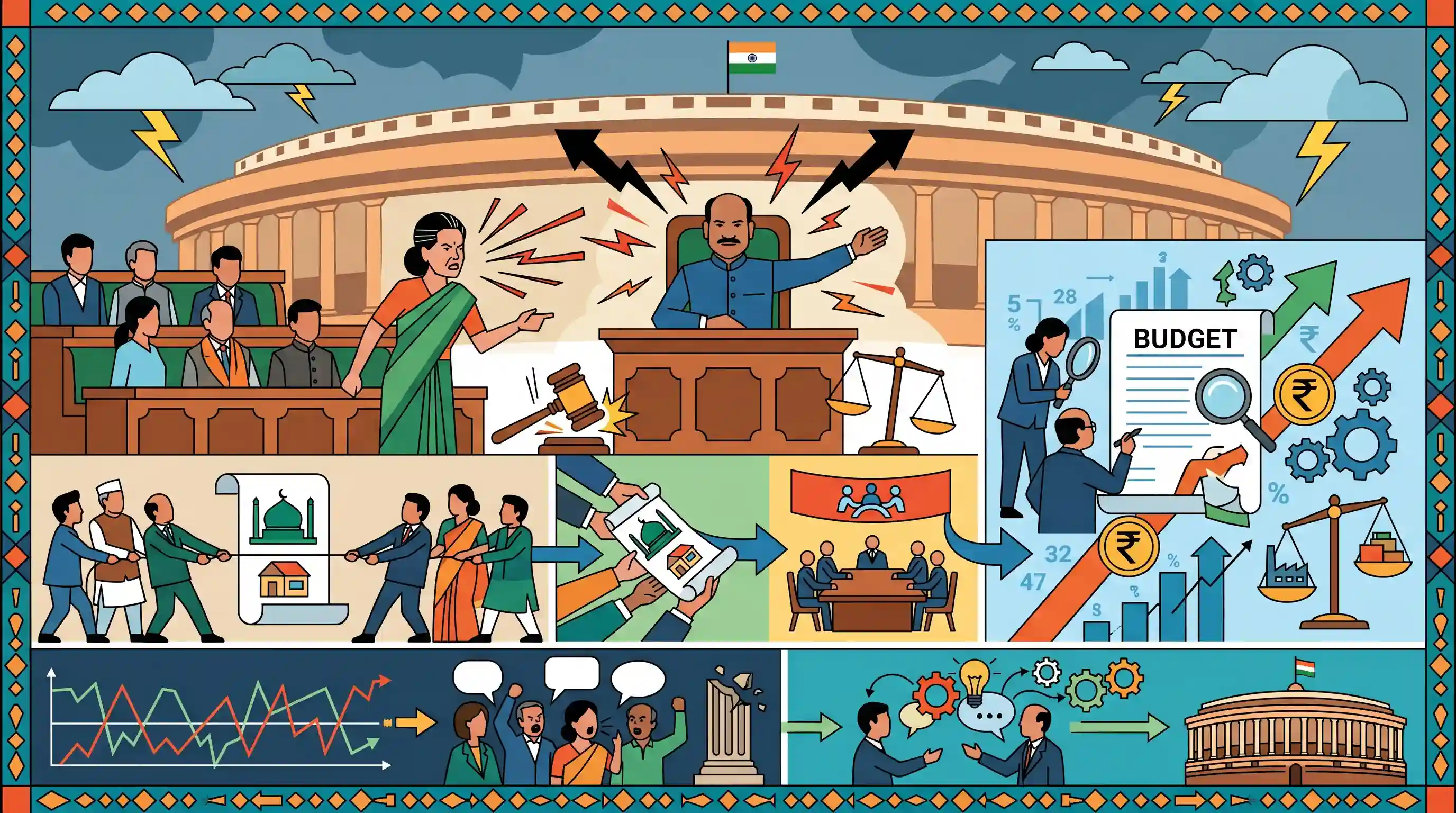
The recent Budget Session of Parliament was heavily disrupted by a political storm over the Waqf (Amendment) Bill, which the Opposition heavily criticized, ultimately leading to its referral to a Joint Parliamentary Committee (JPC). The session was marked by a deepening rift between the government and the Opposition, further highlighted by a significant row between Lok Sabha Speaker Om Birla and Congress leader Sonia Gandhi. This confrontation brought the impartiality and functioning of the Speaker's office into question. Additionally, legislative focus shifted to economic policies with debates over tariff adjustments in the Budget. The overall turbulent session underscores ongoing challenges in parliamentary functioning, the importance of legislative committees, and the need for constructive debate in India's democratic framework.
Key Points
- The Budget Session witnessed severe disruptions and a deepening divide between the ruling government and the Opposition over the controversial Waqf (Amendment) Bill.
- Due to intense opposition pushback, the Waqf Bill was sent to a Joint Parliamentary Committee (JPC) to ensure broader scrutiny and address concerns over minority rights.
- A notable confrontation occurred between Lok Sabha Speaker Om Birla and senior Congress leader Sonia Gandhi, putting the spotlight on the impartiality and role of the Presiding Officer in maintaining order.
- The session also featured debates on economic measures, specifically concerning tariffs and protectionist trade policies introduced in the Union Budget.
- The recurring gridlock in Parliament raises serious questions about the declining quality of legislative debate and the effectiveness of parliamentary mechanisms.
Important Terms
Waqf (Amendment) Bill, 2024

Legislation proposing reforms to the 1995 Act, including non-Muslim representation on boards and granting District Collectors powers to resolve ownership disputes over religious endowments.
UPSC context
GS Paper II: Government policies and interventions; tests understanding of religious autonomy versus administrative transparency.
Joint Parliamentary Committee (JPC)
An ad-hoc, bipartisan committee consisting of members from both Houses, formed to investigate specific matters of public importance or provide detailed legislative scrutiny.
UPSC context
GS Paper II: Parliamentary Committees; crucial for mechanisms of executive accountability and legislative oversight.
Speaker of the Lok Sabha
The constitutional presiding officer of the Lower House (Article 93), responsible for maintaining decorum, interpreting rules, and certifying Money Bills with finality.
UPSC context
GS Paper II: Constitutional posts; tests knowledge of parliamentary structure and the impartiality of the chair.
Leader of the Opposition (LoP)
A statutory position (1977 Act) held by the leader of the largest opposition party having at least one-tenth of the total House strength.
UPSC context
GS Paper II: Parliamentary democracy; vital for executive oversight and selection of statutory heads.
Union Budget
The 'Annual Financial Statement' (Article 112) detailing estimated receipts and expenditures, reflecting the government's economic vision and fiscal policy for the year.
UPSC context
GS Paper III: Government budgeting; tests understanding of public finance and economic development priorities.
Prelims Trap
"The Constitution mandates that the Speaker must resign from their political party upon assuming office."
Unlike the strict British convention, the Indian Constitution does not mandate the Speaker to resign from their party to ensure impartiality.
Static Concepts Connected
What are the composition and powers of a Joint Parliamentary Committee (JPC)?
- Ad-hoc Nature: They are ad-hoc bodies constituted for a specific purpose (scrutinizing bills or investigating issues) and dissolve after submitting their report.
- Membership Ratio: They comprise members from both Houses of Parliament, typically structured in a 2:1 ratio (Lok Sabha to Rajya Sabha).
- Advisory Powers: They can summon individuals and demand documents, but their final recommendations are advisory, not binding on the government.
How does Waqf property management intersect with Constitutional Fundamental Rights?
- Article 26: Guarantees religious denominations the fundamental right to establish and maintain institutions for religious and charitable purposes.
- Administration by Law: Article 26(d) protects the right to administer such property, but strictly "in accordance with law," allowing legislative oversight.
- State Regulation: The State can legally regulate the secular and administrative aspects of religious endowments without violating core religious rights.
Cross-Topic Patterns
Fundamental Rights vs Legislative Control
The Waqf debate mirrors the broader constitutional tussle over Article 26 rights versus the State's power to regulate the secular administrative activities of religious endowments.
Protectionism vs GVC Integration
Budget tariff hikes aimed at domestic protectionism often conflict with India's concurrent macroeconomic goals of integrating into Global Value Chains (GVCs), a recurring GS-3 theme.

Expect a multi-statement Prelims question comparing the ad-hoc nature, composition, and powers of JPCs vs Departmental Standing Committees.
Linked PYQs · 4
Linked PYQs · 4
- 2020MainsGS2
Once a Speaker, Always a Speaker' ! Do you think this practice should be adopted to impart objectivity to the office of the Speaker of Lok Sabha ? What could be its implications for the robust functioning of parliamentary business in India?
- 2023MainsGS2
Discuss the role of Presiding Officers of state legislatures in maintaining order and impartiality in conducting legislative work and in facilitating best democratic practices.
- 2021MainsGS2
Do Department-related Parliamentary Standing Committees keep the administration on its toes and inspire reverence for parliamentary control? Evaluate the working of such committees with suitable examples.
- 2018MainsGS3
How would the recent phenomena of protectionism and currency manipulations in world trade affect macroeconomic stability of India?
