Budget proposes schemes to modernize legacy industrial clusters
Source:Indian Express ↗
Why It Matters
Legacy industrial clusters are vital sources of localized employment and traditional manufacturing. Their revitalization is essential for solving systemic inefficiencies in the MSME sector, promoting labor-intensive growth, and achieving structural transformation in the Indian economy.
Summary
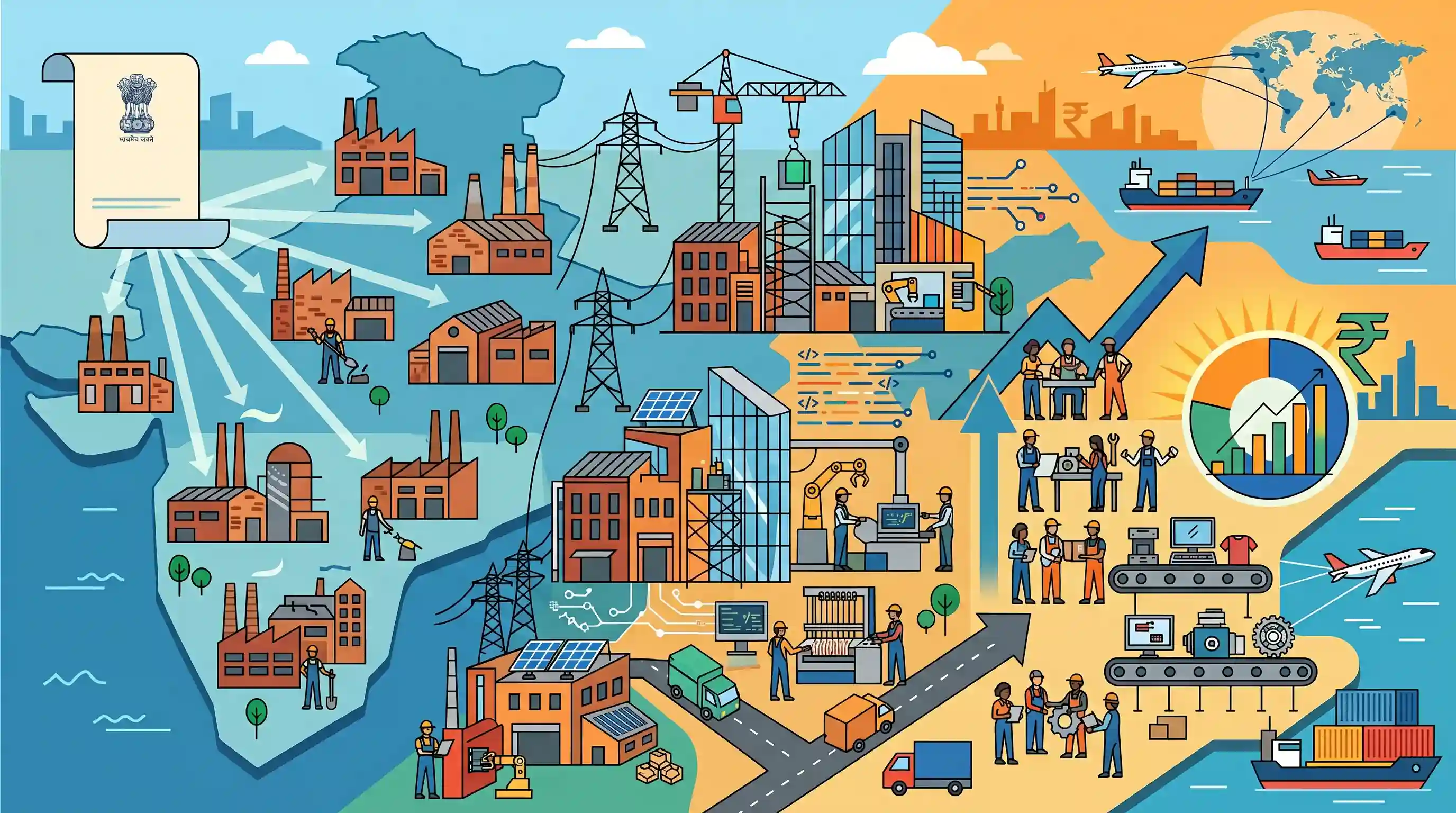
The Union Budget has announced targeted schemes to revive 200 legacy industrial clusters. This initiative seeks to modernize traditional manufacturing hubs by upgrading their infrastructure and technological capabilities. Primarily benefiting the MSME sector, the move is designed to drive job creation, improve productivity, and integrate domestic manufacturing into global value chains, thereby supporting the goal of increasing manufacturing's share in the national GDP.
Key Points
- The Union Budget proposes new schemes aimed at the revival and modernization of 200 legacy industrial clusters across India.
- The initiative focuses on upgrading infrastructure, technology, and operational efficiency within these traditional manufacturing hubs.
- This policy intervention is crucial for the MSME sector, aiming to boost local employment, enhance productivity, and make traditional industries globally competitive.
- Revitalizing legacy clusters aligns with broader economic goals to increase the manufacturing sector's share in GDP and integrate domestic industries into global value chains.
Important Terms
Legacy Industrial Clusters

Traditional geographical hubs of interconnected industries (e.g., textiles, agro-processing) with outdated technology. The 2026 Budget proposes modernizing 200 such clusters to enhance their cost-competitiveness and productivity.
UPSC context
GS Paper III: Industrial Policy. Tests knowledge of cluster-based development and strategies to revive traditional manufacturing sectors.
MSME Sector
Enterprises categorized by investment and turnover (e.g., Micro: <₹1cr investment/<₹5cr turnover). They contribute ~30% to India's GDP and are vital for employment and exports.
UPSC context
GS Paper III: Indian Economy. Frequent topic regarding inclusive growth, employment generation, and the MSMED Act, 2006.
Global Value Chains (GVCs)
The fragmented international production process where different stages of a product's creation (design, manufacturing, assembly) occur across multiple countries to optimize comparative advantages.
UPSC context
GS Paper III: Trade and Economy. Tests understanding of India's integration into world trade and the 'Make in India' initiative.
Manufacturing’s Share in GDP
The percentage of total economic output derived from manufacturing. India aims to increase this from ~17% to 25% to drive high economic growth and quality employment.
UPSC context
GS Paper III: Economic Development. Relates to industrial growth targets, 'Viksit Bharat 2047' goals, and structural economic shifts.
Union Budget
Presented under Article 112 as the 'Annual Financial Statement,' it outlines the Union Government’s estimated receipts and expenditures for the upcoming fiscal year.
UPSC context
GS Paper II & III: Governance and Economy. Core topic for fiscal policy, parliamentary procedures, and government expenditure priorities.
Prelims Trap
"The scheme establishes 200 newly built greenfield industrial smart cities."
The scheme aims to revive and modernize existing traditional manufacturing hubs, not build new greenfield projects. It leverages established agglomeration economies.
Static Concepts Connected
What is the Cluster Development Approach for industrial growth?
- Agglomeration economies: Reduces MSME operational costs by providing shared physical infrastructure like common effluent treatment plants, design centres, and testing labs.
- Existing frameworks: Operates under structural initiatives like MSE-CDP and SFURTI (for traditional rural industries) to organize fragmented enterprises into cohesive supply chains.
How are MSMEs currently defined in India?
- Composite criteria: Uses both investment in plant/machinery and annual turnover limits, officially eliminating the previous distinction between manufacturing and services sectors.
- Medium threshold: A medium enterprise is defined as having an investment up to ₹50 crore and an annual turnover up to ₹250 crore.
Cross-Topic Patterns
Economic Geography: Agglomeration Economies
The push to revive older industrial nodes links directly to Weber’s industrial location theory and the economic benefits of agglomeration taught in Human Geography.
Foreign Trade Policy & GVC Integration
Upgrading legacy infrastructure is a fundamental prerequisite for the Foreign Trade Policy's goal of embedding domestic MSMEs into international supply chains.

Expect 2026 Prelims to test 'agglomeration economies' as a concept alongside statements on MSE-CDP and the new legacy clusters scheme.
Linked PYQs · 4
Linked PYQs · 4
- 2023MainsGS3
Faster economic growth requires increased share of the manufacturing sector in GDP, particularly of MSMEs. Comment on the present policies of the Government in this regard.
- 2017MainsGS3
Industrial growth rate has lagged-behind in the overall growth of Gross-Domestic-Product (GDP) in the post-reform period." Give reasons. How far the recent changes in Industrial-Policy are capable of increasing the industrial growth rate?
- 2012PrelimsGS1
What is/are the recent policy initiative(s) of Government of India to promote the growth of manufacturing sector? 1. Setting up of National Investment and Manufacturing Zones 2. Providing the benefit of ‘single window clearance’ 3. Establishing the Technology Acquisition and Development Fund Select the correct answer using the codes given below:
- 2023PrelimsGS1
Consider the following statements with reference to India: 1. According to the 'Micro, Small and Medium Enterprises Development (MSMED) Act, 2006', the 'medium enterprises' are those with investments in plant and machinery between ₹ 15 crore and ₹ 25 crore. 2. All bank loans to the Micro, Small and Medium Enterprises qualify under the priority sector. Which of the statements given above is/are correct?
