Budget announces customs duty exemptions for aircraft parts
Source:The Hindu ↗
Why It Matters
This highlights government interventions to build domestic capacity in the high-value aerospace and defence manufacturing sectors. It directly links to GS-3 topics involving infrastructure development (UDAN scheme), industrial policy (SEZ reforms), and indigenisation of technology.
Summary
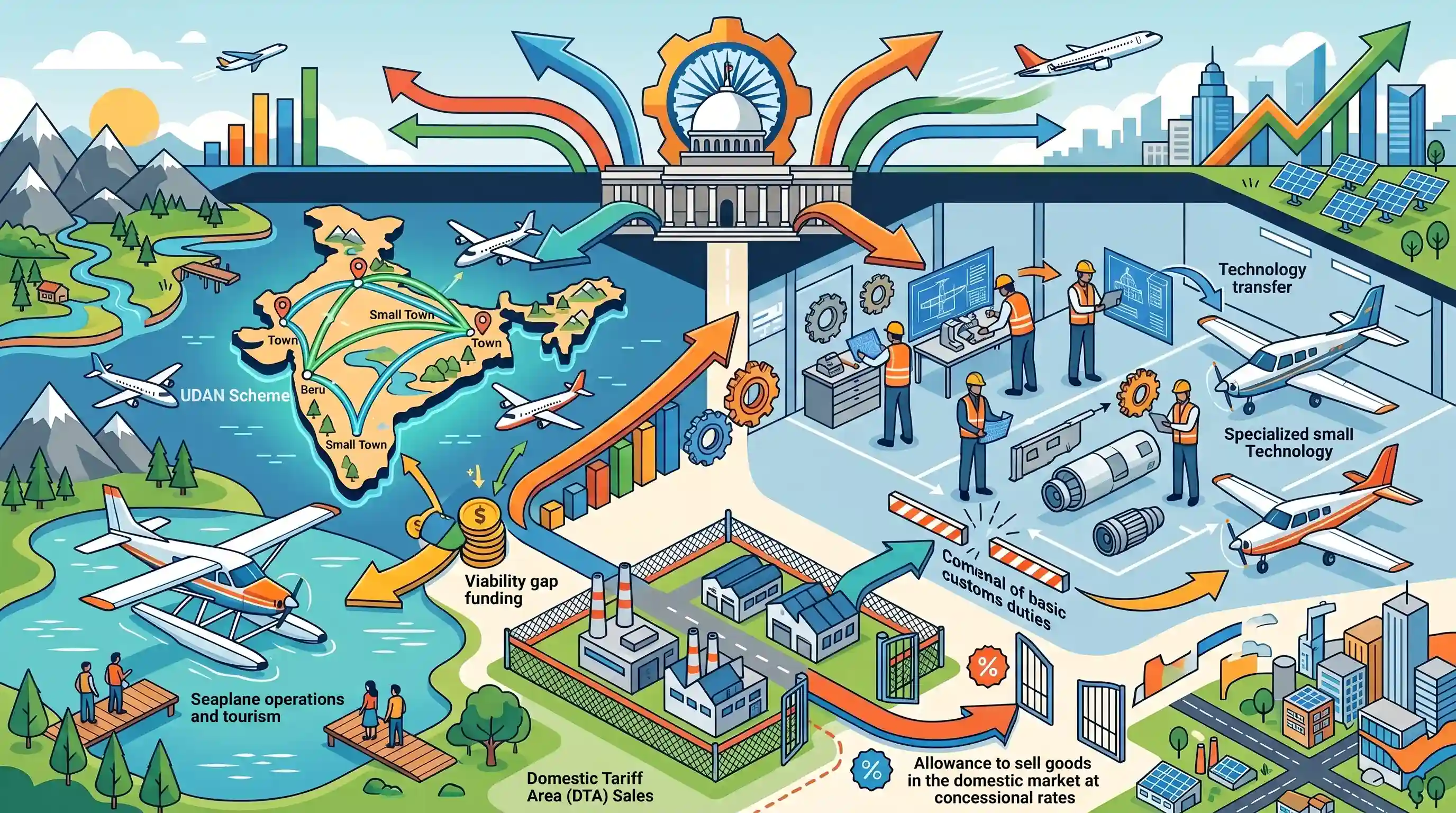
The Union Budget 2026-27 introduces substantial incentives to propel India's domestic aviation manufacturing, with a targeted focus on training aircraft and seaplanes. Central to these reforms is the removal of basic customs duties on imported parts for civilian aircraft and raw materials for defence MRO services. To bolster regional connectivity and tourism via the UDAN scheme, viability gap funding for seaplanes has been announced. Furthermore, in a bid to decouple from Chinese supply chains and strengthen indigenisation, SEZs have been granted a one-time allowance to sell goods in the domestic tariff area at concessional rates. These fiscal and policy interventions, alongside technology transfers for indigenous aircraft like the Hansa 3(NG), align with the broader 'Make in India' vision for a self-reliant aerospace sector.
Key Points
- The Union Budget 2026-27 removes the 7.5% to 15% basic customs duty on components and parts used in manufacturing civilian, training, and other aircraft to boost domestic aerospace manufacturing.
- Basic customs duty exemption is also extended to raw materials imported for Maintenance, Repair, and Overhaul (MRO) services in the defence sector.
- To enhance last-mile connectivity and tourism, the budget proposes a viability gap funding scheme for seaplanes, integrating them into the broader UDAN regional connectivity scheme.
- Special Economic Zones (SEZs) have been permitted a one-time measure to sell domestically at concessional duty rates, aiming to reduce dependence on Chinese supply chains and encourage indigenisation.
- Technology transfers, such as the NAL's two-seater trainer aircraft Hansa 3(NG), are highlighted as steps toward fulfilling India's ambition for indigenously manufactured passenger aircraft.
Important Terms
UDAN Scheme

A flagship regional connectivity scheme (RCS) launched in 2016 to make air travel affordable and widespread by connecting unserved and underserved airports.
UPSC context
GS Paper 2 (Govt Policies) and Paper 3 (Infrastructure). Tests knowledge of regional connectivity and aviation sector reforms.
Viability Gap Funding (VGF)
A one-time or deferred grant provided to infrastructure projects that are economically justified but lack financial viability due to long gestation periods or low user charges.
UPSC context
GS Paper 3 (Investment Models). Essential for understanding Public-Private Partnership (PPP) mechanisms.
Maintenance, Repair, and Overhaul (MRO)
The technical and administrative activities, including inspection and repair, required to ensure the continuous airworthiness and safety of aircraft throughout their service lives.
UPSC context
GS Paper 3 (Infrastructure/Indigenisation). Focuses on India's ambition to become a global aviation service hub.
National Aerospace Laboratories (NAL)
India's premier civilian aerospace R&D laboratory under the CSIR, responsible for the design and development of indigenous light aircraft like the Hansa and Saras.
UPSC context
GS Paper 3 (Science & Tech). Tests awareness of indigenous technology and R&D institutions.
Hansa 3(NG)
A next-generation indigenous two-seater trainer aircraft developed by NAL for pilot training (ab-initio), featuring a glass cockpit and composite airframe.
UPSC context
GS Paper 3 (Indigenisation of Tech). Key example of Make in India in the aviation sector.
Tata-Airbus C-295 Project
A strategic partnership to manufacture 56 C-295 transport aircraft in Vadodara, Gujarat; the first private-sector project in India to produce full military aircraft.
UPSC context
GS Paper 3 (Defence/Manufacturing). Significant for private sector involvement in strategic defense manufacturing.
Adani-Embraer Partnership
A strategic collaboration aimed at establishing India's first commercial aircraft final assembly line (FAL) for regional jets, enhancing the domestic aviation ecosystem.
UPSC context
GS Paper 3 (Economy/Manufacturing). Highlights growing private investment and global collaborations in Indian aerospace.
Domestic Tariff Area (DTA)
The territory within India that is outside the Special Economic Zones (SEZs). Sales from SEZs to the DTA are typically treated as imports.
UPSC context
GS Paper 3 (Economic Zones). Crucial for understanding trade barriers and fiscal reforms within SEZs.
Prelims Trap
Goods cleared from an SEZ to the Domestic Tariff Area (DTA) are treated as standard domestic trade, exempt from customs duties.
Under the SEZ Act 2005, goods moved from an SEZ to the DTA are legally treated as imports and attract standard customs duties, unless a specific government concession applies.
Static Concepts Connected
What is the Domestic Tariff Area (DTA) rule for Special Economic Zones (SEZs)?
- Foreign territory: Under the SEZ Act, an SEZ is a deemed foreign territory for trade operations, duties, and tariffs.
- DTA sales: Selling goods from an SEZ to the DTA is legally treated as importing into India, thereby attracting standard customs duties.
- FDI & Taxes: SEZs enjoy 100% FDI under the automatic route and initial income tax exemptions under Section 10AA of the Income Tax Act.
How does Viability Gap Funding (VGF) work in infrastructure?
- Objective: Capital grants provided to support infrastructure projects that are economically justified but fall short of financial viability.
- Funding share: Usually up to 20% of total project cost is funded by the Centre, with an additional matching grant up to 20% by the States.
- Application: Widely used in PPP models and schemes like UDAN to subsidize airline operational losses on under-served regional routes.
Cross-Topic Patterns
SEZ structural reforms & China+1
The push to allow concessional DTA sales from SEZs aligns with the DESH Bill's objective to shift SEZs from pure export hubs to domestic manufacturing enablers, countering Chinese supply dominance.
VGF for Seaplanes & Island Development
Seaplane integration under UDAN converges with the NITI Aayog's Island Development Agency (IDA) mandate, strategically boosting high-value tourism in Lakshadweep and the Andaman & Nicobar islands.
Defence MRO as a strategic sector
Slashing BCD for MRO raw materials complements the Defence Acquisition Procedure (DAP) focus on localising life-cycle support, reducing foreign exchange outgo and long-term strategic vulnerabilities.

Expect a multi-statement question on SEZ vs DTA trade rules alongside UDAN's VGF funding mechanism in the 2026 Prelims Economy paper.
Linked PYQs · 2
Linked PYQs · 2
- 2024MainsGS3
What is the need for expanding the regional air connectivity in India? In this context, discuss the government's UDAN Scheme and its achievements.
- 2015MainsGS3
There is a clear acknowledgement that Special Economic Zones (SEZs) are a tool of industrial development, manufacturing and exports. Recognizing this potential, the whole instrumentality of SEZs requires augmentation. Discuss the issues plaguing the success of SEZs with respect to taxation, governing laws and administration.
