US legislative budget deadlock leads to homeland security shutdown
Source:The Hindu ↗
Why It Matters
The U.S. budget impasse provides a real-world case study of the "Separation of Powers" and legislative financial control over the executive. Aspirants should contrast this with India's parliamentary system, where a budget defeat usually entails the government's resignation. Additionally, the debate over ICE's operational limits is highly relevant to GS-2 topics on state accountability, human rights mechanisms, and policing reforms.
Summary
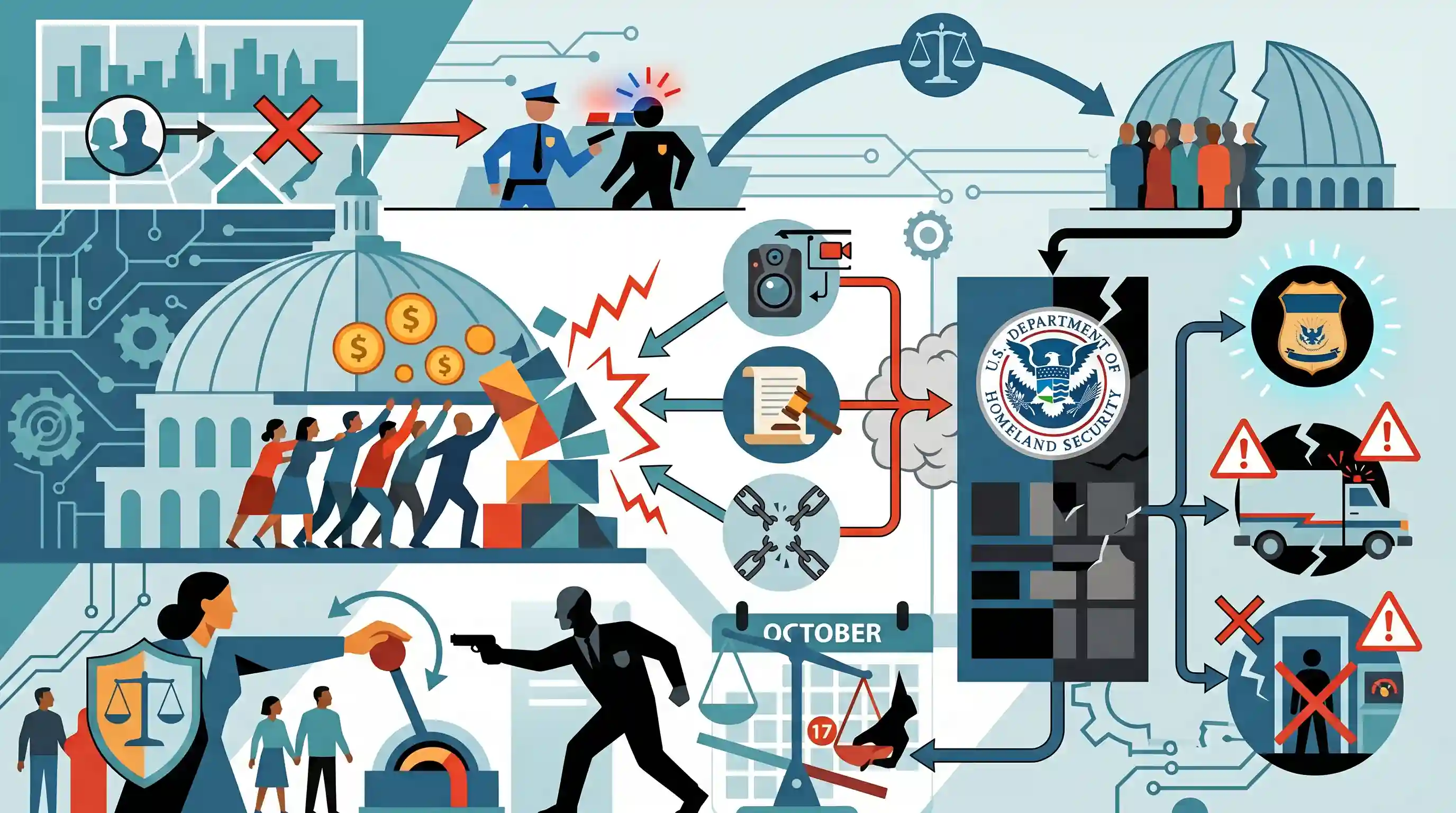
A budget impasse in the U.S. Congress has triggered a partial shutdown of the Department of Homeland Security (DHS), as Democrats block funding to demand reforms in Immigration and Customs Enforcement (ICE). The legislative deadlock follows the killings of two U.S. citizens by ICE agents in Minneapolis, prompting calls for strict operational curbs, body cameras, and judicial warrants. While ICE remains operational under previous funding, agencies like FEMA and TSA face potential disruptions. The incident underscores the tension between law enforcement excesses and civil liberties, while exemplifying how the U.S. legislature leverages its budgetary powers to hold the executive accountable.
Key Points
- A partial shutdown of the U.S. Department of Homeland Security (DHS) began due to a budget deadlock in Congress.
- Democrats are withholding funding to force operational reforms on Immigration and Customs Enforcement (ICE) after the killing of two U.S. citizens by ICE agents.
- Demands include banning face masks for agents, requiring judicial warrants for private property, and curbing certain patrols.
- The standoff illustrates the U.S. legislative branch utilizing the "power of the purse" to exact accountability from executive law enforcement agencies.
- While ICE operates on previous funding, the shutdown risks furloughing non-essential staff in agencies like FEMA and TSA.
Important Terms
U.S. Congress

The bicameral legislature of the U.S. federal government, possessing the "power of the purse" to authorize spending and oversee executive branch actions through budgetary control.
UPSC context
GS-2: Comparison of Constitutions (India vs USA), specifically regarding parliamentary control over executive spending and legislative oversight mechanisms.
Department of Homeland Security (DHS)
A Cabinet-level department established post-9/11 to coordinate U.S. internal security, including anti-terrorism, border protection, and disaster management; it oversees agencies like ICE, FEMA, and the TSA.
UPSC context
GS-2: Comparison of executive structures and internal security frameworks; tests understanding of departmental accountability within a presidential system.
Immigration and Customs Enforcement (ICE)
A DHS agency responsible for enforcing federal laws governing border control, customs, and immigration; currently facing legislative demands for reform following controversial operational excesses.
UPSC context
GS-2: Accountability and Human Rights; tests the role of the legislature in reining in law enforcement agencies to protect civil liberties.
Federal Emergency Management Agency (FEMA)
The U.S. agency under DHS tasked with disaster mitigation, preparedness, and response; its funding often becomes a point of leverage during legislative budget stalemates.
UPSC context
GS-3: Disaster Management; examines the impact of political and administrative gridlock on a nation's emergency response capabilities.
Transportation Security Administration (TSA)
The U.S. agency responsible for the security of public transportation systems, primarily aviation; budget impasses often lead to operational disruptions and staffing shortages at airports.
UPSC context
GS-2/GS-3: Government policies and infrastructure security; highlights how legislative-executive friction affects essential public services and national security.
Prelims Trap
"Failure to pass the Union budget in India results in a temporary government shutdown similar to the United States."
In India's parliamentary democracy, defeating the budget signals a loss of confidence, forcing the Council of Ministers to resign. There is no executive "shutdown" mechanism.
Static Concepts Connected
How does legislative budgetary control differ between the US and Indian constitutional systems?
- US System (Shutdown): A budget impasse freezes agency funding, causing a temporary shutdown. The President does not resign due to the strict separation of powers.
- Indian System (Resignation): The defeat of the budget or passage of a Cut Motion indicates a loss of Lok Sabha confidence, forcing the immediate resignation of the government.
What are the key Supreme Court mechanisms ensuring police accountability in India?
- Institutional Oversight: The Prakash Singh directives mandated Police Complaints Authorities (PCA) at state and district levels to inquire into serious misconduct by police personnel.
- Technological Transparency: The Paramvir Singh Saini judgment mandated CCTV installations in all police stations and investigative agency offices to prevent custodial violence and ensure transparency.
Cross-Topic Patterns
Budgetary powers as a human rights tool
The US Congress using appropriations to force ICE reforms mirrors how India's Parliament uses 'Token Cut Motions' to ventilate specific citizen grievances against executive actions.
Tech mandates for police accountability
Demands for ICE body cameras echo the Supreme Court of India's directives for mandatory CCTV cameras in investigative agencies (CBI, NIA, ED) to prevent custodial rights abuses.

Expect a GS-2 Mains question comparing the "Power of the Purse" and executive accountability in the US and Indian constitutional schemes.
Linked PYQs · 3
Linked PYQs · 3
- 2021MainsGS2
To what extent, in your view, the Parliament is able to ensure accountability of the executive in India?
- 2014MainsGS2
National Human Rights Commission (NHRC) in India can be most effective when its tasks are adequately supported by other mechanisms that ensure the accountability of a government. In light of the above observation assess the role of NHRC as an effective complement to the judiciary and other institutions in promoting and protecting human rights standards.
- 2021MainsGS2
Though the Human Rights Commissions have contributed immensely to the protection of human rights in India, yet they have failed to assert themselves against the mighty and powerful. Analyzing their structural and practical limitations, suggest remedial measures.
