Budget focuses on climate mitigation but lacks adaptation measures
Source:Indian Express ↗
Why It Matters
Understanding the dichotomy between climate mitigation and adaptation in government policy is crucial for GS3 (Environment and Disaster Management). It highlights gaps in fiscal planning for climate resilience, a frequent topic in UPSC Mains regarding sustainable development and vulnerability.
Summary
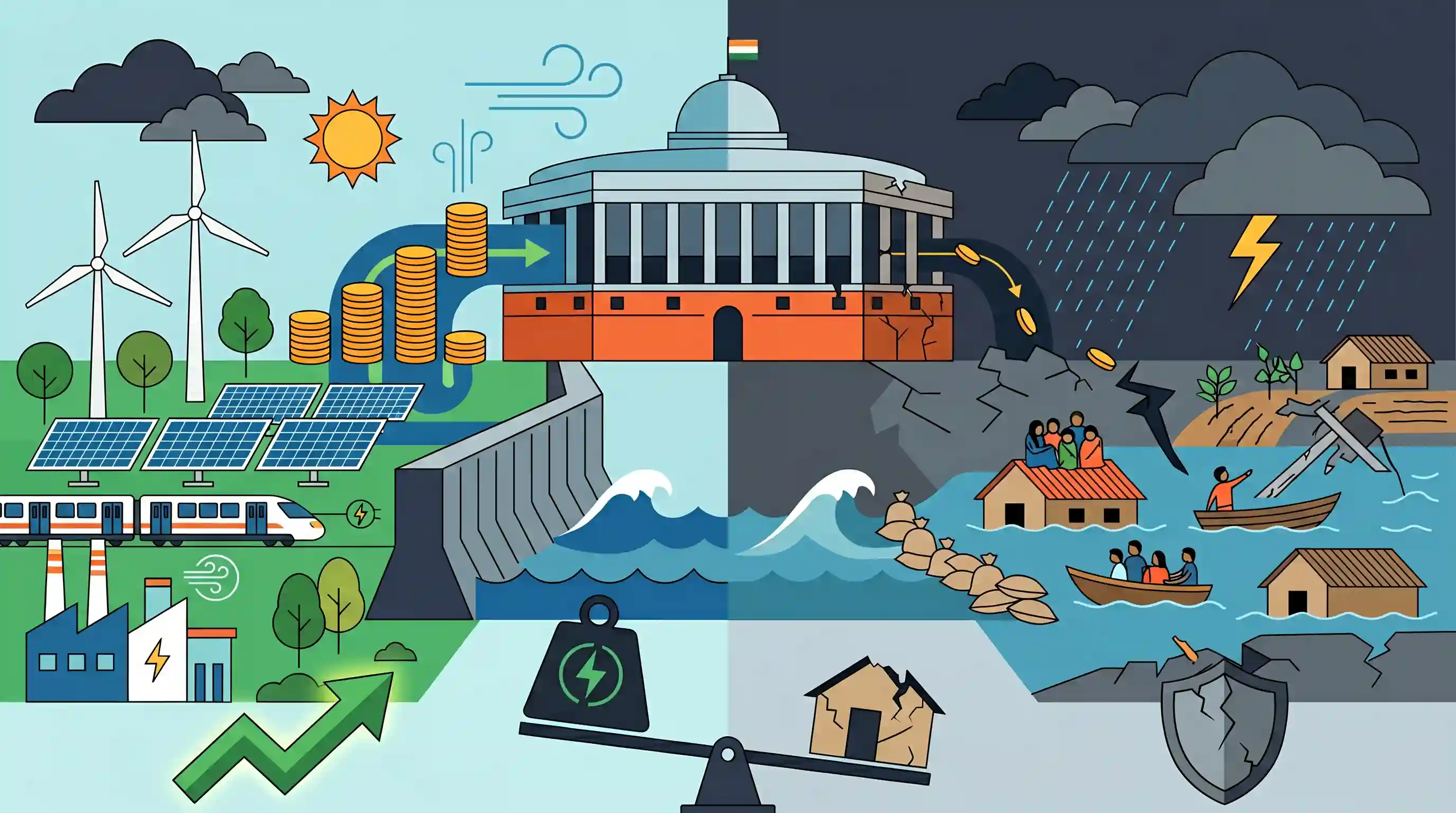
The article analyzes the Union Budget 2026-27's approach to climate change, commending its bold steps toward mitigation and emission reduction. However, it critiques the budget for neglecting climate adaptation and failing to build the necessary defenses for populations vulnerable to extreme weather and climate impacts. The author argues for a more balanced allocation of climate finance that addresses both long-term sustainability goals and the immediate need for disaster resilience and localized adaptation strategies.
Key Points
- The Union Budget 2026-27 prioritizes climate change mitigation through aggressive measures to reduce emissions and transition to renewable energy.
- Despite these bold steps, the budget lacks sufficient focus and funding for climate adaptation and building the resilience of vulnerable populations.
- There is an urgent need to address immediate climate impacts, such as extreme weather events, heatwaves, and changing agricultural patterns, by investing in local adaptation strategies.
- A balanced approach to climate finance is required, ensuring that resources are allocated not only to long-term mitigation projects but also to disaster management and community-level climate defenses.
Important Terms
Union Budget 2026-27

The annual financial statement of India for FY2026-27, emphasizing industrial decarbonization through CCUS and renewables while facing criticism for limited explicit climate adaptation and people-centric defense funding.
UPSC context
GS3 (Economy/Environment) — Tests understanding of fiscal priorities, green growth strategies, and sectoral allocations for sustainable development.
Climate Change Mitigation
Human interventions to reduce greenhouse gas sources or enhance 'sinks' (like forests) to limit global warming and prevent severe climate impacts.
UPSC context
GS3 (Environment) — Essential for topics on the Paris Agreement, renewable energy, and India's net-zero 2070 strategy.
Climate Change Adaptation
Adjusting to current or expected climate impacts (e.g., heatwaves, floods) to reduce vulnerability and protect communities, infrastructure, and livelihoods.
UPSC context
GS3 (Environment/Disaster Management) — Tests ability to evaluate strategies for protecting vulnerable populations against extreme weather events.
Climate Finance
Local, national, or international funding from public and private sources dedicated to supporting climate mitigation and adaptation actions.
UPSC context
GS3 (Economy/Environment) — Critical for understanding global COP negotiations, green bonds, and funding gaps in developing nations.
Disaster Resilience
The capacity of a community or system to resist, absorb, and recover from hazards quickly and efficiently, minimizing socio-economic losses.
UPSC context
GS3 (Disaster Management) — Core topic regarding the Sendai Framework, NDMA guidelines, and resilient infrastructure planning.
Carbon Capture, Utilisation and Storage (CCUS)
Technology that captures CO2 from industrial sources like power or steel plants to either reuse it or store it permanently underground.
UPSC context
GS3 (Science & Tech/Environment) — Tests awareness of emerging technologies for decarbonizing 'hard-to-abate' industrial sectors.
Prelims Trap
"NAFCC is a Centrally Sponsored Scheme implemented directly by the Ministry of Environment, Forest and Climate Change."
NAFCC is actually a Central Sector Scheme (100% central funding), and the National Bank for Agriculture and Rural Development (NABARD) is its National Implementing Entity.
Static Concepts Connected
What is the core difference between Climate Mitigation and Climate Adaptation?
- Mitigation: Interventions to reduce the sources or enhance the sinks of greenhouse gases, such as transitioning to renewable energy.
- Adaptation: Adjusting human or natural systems in response to actual or expected climate stimuli to minimize harm, like building seawalls.
What are the core priorities of the Sendai Framework (2015-2030)?
- Understanding Risk: Focusing heavily on assessing vulnerability, capacity, exposure, and hazard characteristics to understand disaster risks.
- Governance & Investment: Strengthening risk governance and investing in public and private resilience measures (both structural and non-structural).
- Build Back Better: Enhancing disaster preparedness for effective response, recovery, rehabilitation, and reconstruction post-disaster.
Cross-Topic Patterns
Climate Finance & Agriculture
The adaptation funding deficit directly impacts GS3 Agriculture. Expect questions linking climate anomalies to the urgent need for climate-resilient agriculture (CRA) and micro-irrigation schemes.
Urban Governance & Disaster Resilience
Urban flooding is a severe adaptation failure. UPSC frequently links local urban governance deficits (GS2) with disaster resilience (GS3) and climate anomalies (GS1).

Expect a 2026 GS3 Mains question evaluating India's budgetary bias toward climate mitigation over adaptation in disaster preparedness.
Linked PYQs · 5
Linked PYQs · 5
- 2024MainsGS3
What is disaster resilience? How is it determined? Describe various elements of a resilience framework. Also mention the global targets of Sendai Framework for Disaster Risk Reduction (2015–2030).
- 2019MainsGS3
Vulnerability is an essential element for defining disaster impacts and its threat to people. How and in what ways can vulnerability to disasters be characterized? Discuss different types of vulnerability with reference to disasters.
- 2017MainsGS3
One of the intended objectives of the Union Budget 2017-18 is to 'transform, energise and clean India'. Analyse the measures proposed in the Budget 2017-18 to achieve the objective.
- 2022MainsGS3
Discuss global warming and mention its effects on the global climate. Explain the control measures to bring down the level of greenhouse gases which cause global warming, in the light of the Kyoto Protocol, 1997.
- 2022PrelimsGS1
"Climate Action Tracker" which monitors the emission reduction pledges of different countries is a :
