Union Budget Allocation for Carbon Capture and Climate Goals
Source:Indian Express ↗
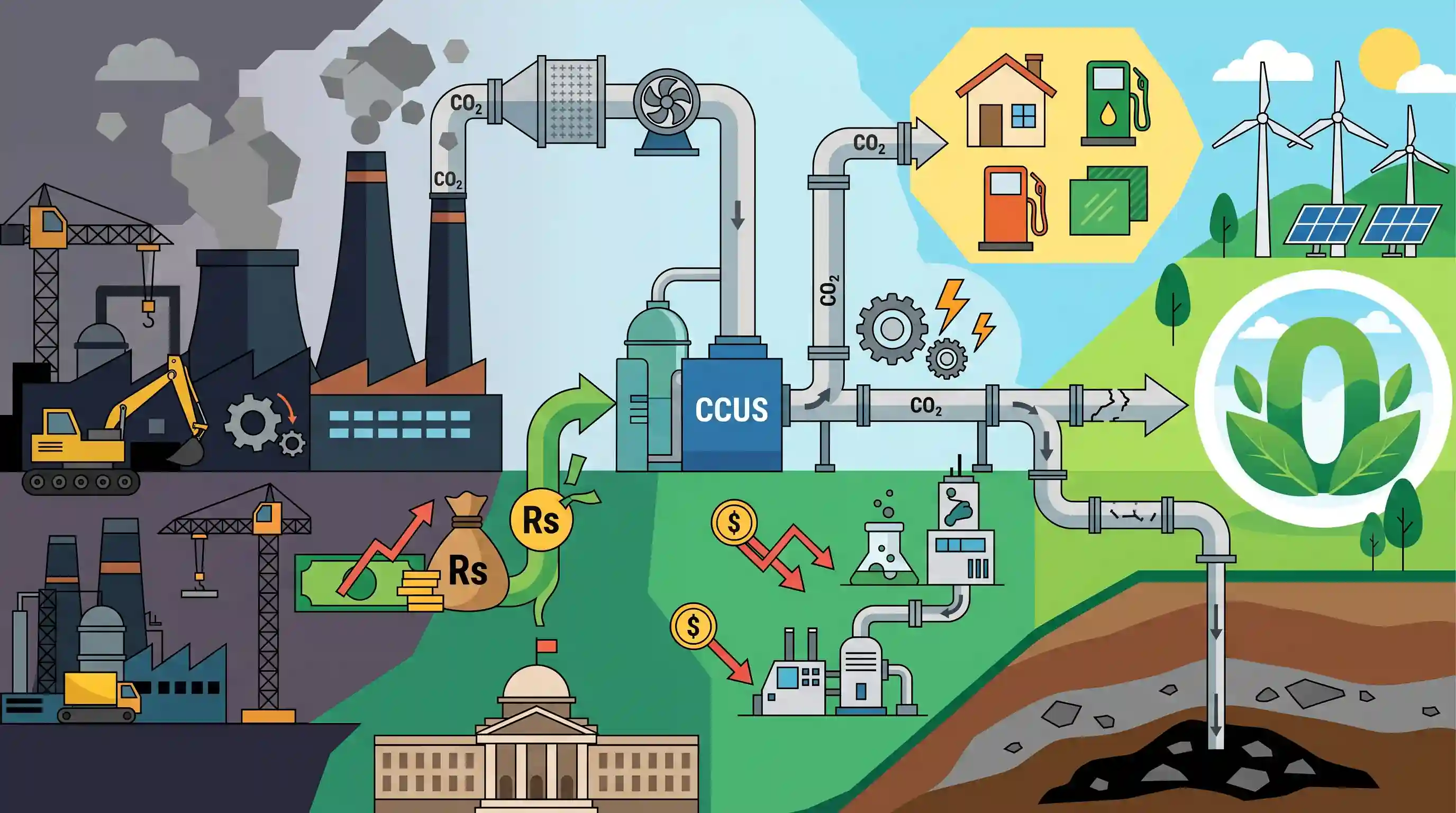
Why It Matters
CCUS is gaining immense policy traction as evident from the substantial budgetary allocation and recent UPSC questions (including a direct 2025 Mains question). Understanding the utility, technological facets, and economic challenges of CCUS is critical for GS3 Environment and Economy syllabi.
Summary
The article examines the strategic importance of the Rs 20,000 crore allocation in the Union Budget for Carbon Capture, Utilisation, and Storage (CCUS) technologies. It highlights the indispensable role of CCUS in mitigating emissions from hard-to-abate industrial sectors—such as cement and steel—which cannot transition easily to renewable electricity. The piece also outlines the formidable challenges ahead, including the technology's nascent stage, high deployment costs, energy requirements, and the necessity of establishing viable carbon transport and storage infrastructure, all of which must be addressed for India to reach its 2070 Net-Zero goal.
Key Points
- The Union Budget 2025-26 has allocated Rs 20,000 crore to support Carbon Capture, Utilisation, and Storage (CCUS) projects in India.
- CCUS technologies are considered essential for decarbonising hard-to-abate sectors like steel, cement, and fertilisers, where carbon emissions are inherent to the production process.
- Captured carbon can be stored safely underground in depleted oil and gas fields or deep saline aquifers, or repurposed for manufacturing chemicals, synthetic fuels, and building materials.
- Major challenges in scaling CCUS include exorbitant capital and operational costs, the significant energy penalty (energy required to capture carbon), and the lack of developed storage infrastructure.
- Integrating CCUS is pivotal for India to meet its commitment of achieving Net-Zero carbon emissions by the year 2070.
Important Terms
Carbon Capture, Utilisation, and Storage (CCUS)

A suite of technologies that capture CO2 from industrial plants or the air, then either recycle it for industrial use or store it permanently underground.
UPSC context
GS Paper 3 (Environment/Science); tests mitigation strategies for industrial emissions and technological solutions for climate change.
Hard-to-Abate Sectors
Industrial industries like steel, cement, and chemicals where emissions are structurally difficult to eliminate because they require high-heat processes or involve chemical reactions that release CO2.
UPSC context
GS Paper 3 (Economy/Environment); tests understanding of industrial transition challenges and the necessity of innovative decarbonization tools.
Net Zero 2070
India’s long-term climate target to balance all greenhouse gas emissions with equivalent removals by 2070, ensuring no net addition to atmospheric carbon levels.
UPSC context
GS Paper 3 (Environment); foundational climate target for India, central to Nationally Determined Contributions (NDCs).
Panchamrit
A five-point action plan presented by India at COP26, outlining targets for renewable energy capacity, carbon intensity reduction, and the ultimate 2070 net-zero goal.
UPSC context
GS Paper 3 (Environment); core framework of India's international climate diplomacy and domestic environmental policy.
Carbon Sequestration
The long-term storage of captured carbon dioxide in geological formations, such as saline aquifers or depleted oil fields, to prevent it from entering the atmosphere.
UPSC context
GS Paper 3 (Environment); technical mechanism for carbon removal, critical for both natural and artificial climate mitigation strategies.
Union Budget
The annual financial statement used by the government to allocate funds for climate goals, such as providing Viability Gap Funding for nascent green technologies.
UPSC context
GS Paper 3 (Economy/Environment); tests the role of public finance and fiscal policy in driving the green energy transition.
Prelims Trap
Emissions from hard-to-abate sectors like cement can be completely eliminated simply by transitioning the plant to 100% renewable electricity.
False. In industries like cement, CO2 is an inherent chemical byproduct of raw material processing (e.g., limestone calcination). Clean energy alone cannot stop these process emissions; physical capture is required.
Static Concepts Connected
What is the 'Energy Penalty' associated with Carbon Capture technologies?
- Definition: The additional energy a power plant or industrial facility must consume strictly to operate the carbon capture and compression equipment.
- Efficiency drop: Diverting generated power to run CCUS equipment reduces the overall energy output and efficiency of the plant, typically by 15-25%.
- Economic barrier: This high parasitic load significantly increases the operational expenditure (OPEX) of industrial plants, hindering spontaneous private sector adoption without subsidies.
What are the primary geological sinks used for storing captured carbon dioxide?
- Depleted reservoirs: Abandoned oil and gas fields where injected CO2 can safely be trapped, and is sometimes used for Enhanced Oil Recovery (EOR).
- Saline aquifers: Deep underground porous rock formations saturated with un-drinkable brine, offering the largest global long-term storage capacity for CO2.
- Unmineable coal seams: Deep coal seams that are uneconomic to mine; CO2 adsorbs onto the coal surface, sometimes displacing usable methane gas (ECBM).
Cross-Topic Patterns
CCUS & National Green Hydrogen Mission
Blue hydrogen production relies entirely on CCUS to capture emissions from steam methane reforming. Both technologies must scale together to decarbonize steel and heavy refineries.
Circular Economy: Carbon Utilization
Converting captured CO2 into green urea or synthetic aviation fuels ties climate mitigation directly to India's agricultural fertilizer self-sufficiency and circular economy goals.

Expect a multi-statement question on 'hard-to-abate' sectors testing why renewables fail them and why CCUS is mandatory for Net-Zero 2070.
Linked PYQs · 4
Linked PYQs · 4
- 2025MainsGS3
What is Carbon Capture, Utilization and Storage (CCUS)? What is the potential role of CCUS in tackling climate change?
- 2025PrelimsGS1
With reference to 'Direct Air Capture', an emerging technology, which of the following statements is/are correct? I. It can be used as a way of carbon sequestration. II. It can be a valuable approach for plastic production and in food processing. III. In aviation, it can be a source of carbon for combining with hydrogen to create synthetic low-carbon fuel. Select the correct answer using the code given below.
- 2023PrelimsGS1
Consider the following activities: 1. Spreading finely ground basalt rock on farmlands extensively 2. Increasing the alkalinity of oceans by adding lime 3. Capturing carbon dioxide released by various industries and pumping it into abandoned subterranean mines in the form of carbonated waters How many of the above activities are often considered and discussed for carbon capture and sequestration?
- 2017PrelimsGS1
In the context of mitigating the impending global warming due to anthropogenic emissions of carbon dioxide, which of the following can be the potential sites for carbon sequestration? 1. Abandoned and uneconomic coal seams 2. Depleted oil and gas reservoirs 3. Subterranean deep saline formations Select the correct answer using the code given below:
