Budget 2026 unveils strategic tech push for semiconductors and AI
Source:Indian Express ↗
Why It Matters
These budget announcements represent India's strategic shift from basic assembly to deep-tech manufacturing and ecosystem building. Understanding these initiatives (ISM 2.0, ECMS, rare earths, AI in agriculture) is crucial for GS3 questions on industrial policy, technology adoption, and economic self-reliance.
Summary
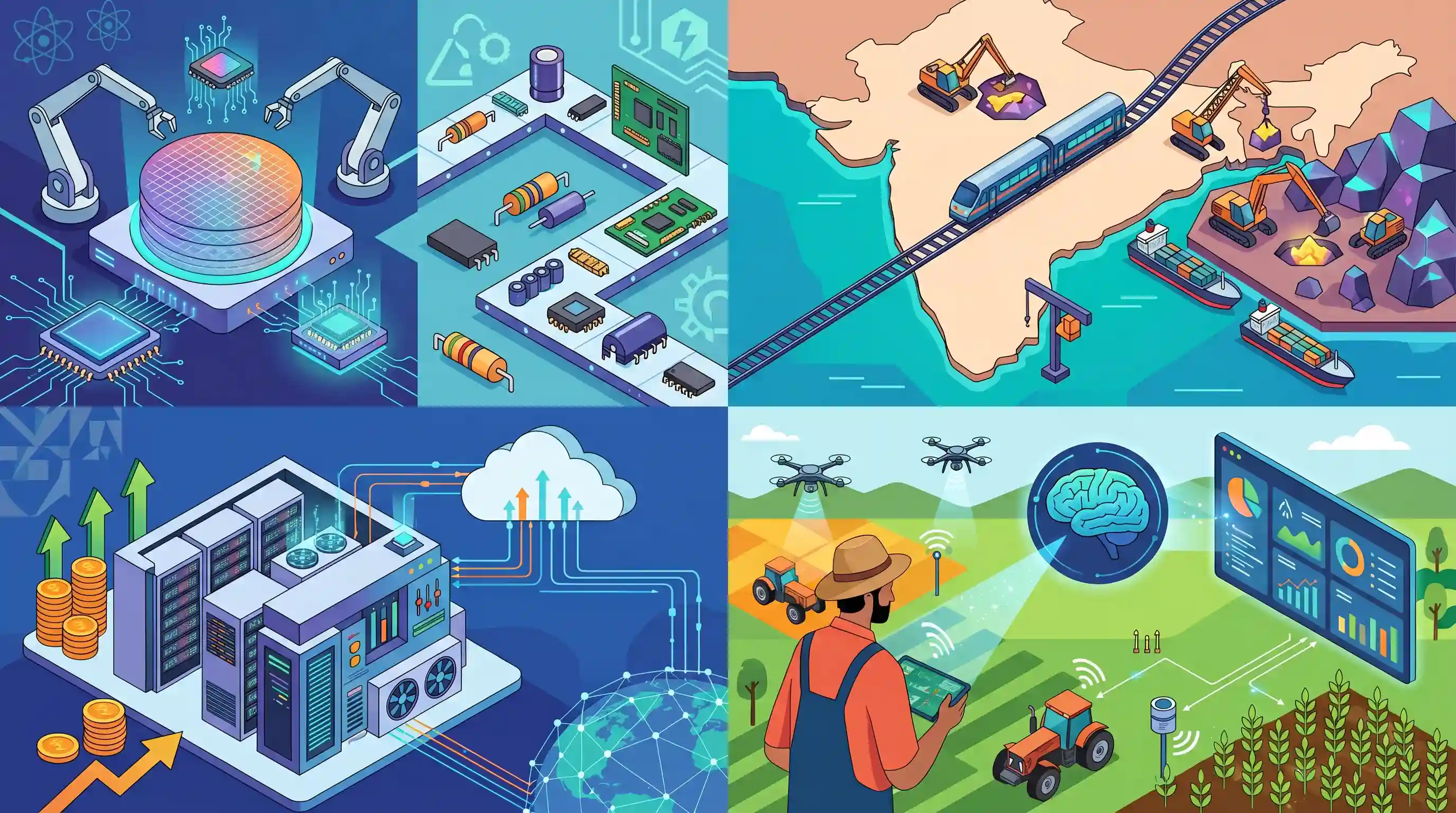
The Union Budget 2026-27 outlined significant technological and manufacturing initiatives aimed at achieving self-reliance in critical sectors. Key highlights include the launch of India Semiconductor Mission 2.0 (ISM 2.0) to build a comprehensive semiconductor ecosystem, and the Electronics Components Manufacturing Scheme (ECMS) to boost domestic production of vital electronic components. To secure strategic supply chains, Rare Earth Corridors will be established in coastal states for mining heavy rare earth elements. Additionally, the budget introduced tax incentives to promote Indian data centres for global cloud services and announced the integration of an AI tool, 'Bharat-VISTAAR', into the Agri-Stack platform to aid farmers.
Key Points
- Budget 2026-27 introduced India Semiconductor Mission 2.0 (ISM 2.0) with an Rs 8,000-crore outlay, pivoting from fabrication plants to building a broader ecosystem covering equipment, Indian IP, and compound semiconductors.
- The Rs 40,000-crore Electronics Components Manufacturing Scheme (ECMS) was launched to localize the production of critical sub-assemblies like display/camera modules and PCBAs, extending beyond final product assembly.
- 'Rare Earth Corridors' will be established in coastal states (Odisha, Kerala, Tamil Nadu, Andhra Pradesh) to mine and process heavy rare earth elements (HREEs), crucial for EVs, AI, and green tech.
- A tax holiday until 2047 was announced for foreign companies providing global cloud services through Indian data centres, aiming to boost local data infrastructure.
- The multilingual AI tool 'Bharat-VISTAAR' will be integrated into the Agri-Stack platform to provide smart, customized agricultural intelligence to farmers.
Important Terms
India Semiconductor Mission 2.0 (ISM 2.0)

An enhanced phase of India's semiconductor strategy focusing on domestic production of equipment, materials, and indigenous chip design to build a comprehensive, self-reliant ecosystem.
UPSC context
GS III: Science & Technology, Industrial Policy; tests understanding of strategic autonomy in electronics.
Electronics Components Manufacturing Scheme (ECMS)
A fiscal incentive scheme (turnover and capex-linked) aimed at boosting domestic production of electronic components like PCBs and display modules to reduce import dependency.
UPSC context
GS III: Economic Development, Manufacturing Sector; relevant for "Make in India" initiatives.
Bharat-VISTAAR
A multilingual AI-powered platform integrating Agri-Stack and ICAR data to provide farmers with personalized, 24/7 advisory on crops, pests, and market prices in local languages.
UPSC context
GS III: E-technology in the aid of farmers; tests knowledge of digital agriculture.
Agri-Stack
A Digital Public Infrastructure (DPI) consisting of foundational registries—Farmer, Crop Sown, and Geo-referenced Village Maps—to streamline service delivery and credit for cultivators.
UPSC context
GS III: Digital Public Infrastructure, Agriculture; crucial for governance and direct benefit transfers.
Rare Earth Corridors
Strategic coastal industrial zones in Odisha, Kerala, Andhra Pradesh, and Tamil Nadu established for mining and processing monazite-rich beach sands to secure critical mineral supplies.
UPSC context
GS III: Mineral Resources, Infrastructure; relevant for energy security and manufacturing.
Design-Linked Incentive (DLI)
A scheme providing financial and infrastructural support to startups and MSMEs for developing indigenous integrated circuits, chipsets, and semiconductor intellectual property (IP).
UPSC context
GS III: Science & Tech, Startups; focuses on moving up the global value chain.
Production Linked Incentive (PLI)
A flagship policy offering financial incentives to companies based on incremental production to boost domestic manufacturing capacity and exports across multiple sectors.
UPSC context
GS III: Indian Economy, Industrial Growth; fundamental concept for manufacturing-led growth.
Prelims Trap
India Semiconductor Mission 2.0 is primarily designed to fund large-scale silicon fabrication plants.
Budget 2026 shifted ISM 2.0 away from just fabrication plants, pivoting to a broader ecosystem covering equipment, Indian IP, and compound semiconductors.
Static Concepts Connected
What are Heavy Rare Earth Elements (HREEs) and their Indian sources?
- HREEs vs LREEs: HREEs (e.g., Dysprosium, Terbium) have higher atomic weights and are scarcer than Light Rare Earths, yet are critical for advanced high-tech applications.
- Monazite Sands: India's primary rare earth resources are found in coastal monazite beach sands (placer deposits) across Kerala, Tamil Nadu, Odisha, and Andhra Pradesh.
- Strategic Applications: They are indispensable for creating permanent magnets used in electric vehicles, wind turbines, and defense systems, reducing reliance on Chinese imports.
What is the architecture and purpose of the Agri-Stack?
- Federated Databases: It comprises federated core registries: Farmer Registry, Geo-referenced Village Maps, and Crop Sown Registry, maintained primarily by state governments.
- Digital Identity: It links farmer data with Aadhaar and land records to enable the precise targeting of credit, insurance, and direct benefit transfers.
- Open API Framework: Allows private agri-tech startups and government agencies to build localized services (like the Bharat-VISTAAR AI tool) securely on top of state data.
Cross-Topic Patterns
Coastal Placer Deposits + Green Tech
The 'Rare Earth Corridors' map GS1 Geography (monazite coastal sands) directly to GS3 Industrial Policy (securing supply chains for EVs, AI, and green tech).
PLI Evolution + Component Manufacturing
The ECMS marks a policy maturation from 'assemble-in-India' (early PLIs) to deep Global Value Chain (GVC) integration by focusing on critical sub-assemblies like PCBAs.
AI Models + Farm Extension Services
Bharat-VISTAAR highlights the integration of multilingual AI models with foundational digital public infrastructure (Agri-Stack) to revolutionize and hyper-localize agricultural extension services.

A 2026 multi-statement Prelims question will likely test the distinction between ISM 2.0's ecosystem focus versus ISM 1.0's fab focus.
Linked PYQs · 4
Linked PYQs · 4
- 2025MainsGS3
India aims to become a semiconductor manufacturing hub. What are the challenges faced by the semiconductor industry in India? Mention the salient features of the India Semiconductor Mission.
- 2025MainsGS3
Discuss the rationale of the Production Linked Incentive (PLI) scheme. What are its achievements? In what way can the functioning and outcomes of the scheme be improved?
- 2025PrelimsGS1
Consider the following statements : Statement I: Some rare earth elements are used in the manufacture of flat television screens and computer monitors. Statement II : Some rare earth elements have phosphorescent properties. Which one of the following is correct in respect of the above statements?
- 2023MainsGS3
How does e-Technology help farmers in production and marketing of agricultural produce? Explain it.
