Fiscal Consolidation and Tax Certainty in Union Budget Policy
Source:Indian Express ↗
Why It Matters
Understanding the trade-offs between populist welfare spending and capital expenditure is a core theme in UPSC GS3. The concept of 'tax certainty' directly links to resource mobilization, ease of doing business, and investment models.
Summary
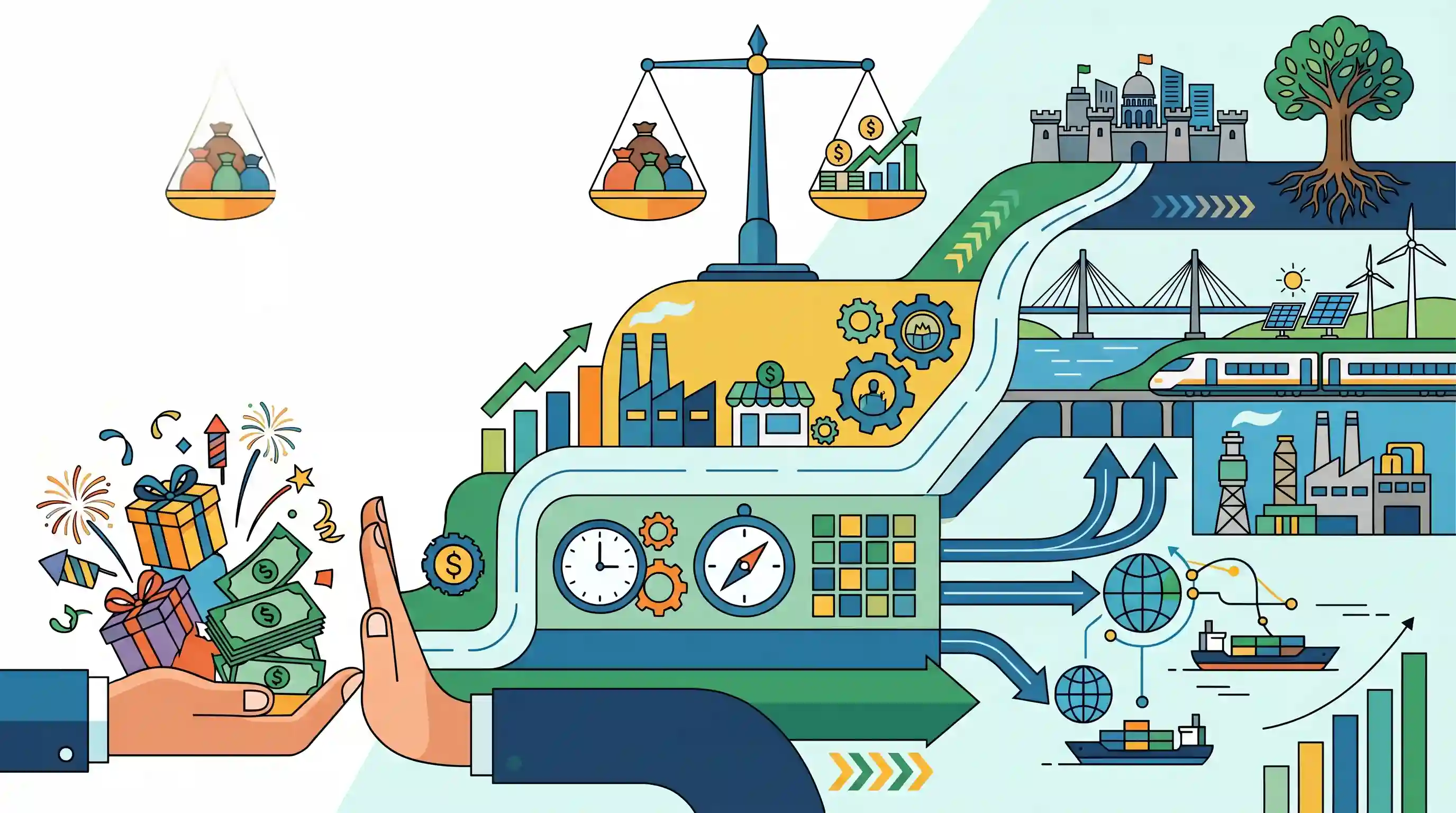
The article analyzes the approach of the Union Budget 2026, highlighting the government's strategic choice to avoid populist freebies in favor of long-term economic resilience. A central theme is the emphasis on 'tax certainty'—ensuring a predictable tax environment that encourages both domestic and foreign investments without frequent policy shocks. By resisting the urge for short-term consumption stimuli, the budget reinforces the ongoing commitment to fiscal consolidation, capital expenditure, and self-reliance, aligning with the broader goals of macroeconomic stability and responsible public expenditure management.
Key Points
- The government prioritized macroeconomic stability and fiscal prudence over short-term populist measures and subsidies in Budget 2026.
- A significant focus is placed on 'tax certainty'—maintaining a stable, predictable tax regime to boost investor confidence and ease of doing business.
- The budget strategy continues to lean on capital expenditure and self-reliance to drive sustainable long-term economic growth rather than consumption-led fiscal stimuli.
- Balancing growth objectives with fiscal consolidation remains crucial for managing public debt in alignment with FRBM principles.
Important Terms
Union Budget

Known constitutionally as the 'Annual Financial Statement' (Article 112), it is the government's estimate of receipts and expenditures for a specific financial year.
UPSC context
GS Paper 3: Government Budgeting. Vital for understanding fiscal policy, resource mobilization, and constitutional requirements.
Fiscal Consolidation
A process involving policies and strategies aimed at reducing government deficits and debt accumulation to ensure long-term macroeconomic stability.
UPSC context
GS Paper 3: Indian Economy. Tests knowledge of fiscal health indicators and debt-to-GDP sustainability.
Fiscal Responsibility and Budget Management (FRBM) Act
A 2003 law enacted to institutionalize fiscal discipline, reduce the fiscal deficit to sustainable levels, and ensure transparency in India's financial management.
UPSC context
GS Paper 3: Government Budgeting. Core legal framework for fiscal targets and 'escape clauses' during crises.
Capital Expenditure
Government spending on the creation of long-term assets like infrastructure, which improves the economy's productive capacity and generates future revenue.
UPSC context
GS Paper 3: Planning/Growth. Focuses on the quality of spending and its multiplier effect on GDP.
Tax Certainty
A predictable and stable tax environment where laws are clear, amendments are infrequent, and dispute resolution is swift, encouraging long-term investment.
UPSC context
GS Paper 3: Investment Models/Taxation. Critical for FDI, ease of doing business, and reducing tax litigation.
Prelims Trap
The FRBM Act strictly caps the fiscal deficit at 3% of GDP with no provisions for deviation.
The FRBM Act includes an 'escape clause' allowing deviation (up to 0.5%) during structural reforms, national security emergencies, or unforeseen economic shocks.
Static Concepts Connected
What is the macroeconomic difference between Capital Expenditure and Revenue Expenditure?
- Capital Expenditure: Spending that creates physical/financial assets or reduces government liabilities (e.g., infrastructure, loan repayment).
- Revenue Expenditure: Recurring spending that neither creates assets nor reduces liabilities (e.g., salaries, pensions, subsidies, interest payments).
- Multiplier Effect: Capex has a higher fiscal multiplier, driving long-term growth and 'crowding in' private investment, whereas revenue expenditure mainly boosts short-term consumption.
What are the core pillars of India's FRBM framework?
- Deficit Targets: Mandates the government to progressively reduce the fiscal deficit (traditionally aiming for 3% of GDP) and eliminate the revenue deficit.
- Debt-to-GDP Ratio: The NK Singh review committee recommended a ceiling of 60% (40% for the Centre and 20% for States).
- Escape Clause: Allows the government to breach the deficit target under exceptional circumstances like war, calamities, or structural reforms.
Cross-Topic Patterns
Tax certainty as an FDI driver
Retrospective taxation disputes (e.g., Vodafone, Cairn) historically hurt India's image. 'Tax certainty' directly connects to Ease of Doing Business rankings and the negotiation of Bilateral Investment Treaties (BITs).
Freebies vs. State Finance Commission targets
The debate on 'irrational freebies' (revenue expenditure) connects to Article 282 (discretionary grants) and the Finance Commission's mandate to incentivize fiscal discipline and debt management among States.

Expect a multi-statement prelims question contrasting the macroeconomic multipliers of capital vs. revenue expenditure alongside FRBM rules.
Linked PYQs · 4
Linked PYQs · 4
- 2019MainsGS3
The public expenditure management is a challenge to the Government of India in the context of budget making during the post-liberalization period. Clarify it.
- 2013MainsGS3
What were the reasons for the introduction of Fiscal Responsibility and Budget Management (FRBM) Act, 2003 ? Discuss critically its salient features and their effectiveness.
- 2018MainsGS3
Comment on the important changes introduced in respect of the Long-term Capital Gains Tax (LCGT) and Dividend Distribution Tax (DDT) in the Union Budget for 2018-2019.
- 2021PrelimsGS1
Which one of the following is likely to be the most inflationary in its effects?
