Livestock and Fisheries Sector Budgetary Allocation Strategy
Source:The Hindu ↗
Why It Matters
Livestock and fisheries represent crucial areas for rural income diversification and non-farm employment. Budgetary pushes toward value addition, entrepreneurship, and reduced post-harvest losses are central to the government's strategy for enhancing the Blue Economy and broader rural development.
Summary
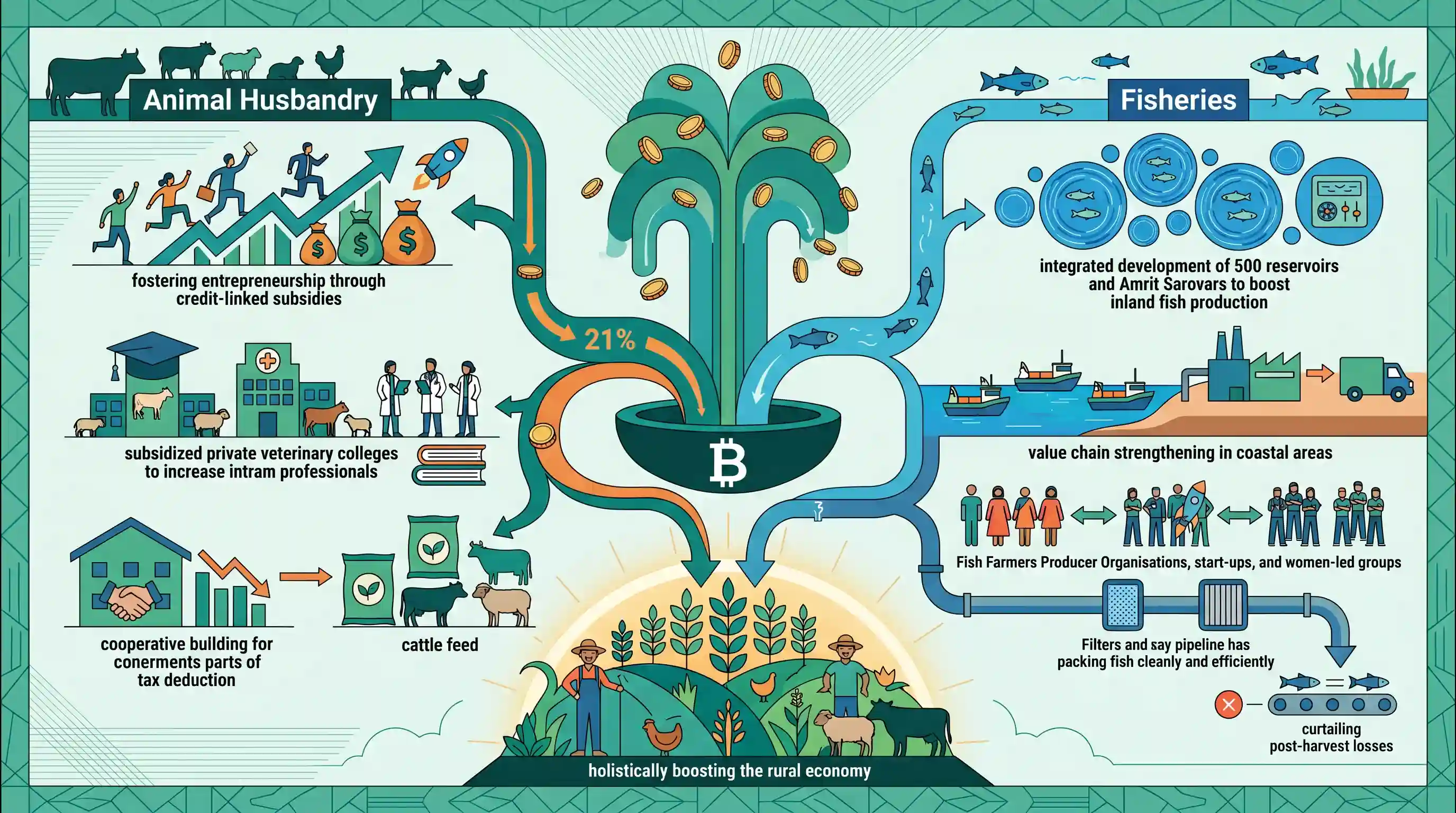
The Union Budget 2026 focuses heavily on the livestock and fisheries sectors, allocating ₹6,153.46 crore to Animal Husbandry (a 21% increase) and ₹2,761.80 crore to Fisheries. The strategy prioritizes value-chain strengthening, entrepreneurship via credit-linked capital subsidies for veterinary infrastructure, and rural employment generation. Key initiatives include the integration of Amrit Sarovars into inland fisheries, support for Fish Farmers Producer Organisations (FFPOs), and tax deductions for primary cooperative societies supplying cattle feed, aiming to boost the blue economy and mitigate post-harvest losses.
Key Points
- Animal Husbandry outlay rose 21% to ₹6,153.46 crore; Fisheries allocated ₹2,761.80 crore in Budget 2026.
- A credit-linked capital subsidy program aims to spur entrepreneurship in veterinary care, targeting private clinics, diagnostic labs, and breeding facilities.
- The government seeks to increase veterinary professionals by over 20,000 to manage expanding livestock needs.
- Fisheries initiatives focus on reducing post-harvest losses and promoting value chains in coastal regions, integrating with 1,222 out of 68,827 developed Amrit Sarovars.
- Primary cooperative societies receive new tax deductions for supplying cattle feed and cottonseed, alongside a ₹50,000 standard deduction on dividend income for individuals under the new tax regime.
Important Terms
Mission Amrit Sarovar

A national initiative to rejuvenate at least 75 water bodies in every district; Budget 2026 integrates these with fisheries to boost inland fish production and rural livelihoods.
UPSC context
GS3 (Agriculture/Water Conservation) and GS2 (Government Schemes); tests knowledge of rural infrastructure and water management.
Fish Farmers Producer Organisations (FFPOs)
Legal entities of fishers and fish workers promoted under PMMSY to provide economies of scale, enhance bargaining power, and provide end-to-end technical and marketing support.
UPSC context
GS3 (Agriculture/Allied Sectors); essential for doubling farmers' income and understanding producer-led collectives.
Blue Economy
Sustainable use of ocean and water resources for economic growth, improved livelihoods, and ecosystem health; Budget 2026 prioritizes this via record outlays and deep-sea fishing incentives.
UPSC context
GS3 (Economy/Environment); vital for maritime security, sustainable resource management, and India's long-term economic vision.
Primary Cooperative Societies
Village-level cooperative units; Budget 2026 expands their tax deductions to include profits from supplying cattle feed and cotton seeds produced by members.
UPSC context
GS2 (Statutory Bodies) and GS3 (Agriculture Credit); tests understanding of the cooperative movement and rural financial reforms.
Allied Sectors
Agricultural sub-sectors like livestock, dairying, and fisheries; recognized in Budget 2026 as the primary drivers of agricultural growth (outpacing traditional crops).
UPSC context
GS3 (Agriculture); important for diversification of farm income and rural entrepreneurship strategies.
Value-chain Strengthening
An end-to-end approach to improve stages from production to consumer; Budget 2026 focuses on this to reduce post-harvest losses and improve price realization for producers.
UPSC context
GS3 (Food Processing/Agriculture); key to enhancing market linkages and increasing rural income efficiency.
Prelims Trap
Mission Amrit Sarovar was launched primarily to boost inland fisheries and provide aquaculture infrastructure.
Amrit Sarovar was launched purely for water conservation (75 water bodies per district). Integrating fisheries into them is a secondary, subsequent livelihood integration, not the original primary aim.
Static Concepts Connected
What is the structural shift in India's agricultural GVA regarding allied sectors?
- Growth driver: Livestock and fisheries have consistently grown faster than the traditional crop sector over the last decade, driving overall agricultural growth.
- Income resilience: Allied activities provide stable, year-round income to marginal farmers, acting as critical insurance against climate-induced crop failures.
- GVA share: Livestock now accounts for roughly 30% of total agricultural GVA, highlighting a structural shift away from cereal-centric agriculture.
How do Fish Farmers Producer Organisations (FFPOs) solve post-harvest challenges?
- Economies of scale: Collective pooling of resources allows small fishers to afford expensive localized cold storage and refrigerated transport.
- Direct negotiation: By bypassing traditional middlemen, FFPOs can negotiate directly with processing plants and exporters, ensuring better price realization.
- Formal credit access: They operate as registered business entities, making them eligible for institutional credit and dedicated government capital subsidies.
Cross-Topic Patterns
Water Conservation + Blue Economy linkage
Integrating inland fisheries into Amrit Sarovars bridges the Ministry of Rural Development's water conservation assets with the Ministry of Fisheries' livelihood and Blue Economy goals.
Cooperatives + Corporate Tax Parity
Tax deductions for primary cooperatives supplying cattle feed reflect the broader ongoing policy push to bring financial and tax parity between cooperative societies and corporate entities.

Expect a 2026 Prelims statement linking Mission Amrit Sarovar's original water conservation mandate to its new inland fisheries utility.
Linked PYQs · 5
Linked PYQs · 5
- 2015MainsGS3
Livestock rearing has a big potential for providing non-farm employment and income in rural areas. Discuss suggesting suitable measures to promote this sector in India.
- 2017MainsGS3
How do subsidies affect the cropping pattern, crop diversity and economy of farmers? What is the significance of crop insurance, minimum support price and food processing for small and marginal farmers?
- 2025PrelimsGS1
Consider the following statements : Statement I: In India, income from allied agricultural activities like poultry farming and wool rearing in rural areas is exempted from any tax. Statement II: In India, rural agricultural land is not considered a capital asset under the provisions of the Income-tax Act, 1961. Which one of the following is correct in respect of the above statements?
- 2020PrelimsGS1
In India, which of the following can be considered as public investment in agriculture? 1. Fixing Minimum Support Price for agricultural produce of all crops 2. Computerization of Primary Agricultural Credit Societies 3. Social Capital development 4. Free electricity supply to farmers 5. Waiver of agricultural loans by the banking system 6. Setting up of cold storage facilities by the governments Select the correct answer using the code given below:
- 2020PrelimsGS1
Under the Kisan Credit Card scheme, short-term credit support is given to farmers for which of the following purposes ? 1. Working capital for maintenance of farm assets 2. Purchase of combine harvesters, tractors and mini trucks 3. Consumption requirements of farm households 4. Post-harvest expenses 5. Construction of family house and setting up of village cold storage facility Select the correct answer using the code given below:
