Budget increases financial outlay for livestock and fisheries
Source:The Hindu ↗
Why It Matters
Allied sectors like livestock and fisheries are crucial for rural income diversification and employment generation. This article outlines key Budget 2026 interventions targeting value chain efficiencies, infrastructure, and entrepreneurship, which are critical for answering questions on agricultural economics and rural development in GS Paper 3.
Summary
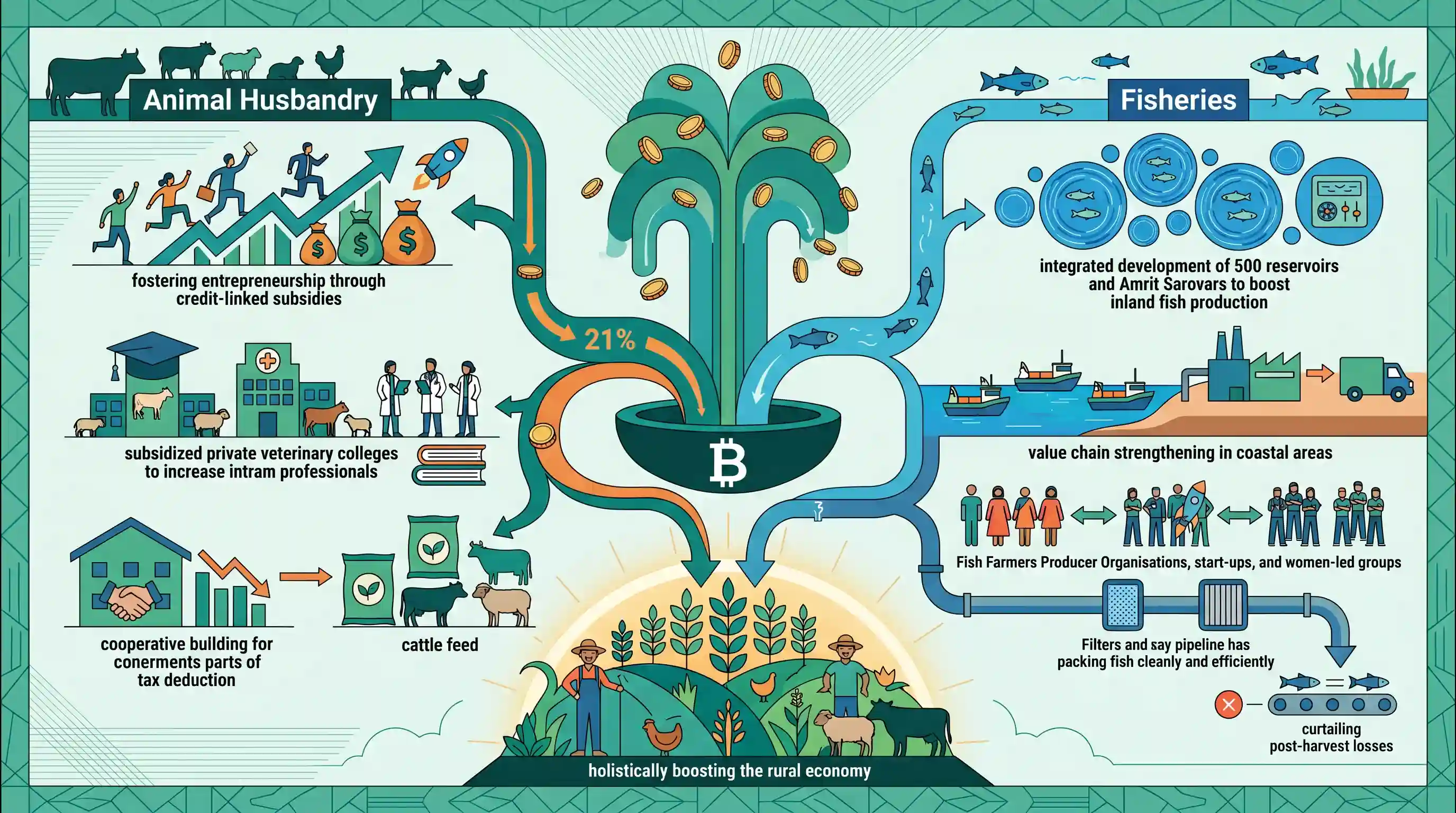
The Union Budget 2026 introduces a substantial push for allied agricultural sectors by increasing allocations for both livestock and fisheries. It allocates ₹2,761.80 crore to fisheries, proposing the integrated development of 500 reservoirs and Amrit Sarovars to boost inland fish production. Emphasizing value chain strengthening in coastal areas, it supports Fish Farmers Producer Organisations, start-ups, and women-led groups to curtail post-harvest losses. Simultaneously, the Animal Husbandry Ministry's budget was raised by 21% to ₹6,153.46 crore to foster entrepreneurship through credit-linked subsidies. Additional measures include subsidizing private veterinary colleges to increase the number of veterinary professionals and offering tax deductions to primary cooperative societies for supplying cattle feed, thereby holistically boosting the rural economy.
Key Points
- Union Budget 2026 has allocated ₹2,761.80 crore for fisheries, focusing on the integrated development of 500 reservoirs and Amrit Sarovars for inland fisheries.
- The fisheries value chain in coastal areas will be strengthened by supporting start-ups, women-led groups, and Fish Farmers Producer Organisations to reduce post-harvest losses and improve price realization.
- The Union Animal Husbandry Ministry received an allocation of ₹6,153.46 crore, marking a 21% increase, primarily to encourage entrepreneurship via credit-linked subsidies.
- The government aims to increase the number of veterinary professionals to over 20,000 by providing credit-linked capital subsidies for private veterinary colleges and animal hospitals.
- Primary cooperative societies supplying cattle feed and cottonseed will now be eligible for tax deductions to support the livestock sector.
Important Terms
Mission Amrit Sarovar

A mission to develop/rejuvenate 75 water bodies in each district. Budget 2026-27 integrates 500 reservoirs and Amrit Sarovars to boost inland fish production and livelihood diversification.
UPSC context
GS Paper III (Agriculture/Water Resources); tests knowledge of integrated rural development and water conservation strategies.
Fish Farmers Producer Organisations (FFPOs)
Legal entities of primary producers providing fishers with collective bargaining power, technology access, and market linkages. Budget 2026-27 prioritizes them to reduce post-harvest losses.
UPSC context
GS Paper III (Agriculture/Food Processing); tests institutional reforms for small-scale producer empowerment.
Primary Cooperative Societies
Grassroots-level cooperative units. Budget 2026-27 proposes tax deductions for these societies when supplying cattle feed and cottonseed to members, aimed at reducing rural operational costs.
UPSC context
GS Paper III (Economic Development/Cooperatives); tests understanding of tax incentives for the cooperative sector.
Pradhan Mantri Matsya Sampada Yojana (PMMSY)
A flagship scheme for sustainable fisheries development. Budget 2026-27 allocates ₹2,500 crore under this umbrella to modernize infrastructure, boost exports, and enhance fisher welfare.
UPSC context
GS Paper II (Govt Schemes) and Paper III; key for questions on the Blue Economy.
Credit-linked Subsidy Scheme
A financial mechanism where the government provides capital subsidies on bank loans to encourage private investment in livestock, dairy, and veterinary infrastructure.
UPSC context
GS Paper III (Agriculture/Economy); tests mechanisms for de-risking private investment in rural sectors.
Fisheries Value Chain
The complete sequence of activities from fish/livestock production to marketing. Budget 2026-27 focuses on 'integrated value chains' to improve price realization and reduce waste.
UPSC context
GS Paper III (Agriculture/Food Processing); relevant for supply chain management and rural industrialization topics.
Prelims Trap
"Mission Amrit Sarovar is strictly dedicated to rural groundwater recharge and drinking water."
Budget 2026 explicitly integrates Amrit Sarovars into inland fish production. Assuming it is strictly for water conservation ignores its evolving multi-sectoral economic utility.
Static Concepts Connected
What is the economic significance of the livestock sector in India?
- GVA Contribution: It accounts for over 30% of agricultural GVA and provides regular income, unlike the seasonal nature of crops.
- Inclusive Growth: It is highly egalitarian; small and marginal farmers own over 80% of livestock, ensuring broad-based rural wealth distribution.
- Risk Mitigation: Livestock acts as a financial cushion and liquid asset during crop failures or extreme weather events.
What is the mandate of Fish Farmer Producer Organisations (FFPOs)?
- Aggregation: Collectivizing small-scale fishers and aquaculture farmers to improve their bargaining power and economies of scale.
- Value Chain linkages: Reducing post-harvest losses by enabling joint investments in cold chains, processing, and direct market access.
Cross-Topic Patterns
Allied Sectors & Climate Resilience
Allied sectors are increasingly funded not just for nutrition, but as primary rural safety nets against climate-induced crop failures.
Cooperatives & Fiscal Policy
Tax deductions for cattle feed cooperatives highlight the growing intersection of the new Ministry of Cooperation's mandate with mainstream fiscal policy.

Prelims 2026 will likely test the expanded utility of Mission Amrit Sarovar in inland fisheries alongside its water conservation mandate.
Linked PYQs · 3
Linked PYQs · 3
- 2015MainsGS3
Livestock rearing has a big potential for providing non-farm employment and income in rural areas. Discuss suggesting suitable measures to promote this sector in India.
- 2025MainsGS3
Elaborate the scope and significance of supply chain management of agricultural commodities in India.
- 2020MainsGS3
Suggest measures to improve water storage and irrigation system to make its judicious use under depleting scenario.
