Finance Minister presents Union Budget 2026 focusing on Viksit Bharat
Source:Indian Express ↗
Why It Matters
The Union Budget is the foundational financial and policy directional document for India. For UPSC aspirants, the transition to the new Income Tax Act, MAT adjustments, TReDS expansion, and the heavy focus on frontier technologies (Semiconductors, CCUS, Critical Minerals) are crucial, recurrent themes across GS3 Economy, Environment, and S&T sections.
Summary
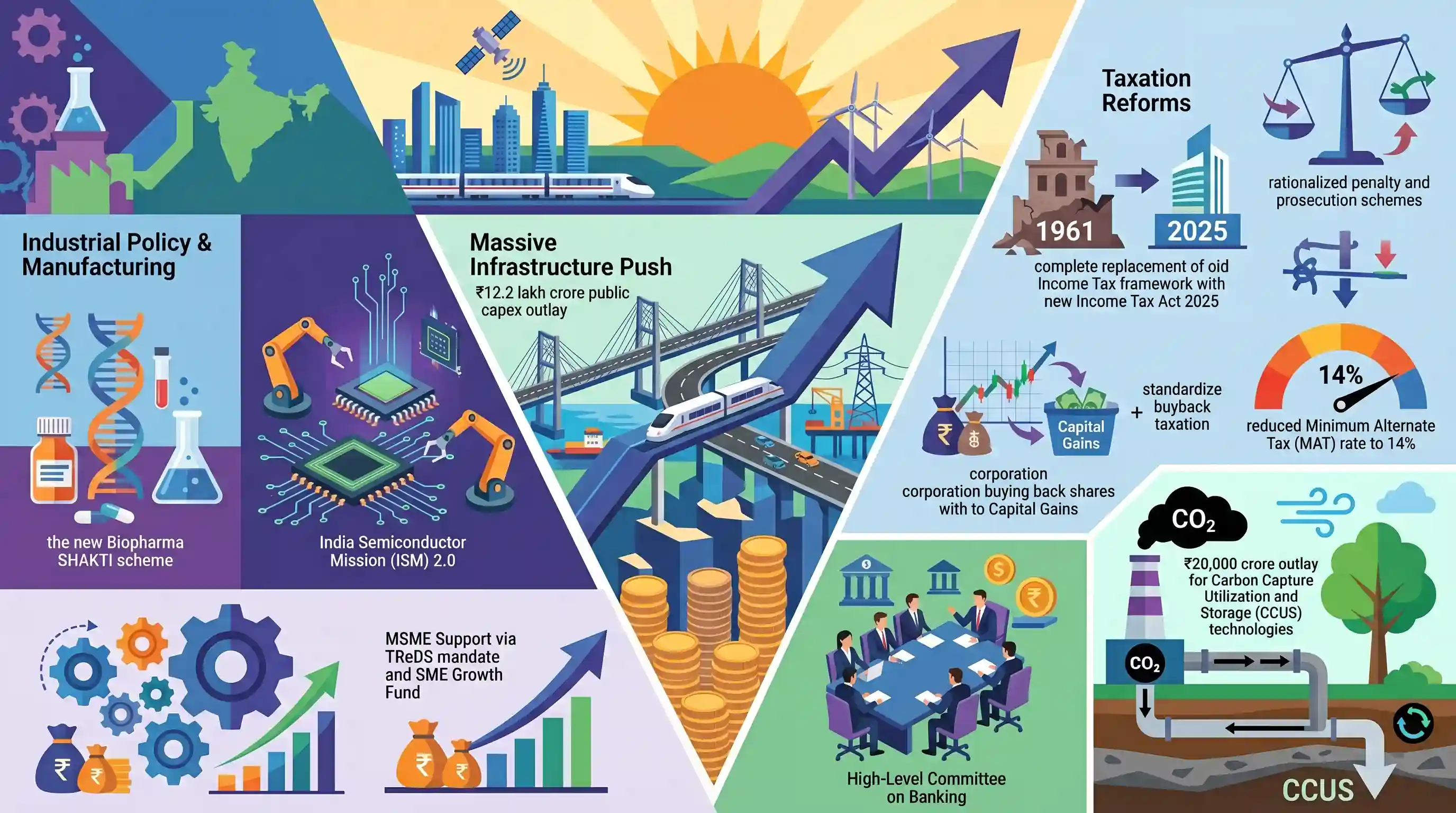
Finance Minister Nirmala Sitharaman presented the Union Budget 2026-27, emphasizing India's transition towards 'Viksit Bharat' through a blend of structural reforms, manufacturing scale-up, and massive infrastructure pushes. Key economic pillars include the new Biopharma SHAKTI scheme, India Semiconductor Mission (ISM) 2.0, a ₹12.2 lakh crore public capex outlay, and a new High-Level Committee on Banking. On the taxation front, the Budget completely replaces the 1961 framework with the new Income Tax Act 2025, rationalizes penalty and prosecution schemes, standardizes buyback taxation as Capital Gains, and reduces the Minimum Alternate Tax (MAT) rate to 14%. Focus is also strongly placed on supporting MSMEs via the TReDS mandate and SME Growth Fund, and spearheading environmental sustainability with a ₹20,000 crore outlay for Carbon Capture Utilization and Storage (CCUS) technologies.
Key Points
- Public capital expenditure has been raised to ₹12.2 lakh crore for FY2026-27 to continue strong infrastructure development.
- The new Income Tax Act 2025 takes effect on April 1, 2026, bringing simplified tax filing, an overseas asset disclosure scheme, and rationalized penalty frameworks.
- Changes in direct taxation include standardizing buyback taxation as Capital Gains and making Minimum Alternate Tax (MAT) a final tax reduced to 14%.
- A major manufacturing push targets 7 frontier sectors, backed by the launch of Biopharma SHAKTI, India Semiconductor Mission (ISM) 2.0, and Rare Earth Corridors.
- To support the green transition, an outlay of ₹20,000 crore is provided for Carbon Capture Utilization and Storage (CCUS) technologies alongside customs duty exemptions for lithium-ion battery materials and critical minerals.
- MSMEs receive significant liquidity and equity backing through a ₹10,000 crore SME Growth Fund and mandatory usage of the TReDS platform for CPSE purchases.
Important Terms
Income Tax Act 2025

A major direct tax reform replacing the 1961 Act. It simplifies legal language, reduces section counts, and introduces a unified 'Tax Year' to streamline compliance and reduce litigation.
UPSC context
GS Paper III (Economy); tests knowledge of structural tax reforms, fiscal policy, and legislative efforts to improve Ease of Doing Business.
Biopharma SHAKTI
A ₹10,000 crore initiative to transform India into a hub for biologics and biosimilars. It prioritizes non-animal research methodologies and affordable treatments for non-communicable diseases.
UPSC context
GS Paper III (Science & Tech/Economy); tests knowledge of biotechnology policy, pharmaceutical innovation, and strategies to address the national disease burden.
India Semiconductor Mission (ISM) 2.0
The mission's second phase focusing on indigenous semiconductor equipment, materials, and intellectual property. It shifts focus from basic ecosystem creation to consolidation and global value chain integration.
UPSC context
GS Paper III (Economy/Industrial Policy); tests understanding of electronics manufacturing, supply chain resilience, and technological sovereignty.
SME Growth Fund
A ₹10,000 crore fund providing equity and quasi-equity support to high-potential MSMEs. It facilitates scaling small businesses into 'Champion SMEs' through structured, investment-driven growth.
UPSC context
GS Paper III (Economy/MSMEs); tests knowledge of credit ecosystems, equity financing, and employment-linked industrial growth.
Mahatma Gandhi Gram Swaraj
A rural development initiative proposed to strengthen India's traditional khadi, handloom, and handicraft sectors. It aims to empower village artisans and revitalize decentralised, heritage-based economic models.
UPSC context
GS Papers II & III (Governance/Rural Development); tests knowledge of rural empowerment schemes and support for traditional village industries.
Prelims Trap
"The Minimum Alternate Tax (MAT) has been completely abolished for companies under the new regime."
MAT has not been abolished; it has been reduced to 14% and made a "final tax". Aspirants often mistake tax rate rationalization for complete abolition in Budget readings.
Static Concepts Connected
What distinguishes Capital from Revenue Expenditure?
- Asset Creation: Capital expenditure creates permanent assets (roads, hospitals, infrastructure) or reduces financial liabilities for the government.
- Recurring Nature: Revenue expenditure is recurring in nature (salaries, pensions, subsidies, interest payments) and neither creates assets nor reduces liabilities.
- Multiplier Effect: Capex generates a much higher macroeconomic multiplier effect compared to revenue spending, driving long-term economic growth.
What is the TReDS platform for MSMEs?
- Purpose: An institutional mechanism to facilitate the discounting of trade receivables of MSMEs from corporate or government buyers.
- Regulatory Framework: It is regulated by the Reserve Bank of India (RBI) under the Payment and Settlement Systems Act, 2007.
- Key Participants: MSME sellers, corporate/government buyers, and financiers (banks and NBFCs) operate collectively on this digital platform.
Cross-Topic Patterns
CCUS scaling & Net Zero 2070
The ₹20,000 crore CCUS outlay shifts India's climate strategy from purely renewable capacity building to active carbon management, directly aligning with India's Net Zero 2070 commitments.
Mineral duty cuts & supply chain resilience
Customs exemptions for lithium and critical minerals pair directly with the India Semiconductor Mission (ISM 2.0) and strategic geopolitical efforts to bypass Chinese supply chain dominance.

The shift from IT Act 1961 to 2025, alongside MAT rationalization and TReDS mechanics, is highly likely to be a 2026 prelims question.
Linked PYQs · 5
Linked PYQs · 5
- 2022MainsGS3
Why is Public Private Partnership (PPP) required in infrastructural projects ? Examine the role of PPP model in the redevelopment of Railway Stations in India.
- 2025MainsGS3
What is Carbon Capture, Utilization and Storage (CCUS)? What is the potential role of CCUS in tackling climate change?
- 2025MainsGS3
Mineral resources are fundamental to the country's economy and these are exploited by mining. Why is mining considered an environmental hazard? Explain the remedial measures required to reduce the environmental hazard due to mining.
- 2023PrelimsGS1
Consider the following statements with reference to India: 1. According to the 'Micro, Small and Medium Enterprises Development (MSMED) Act, 2006', the 'medium enterprises' are those with investments in plant and machinery between ₹ 15 crore and ₹ 25 crore. 2. All bank loans to the Micro, Small and Medium Enterprises qualify under the priority sector. Which of the statements given above is/are correct?
- 2021PrelimsGS1
With reference to India, consider the following statements : 1. Retail investors through demat account can invest in 'Treasury Bills' and 'Government of India Debt Bonds' in primary market. 2. The 'Negotiated Dealing System- Order Matching' is a government securities trading platform of the Reserve Bank of India. 3. The 'Central Depository Services Ltd.' is jointly promoted by the Reserve Bank of India and the Bombay Stock Exchange. Which of the statements given above is/are correct?
