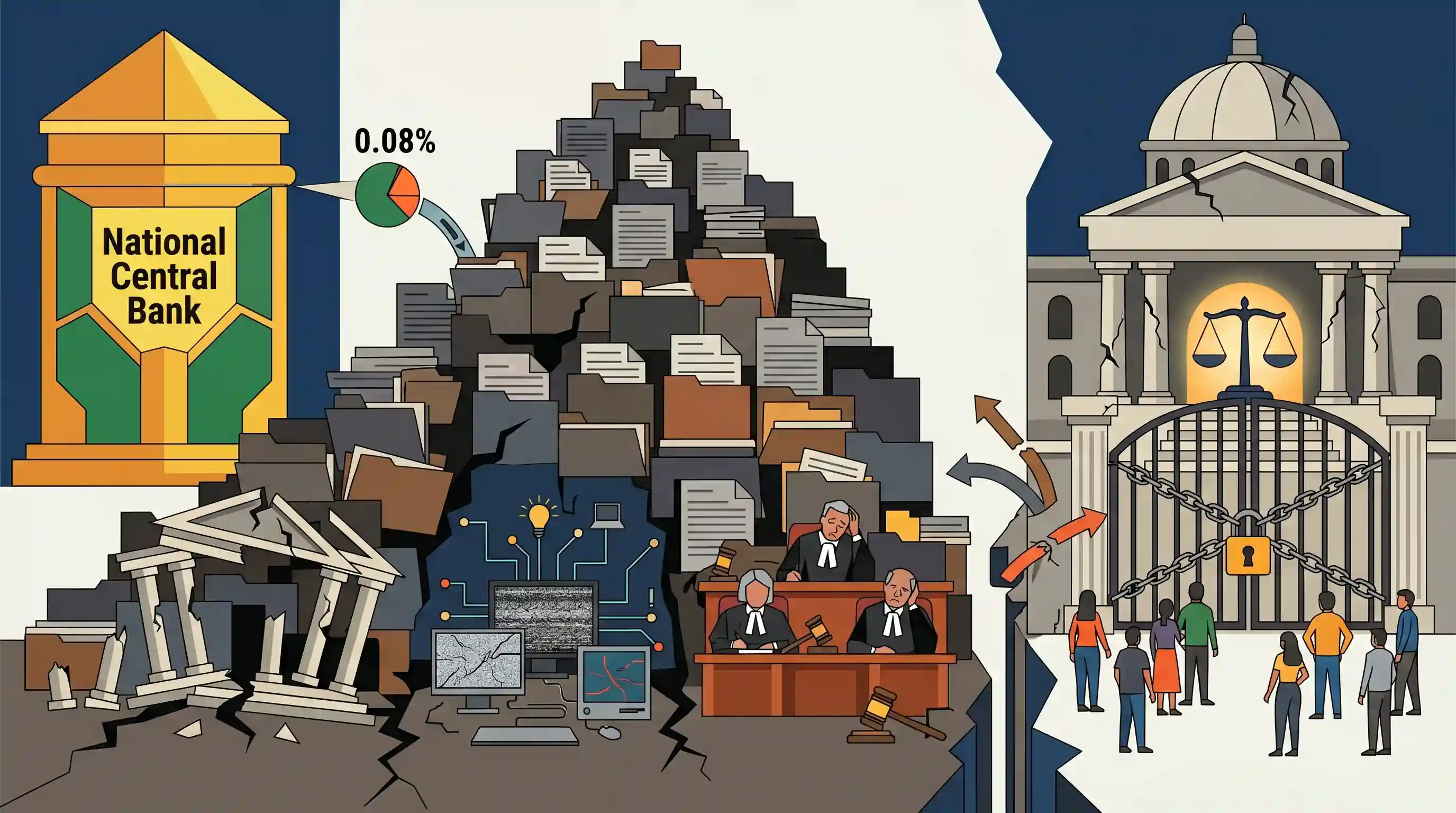
Judicial Pendency High While Budget Allocation Remains Low
Source:Indian Express ↗
Why It Matters
The chronic underfunding of the judicial system directly impacts its capacity to deliver timely justice, exacerbating the backlog of cases and challenging the constitutional promise of effective dispute resolution and the rule of law.
Summary
Advocate Asim Sarode has raised concerns over the gross underfunding of the Indian judiciary in the Union Budget 2026-27, noting that it received merely 0.08% of the total allocation. With approximately 5 crore cases currently pending across the country, this meager funding acts as a major roadblock to improving court infrastructure, undertaking digitization, and expanding judicial capacity. The severe mismatch between the volume of pending litigation and budgetary support highlights a critical governance challenge in ensuring timely access to justice for citizens.
Key Points
- The Indian judicial system is currently grappling with a massive backlog of approximately 5 crore pending cases across various courts.
- Despite this severe pendency, the judiciary has been allocated a meager 0.08% of the total outlay in the Union Budget 2026-27.
- Advocate Asim Sarode emphasized that such inadequate funding severely hampers efforts to improve court infrastructure, modernize technology, and fill judicial vacancies.
- Significantly increasing the budgetary allocation for the judiciary is deemed essential to resolve structural bottlenecks, accelerate justice delivery, and uphold the rule of law.
Important Terms
Judicial Pendency

The cumulative backlog of unresolved cases across all court tiers. In 2026, India's pendency reached 5 crore, signaling a crisis in the justice delivery system's capacity and speed.
UPSC context
GS Paper II (Judiciary); tests understanding of systemic delays, their causes, and the impact on the Rule of Law.
Union Budget 2026-27
India's Annual Financial Statement under Article 112. The 2026-27 budget allocated 0.08% (₹4,509 crore) to the judiciary, underscoring debates on fiscal prioritization and judicial autonomy.
UPSC context
GS Paper III (Economy) and GS Paper II (Governance); tests knowledge of budget components and sectoral allocations.
e-Courts Mission Mode Project
A pan-India project to digitize the judiciary. Phase III (2023-2027) aims for paperless courts, virtual hearings, and AI integration to modernize case management and enhance accessibility.
UPSC context
GS Paper II (e-Governance/Judiciary); tests ability to analyze technology-driven reforms in public service delivery.
National Judicial Data Grid (NJDG)
A real-time online database tracking case status, pendency, and disposal rates nationwide. It serves as a transparent monitoring tool for judicial performance and legislative planning.
UPSC context
GS Paper II (Judiciary); focuses on data-driven governance and transparency in the justice system.
Access to Justice
The constitutional guarantee (Articles 21, 39A) ensuring citizens can obtain legal remedies. It is currently challenged by high litigation costs and inadequate court infrastructure.
UPSC context
GS Paper II (Fundamental Rights/Polity); evaluates knowledge of social justice and constitutional obligations.
National Judicial Infrastructure Authority of India (NJIAI)
A proposed central agency to manage judicial infrastructure funds. It seeks to resolve chronic underinvestment in district and subordinate courts through unified planning and execution.
UPSC context
GS Paper II (Judiciary); tests understanding of proposed institutional reforms to tackle infrastructure bottlenecks.
Prelims Trap
The entire budgetary allocation for the Indian judiciary is 'charged' upon the Consolidated Fund of India and cannot be voted upon.
Only salaries, pensions, and administrative expenses of the SC/HCs are 'charged' (non-votable). The broader budget for infrastructure, e-courts, and judicial modernization schemes must be voted upon by Parliament/State legislatures.
Static Concepts Connected
How is the Indian judiciary funded across different tiers?
- Supreme Court: Salaries and administrative expenses are charged on the Consolidated Fund of India (CFI).
- High Courts: Salaries are charged on the State Consolidated Fund, but their pensions are charged on the CFI.
- Subordinate Judiciary: Funded primarily by State Governments. The Centre provides grants via Centrally Sponsored Schemes (CSS) specifically for upgrading judicial infrastructure.
How does judicial delay intersect with Fundamental Rights?
- Article 21: The Supreme Court (Hussainara Khatoon case) interpreted the right to a speedy trial as an implicit, inalienable fundamental right under Article 21.
- Undertrial Crisis: Over 75% of India's prison inmates are undertrials. Systemic underfunding and delays lead to prolonged detentions, constituting a direct violation of their fundamental rights.
Cross-Topic Patterns
e-Courts Phase III and digital infrastructure
The e-Courts Mission Mode Project under the National e-Governance Plan requires sustained capital for AI integration and cloud storage. Budget constraints directly threaten Phase III's paperless court timelines.
Contract enforcement and Ease of Doing Business
High judicial pendency drastically lowers India's score in the 'Enforcing Contracts' parameter. Economic Surveys consistently warn that underfunded commercial courts deter foreign direct investment and delay economic growth.
Law Commission on judge-to-population ratio
India has ~21 judges per million people. The 120th Law Commission Report recommended a minimum of 50 per million, a structural upgrade impossible to achieve without drastically increasing budget allocations.

Expect a multi-statement prelims question distinguishing the 'charged' vs 'voted' expenditure frameworks for the SC and High Courts.
Linked PYQs · 4
Linked PYQs · 4
- 2025MainsGS2
Comment on the need of administrative tribunals as compared to the court system. Assess the impact of the recent tribunal reforms through rationalization of tribunals made in 2021.
- 2023MainsGS2
“Constitutionally guaranteed judicial independence is a prerequisite of democracy.” Comment.
- 2024MainsGS2
Explain and distinguish between Lok Adalats and Arbitration Tribunals. Whether they entertain civil as well as criminal cases ?
- 2024MainsGS2
Explain the reasons for the growth of public interest litigation in India. As a result of it, has the Indian Supreme Court emerged as the world's most powerful judiciary ?
