Budget proposes initiatives to revitalize domestic shipping industry
Source:The Hindu ↗
Why It Matters
Shipping and logistics account for a significant portion of India's trade costs. Reviving indigenous shipping, enhancing inland waterways, and manufacturing containers domestically align with the Aatmanirbhar Bharat vision, directly impacting GS3 themes of infrastructure, industrial policy, and government budgeting.
Summary
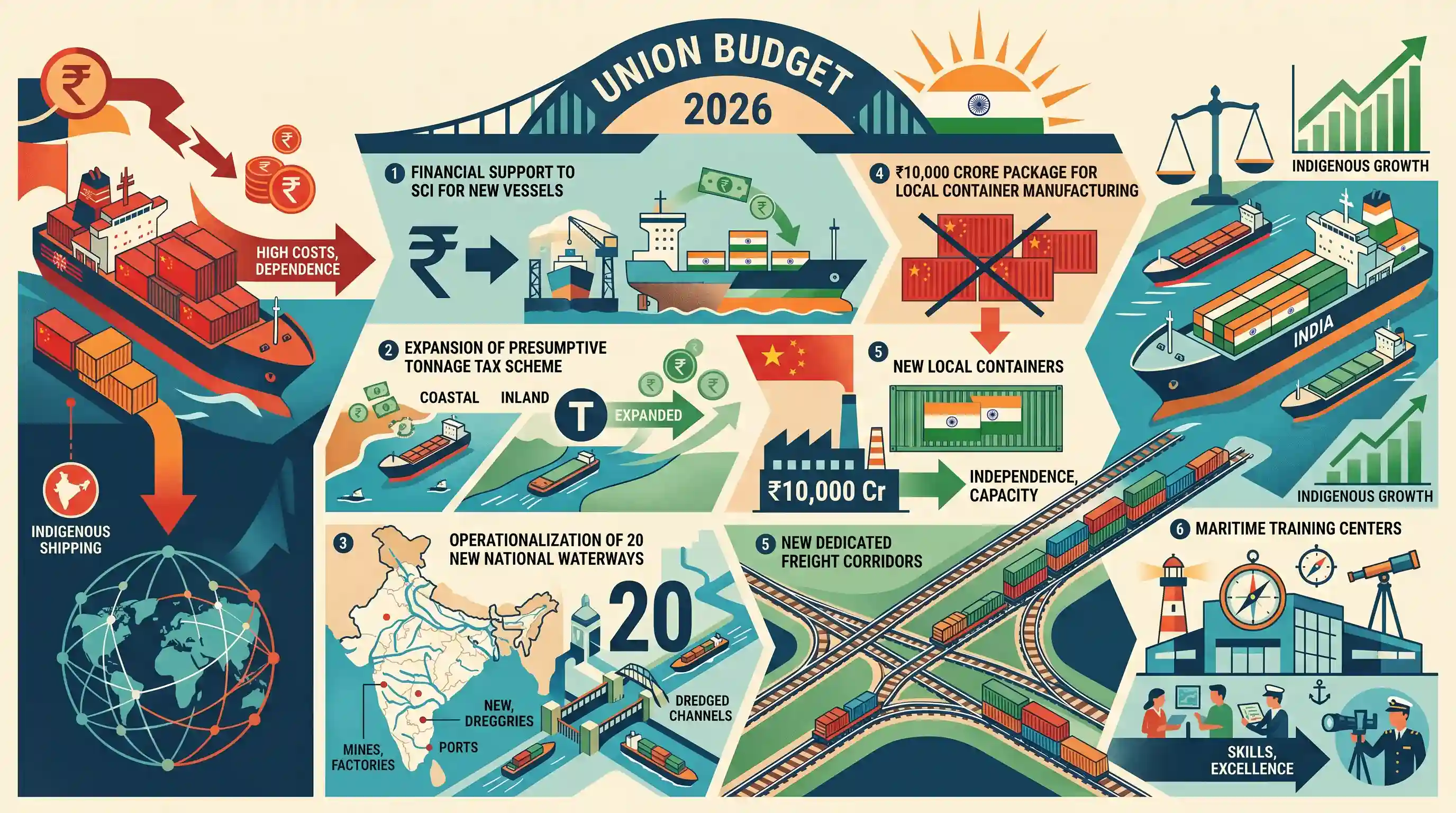
The Union Budget 2026 introduces major proposals to revitalize India's indigenous shipping industry and reduce reliance on foreign shipping lines. Key initiatives include financial support for the Shipping Corporation of India to purchase new vessels, an expansion of the presumptive tonnage tax scheme to inland and coastal shipping, and the operationalization of 20 new national waterways. Furthermore, to build domestic capacity and cut import dependence on China, the government announced a ₹10,000 crore package for a local container manufacturing ecosystem alongside plans for new Dedicated Freight Corridors and maritime training centers.
Key Points
- The Budget aims to double the share of inland and coastal shipping in total cargo movement from 6% to 12%.
- A ₹1,700 crore allocation (out of a ₹69,725 crore comprehensive package) is provided for the Shipping Corporation of India (SCI) to acquire ocean-going merchant ships.
- To encourage fleet expansion, a 5% presumptive tonnage tax scheme will replace the standard income-based tax for inland and coastal shipping companies.
- 20 new national waterways will be operationalized over 5 years, starting with the Brahmani-Mahanadi National Waterway 5.
- New Dedicated Freight Corridors will be developed, including one connecting Dakuni in the east to Surat in the west.
- A ₹10,000 crore Make in India initiative will foster a domestic container manufacturing ecosystem over 5 years, complete with BIS standards for specialized steel to reduce reliance on Chinese imports.
Important Terms
Presumptive tonnage tax scheme

A specialized taxation regime where shipping companies are taxed based on the net tonnage of their fleet rather than actual commercial profits, simplifying compliance and lowering tax liability.
UPSC context
GS-3 (Economy/Infrastructure); important for logistics competitiveness, ease of doing business, and reducing multimodal transport costs.
Shipping Corporation of India (SCI)
A Navratna Public Sector Undertaking under the Ministry of Ports, Shipping and Waterways, serving as India's premier shipping line and largest owner-operator of merchant vessels.
UPSC context
GS-3 (Infrastructure/Investment); central to self-reliance in maritime trade and strategic energy security logistics.
Inland Waterways Authority of India (IWAI)
A statutory body established in 1986 responsible for developing and regulating India’s national waterways to promote eco-friendly and cost-effective inland water transport.
UPSC context
GS-3 (Infrastructure); nodal agency for developing 111 National Waterways to decongest road and rail networks.
Dedicated Freight Corridors (DFC)
High-capacity, specialized railway tracks designed exclusively for goods transport, aiming to improve freight speed, increase capacity, and significantly reduce national logistics costs.
UPSC context
GS-3 (Infrastructure); tests knowledge of multi-modal connectivity, industrial corridors, and the National Rail Plan goals.
Bureau of Indian Standards (BIS)
The national standards body of India that formulates quality and safety standards for products, including critical components for the emerging domestic container manufacturing industry.
UPSC context
GS-3 (Industrial Policy); relevant for technical barriers to trade and maintaining global quality benchmarks in domestic manufacturing.
Inland Vessels Act, 2021
A unified legal framework that replaced the 1917 Act to standardize vessel registration, safety, and operational procedures across all Indian states for inland water transport.
UPSC context
GS-3 (Infrastructure); provides the legal basis for extending tax benefits and promoting private investment in riverine shipping.
Prelims Trap
The Tonnage Tax Scheme calculates a shipping company's tax liability based on its annual cargo volume.
The Tonnage Tax Scheme is a presumptive tax calculated strictly on the vessel's net tonnage capacity, entirely independent of the actual cargo volume transported or corporate profits.
Static Concepts Connected
How are National Waterways constitutionally governed in India?
- Constitutional mandate: Parliament holds exclusive power to declare a waterway as a National Waterway under Entry 24 of the Union List.
- Regulatory body: The Inland Waterways Authority of India (IWAI) acts as the nodal statutory body for developing and regulating these notified routes.
- State vs Union: While 'Water' is primarily a State subject (Entry 17), it remains subject to Parliament's power over inter-state rivers and National Waterways.
What is the Tonnage Tax Scheme for the shipping industry?
- Presumptive taxation: It is a presumptive tax scheme where tax is levied based on the net tonnage capacity of a vessel, replacing standard corporate income tax.
- Profit independence: The tax liability remains fixed based on ship capacity, regardless of whether the shipping company actually makes a profit or incurs a loss.
- Sectoral incentive: Recently extended to inland vessels, it aims to reduce compliance burdens, provide tax certainty, and incentivize fleet expansion for water transport.
Cross-Topic Patterns
Inland shipping and PM Gati Shakti
Shifting cargo to coastal waterways directly supports the National Logistics Policy's aim to reduce logistics costs to single digits, integrating seamlessly with PM Gati Shakti's multi-modal connectivity framework.
Container sovereignty and trade security
Building a local container ecosystem with specific BIS steel standards acts as a strategic buffer against Chinese imports, integrating domestic industrial policy with geopolitical supply-chain resilience.

Expect a multi-statement prelims question linking NW-5 (Brahmani-Mahanadi), the Tonnage Tax capacity mechanism, and logistics cost targets.
Linked PYQs · 3
Linked PYQs · 3
- 2025MainsGS3
Discuss the rationale of the Production Linked Incentive (PLI) scheme. What are its achievements? In what way can the functioning and outcomes of the scheme be improved?
- 2025MainsGS3
Why is maritime security vital to protect India's sea trade? Discuss maritime and coastal security challenges and the way forward.
- 2025PrelimsGS1
India is one of the founding members of the International North-South Transport Corridor (INSTC), a multimodal transportation corridor, which will connect
