Critical minerals roadmap for India in Budget 2026
Source:Indian Express ↗
Why It Matters
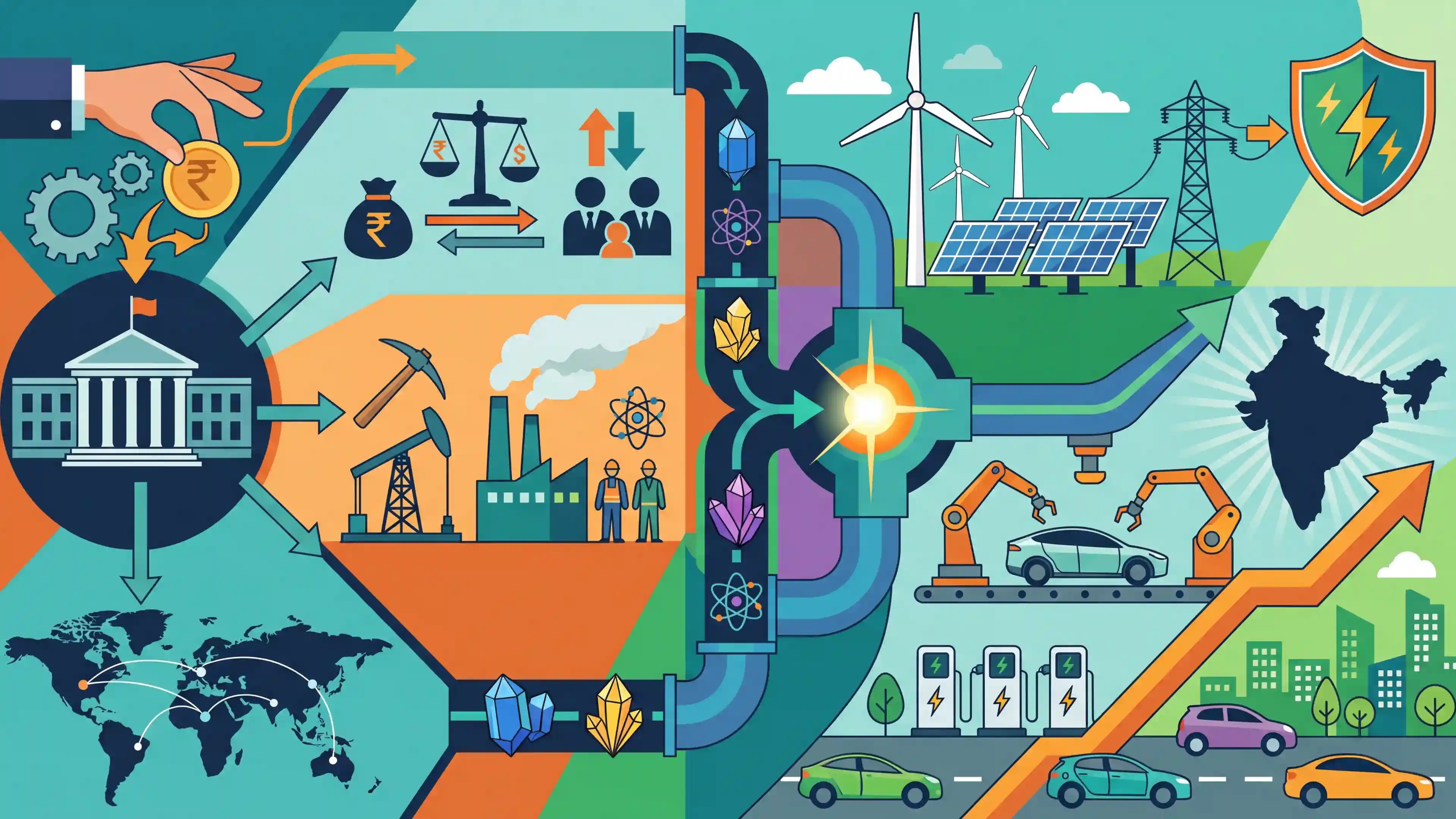
Critical minerals are essential for the manufacturing of green technologies, including EV batteries and solar panels. Securing domestic supply chains and reducing reliance on imports is critical for India's energy security, geopolitical standing, and achievement of net-zero emission goals.
Summary
The article outlines expectations for the Union Budget 2026, focusing on strategic initiatives to transform India into a global powerhouse for critical minerals. Recognizing the vital role of minerals like lithium, cobalt, and rare earths in the clean energy transition and electric vehicle manufacturing, the budget is expected to propose measures to secure supply chains and reduce import dependency. Anticipated interventions include policy frameworks to incentivize domestic exploration and processing, potential customs duty reforms, and strengthening global partnerships. These efforts are crucial for ensuring India's energy security and achieving self-reliance in the manufacturing of future green technologies.
Key Points
- The Union Budget 2026 is anticipated to introduce strategic measures to establish India as a global powerhouse in critical minerals.
- Critical minerals such as lithium, cobalt, and rare earth elements are crucial for India's clean energy transition, particularly for electric vehicle (EV) batteries and renewable energy technologies.
- The budget may focus on reducing import dependency by incentivizing domestic exploration, processing, and refining capabilities.
- Policy tools could include customs duty rationalizations and enhanced frameworks under the MMDR Act to encourage private investment in the mining and processing of these strategic resources.
- Efforts to secure international supply chains, akin to India's participation in the Minerals Security Partnership, are expected to be bolstered.
Important Terms
Critical Minerals

Metallic or non-metallic elements (e.g., lithium, cobalt) essential for high-tech industries and national security, characterized by high economic importance and vulnerability to supply chain disruptions.
UPSC context
GS Paper III: Indian Economy/Environment. Tests knowledge of strategic resources needed for energy transition and manufacturing self-reliance (Atmanirbhar Bharat).
National Critical Mineral Mission (NCMM)
A flagship government initiative launched to secure India's supply chain through domestic exploration, overseas asset acquisition, and recycling, supported by significant fiscal outlays and a fast-track regulatory framework.
UPSC context
GS Paper III: Energy Security/Infrastructure. Crucial for questions on India's roadmap to achieving 500GW renewable capacity and Net Zero 2070.
Mines and Minerals (Development and Regulation) Act (MMDR)
The principal legislation governing India's mining sector; recent 2023 and 2025 amendments specifically liberalized the exploration and mining of critical and deep-seated minerals for private sector participation.
UPSC context
GS Paper II: Government Policies/Polity. Tests understanding of legal reforms, federal mineral rights, and ease of doing business in the extractive industries.
Minerals Security Partnership (MSP)
A US-led strategic grouping of 14 partners, including India, aimed at catalyzing public and private investment to build resilient, transparent, and sustainable global critical mineral supply chains.
UPSC context
GS Paper II: International Relations. Relevant for topics on plurilateral groupings, Indo-Pacific strategy, and reducing global supply dependency on China.
Khanij Bidesh India Ltd (KABIL)
A joint venture of three CPSEs (NALCO, HCL, MECL) under the Ministry of Mines, mandated to identify, explore, and acquire strategic mineral assets abroad, particularly lithium and cobalt.
UPSC context
GS Paper III: Economy/Energy Security. Specific example for India's "resource diplomacy" and efforts to secure critical minerals from the Lithium Triangle.
Rare Earth Elements (REEs)
A group of 17 metallic elements (15 lanthanides plus scandium and yttrium) used in high-tech products like EV motors, wind turbines, and advanced defense systems.
UPSC context
GS Paper I/III: Geography/Science & Tech. Tests knowledge of mineral distribution (monazite sands) and the technological challenges of HREE refining.
Prelims Trap
State governments have exclusive power to auction mining leases for all critical minerals under the MMDR Act.
The MMDR Amendment Act 2023 empowered the Central Government to exclusively auction 24 specified critical and strategic minerals, though revenues still accrue to the states.
Static Concepts Connected
What did the MMDR Amendment Act 2023 change for critical minerals?
- Atomic minerals list: Removed six minerals, including lithium and titanium, from the 'atomic minerals' list, allowing private sector mining and exploration.
- Central auction power: Empowered the Central Government to exclusively auction mining leases and composite licenses for 24 critical and strategic minerals.
- Exploration Licence: Introduced a new Exploration Licence (EL) specifically for deep-seated and critical minerals to encourage advanced private sector exploration.
What is the Minerals Security Partnership (MSP)?
- US-led grouping: A US-led alliance of 14 countries and the EU aiming to catalyze public and private investment in critical mineral supply chains globally.
- Strategic objective: Aims to reduce dependency on a single nation (China) for processing rare earths and battery minerals, ensuring supply chain resilience.
- India's participation: India joined the MSP in 2023, which is crucial for securing the resources needed to meet its 'Panchamrit' climate targets and EV goals.
Cross-Topic Patterns
Supply chains for EV ecosystem
Securing lithium and cobalt via domestic mining and the MSP directly underpins the success of the PM E-DRIVE scheme and the PLI scheme for Advanced Chemistry Cells (ACC).
Environmental paradox of green tech
While crucial for India's 2070 Net Zero target, extracting and processing critical minerals causes severe water contamination and radioactive risks, creating an 'environmental vs climate' governance challenge.

Expect a 2026 Prelims multi-statement question linking MMDR 2023 amendments, delisted minerals like lithium, and the MSP mandate.
Linked PYQs · 3
Linked PYQs · 3
- 2025PrelimsGS1
Consider the following statements : I. India has joined the Minerals Security Partnership as a member. II. India is a resource-rich country in all the 30 critical minerals that it has identified. III. The Parliament in 2023 has amended the Mines and Minerals (Development and Regulation) Act, 1957 empowering the Central Government to exclusively auction mining lease and composite license for certain critical minerals. Which of the statements given above are correct?
- 2025MainsGS3
Mineral resources are fundamental to the country's economy and these are exploited by mining. Why is mining considered an environmental hazard? Explain the remedial measures required to reduce the environmental hazard due to mining.
- 2023MainsGS3
The adoption of electric vehicles is rapidly growing worldwide. How do electric vehicles contribute to reducing carbon emissions and what are the key benefits they offer compared to traditional combustion engine vehicles?
