Union Budget 2026 Focuses on Semiconductors and AI Roadmap
Source:Indian Express ↗
Why It Matters
As global tech supply chains restructure, India's proactive policies on semiconductors, AI, and critical minerals are crucial for economic security and strategic autonomy. This directly aligns with the GS3 syllabus covering technology indigenization, industrial policy, and awareness in IT and computers.
Summary
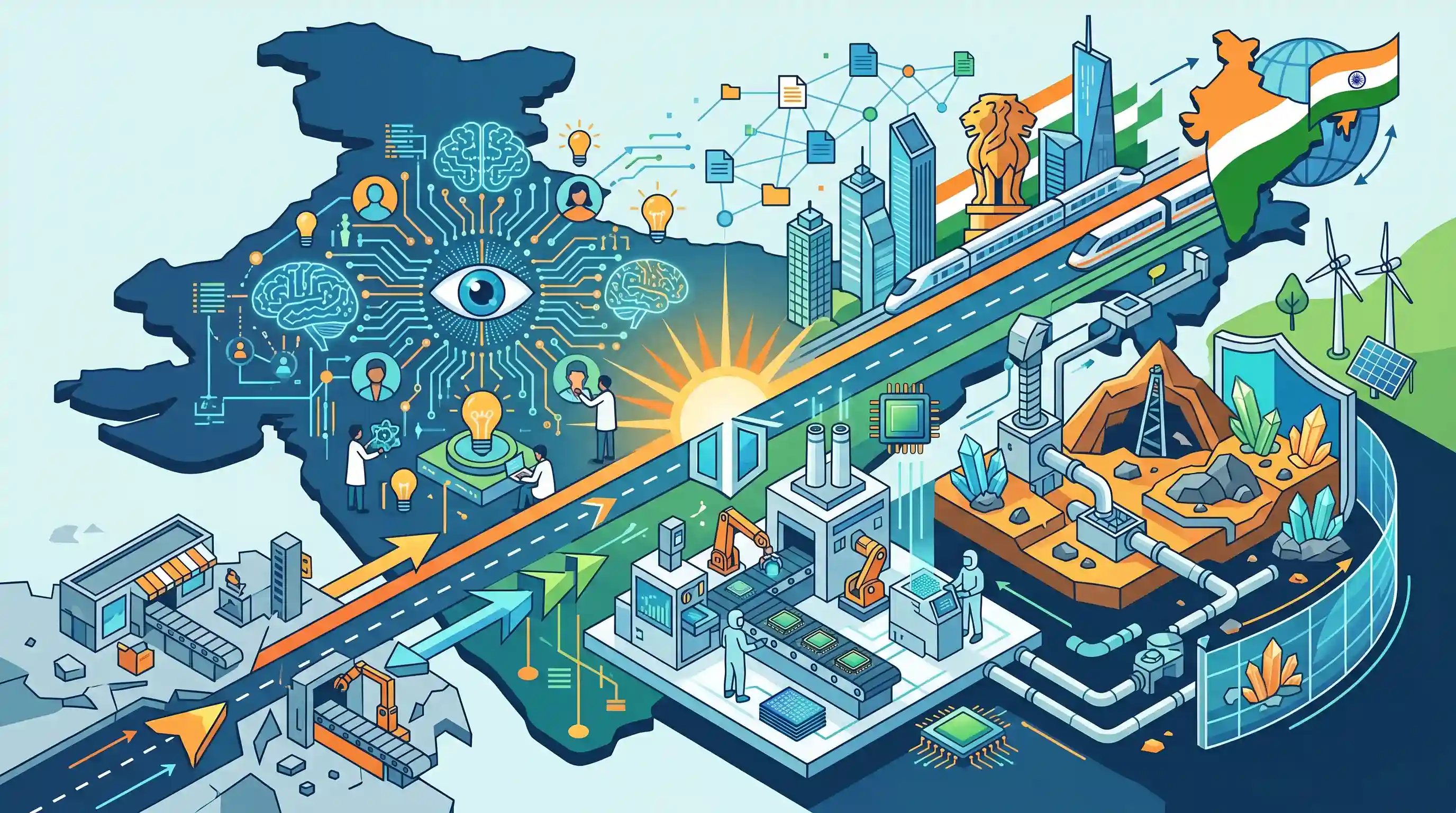
The Union Budget 2026 outlines a strategic vision for India's technological advancement, emphasizing a transition from being a consumer and assembly hub to a key player in the global technology supply chain. The budget lays down a roadmap focusing on three critical pillars: artificial intelligence (AI), semiconductor manufacturing, and rare earth elements. By prioritizing domestic semiconductor fabrication, fostering an AI-driven innovation ecosystem, and securing critical mineral supply chains, the government aims to ensure technological self-reliance, bolster national security, and position India at the forefront of the global digital and green transitions.
Key Points
- The Union Budget 2026 presents a roadmap for India's technological future, prioritizing self-reliance in high-tech and strategic sectors.
- Highlights a targeted push towards semiconductor manufacturing, aiming to build a robust domestic fabrication ecosystem rather than focusing solely on electronics assembly.
- Emphasizes Artificial Intelligence (AI) as a critical pillar for future economic growth, digital public infrastructure, and innovation.
- Focuses on securing supply chains for rare earth elements and critical minerals, which are essential for electronics, defense, and the green energy transition.
- Reflects India's strategic ambition to transition from a global manufacturing destination to a key player at the 'tech high table' with intellectual property and deep-tech capabilities.
Important Terms
India Semiconductor Mission (ISM) 2.0

A government initiative to build a self-reliant semiconductor ecosystem, focusing on domestic manufacturing of equipment, materials, and full-stack indigenous intellectual property for advanced chip technology.
UPSC context
GS3 (Science & Tech/Economy): Essential for indigenization of technology, electronic manufacturing, and global supply chain resilience.
National Critical Mineral Mission (NCMM)
A seven-year comprehensive policy framework aimed at securing strategic minerals (like lithium and cobalt) through domestic exploration, overseas acquisitions, and circular economy practices like recycling.
UPSC context
GS3 (Economic Development/Science): Tests knowledge of strategic resource security and the transition to green energy.
Rare Earth Corridors
Specialized industrial hubs proposed in mineral-rich states to co-locate mining, processing, and manufacturing, specifically targeting the production of rare earth elements and permanent magnets.
UPSC context
GS3 (Industrial Policy): Focuses on regional industrial development and reducing import dependence on critical high-tech inputs.
IndiaAI Mission
A national program designed to foster sovereign AI capabilities by providing compute infrastructure (GPUs), supporting indigenous foundation models, and promoting AI applications in public service sectors.
UPSC context
GS3 (Science & Tech/IT): Relevant for digital governance, innovation ecosystems, and AI-led economic growth.
Anusandhan National Research Foundation (ANRF)
An apex statutory body that provides strategic direction for scientific research in India, aiming to bridge the gap between academia, industry, and government R&D.
UPSC context
GS3 (Science & Tech): Key for understanding India's R&D landscape and the implementation of National Education Policy (NEP) goals.
Minerals Security Partnership (MSP)
A multilateral collaboration of major economies (including India) led by the US to secure sustainable global supply chains for critical energy minerals.
UPSC context
GS2 (International Relations) & GS3: Important for strategic diplomacy and securing resources for the green energy transition.
Prelims Trap
Budget 2026's semiconductor strategy prioritizes basic electronics assembly and consumer packaging over domestic fabrication.
The exact opposite is true. The Budget shifts focus *from* basic assembly *towards* domestic fabrication, deep-tech capabilities, and IP creation for self-reliance.
Static Concepts Connected
What distinguishes Rare Earth Elements (REEs) from broader Critical Minerals?
- Chemical group: REEs are a specific set of 17 elements (lanthanides, scandium, yttrium). Critical minerals are a broader economic and strategic category based on national needs.
- The Intersection: All rare earth elements are classified as critical minerals, but not all critical minerals (like Lithium or Cobalt) are rare earths.
- Indian Reserves: India possesses significant REE reserves, primarily extracted from Monazite sands found in the coastal placers of Kerala, Tamil Nadu, and Odisha.
What are the three distinct stages of semiconductor manufacturing?
- Design (Fabless): Creating the integrated circuit architecture. India has historically been strong here due to a vast pool of IT and VLSI design engineers.
- Fabrication (Foundry): Printing the micro-designs onto pure silicon wafers. This is highly capital intensive and the primary focus of India's new self-reliance push.
- ATMP / OSAT: Assembly, Testing, Marking, and Packaging. The final physical stage before the finished chip is integrated into consumer electronics or defense systems.
Cross-Topic Patterns
Geopolitics + Tech Supply Chains
Linking domestic semiconductor fabs to agreements like the Minerals Security Partnership (MSP) reflects India's strategy to bypass Chinese supply chain dominance and ensure strategic autonomy.
Critical Minerals + Climate Goals
Rare earths like Neodymium are critical for permanent magnets in EVs and wind turbines, bridging deep-tech manufacturing directly with India's Net Zero targets and GS-3 climate syllabus.

Expect a multi-statement Prelims question intertwining India's Semiconductor Mission stages (Fab vs ATMP) with its critical mineral needs.
Linked PYQs · 4
Linked PYQs · 4
- 2025MainsGS3
India aims to become a semiconductor manufacturing hub. What are the challenges faced by the semiconductor industry in India? Mention the salient features of the India Semiconductor Mission.
- 2023MainsGS3
Introduce the concept of Artificial Intelligence (AI). How does Al help clinical diagnosis? Do you perceive any threat to privacy of the individual in the use of Al in healthcare?
- 2025PrelimsGS1
Consider the following statements : I. India has joined the Minerals Security Partnership as a member. II. India is a resource-rich country in all the 30 critical minerals that it has identified. III. The Parliament in 2023 has amended the Mines and Minerals (Development and Regulation) Act, 1957 empowering the Central Government to exclusively auction mining lease and composite license for certain critical minerals. Which of the statements given above are correct?
- 2025PrelimsGS1
Consider the following statements : Statement I: Some rare earth elements are used in the manufacture of flat television screens and computer monitors. Statement II : Some rare earth elements have phosphorescent properties. Which one of the following is correct in respect of the above statements?
