India Semiconductor Mission 2.0 Announced in Union Budget
Source:The Hindu ↗
Why It Matters
The transition to ISM 2.0 and the massive push for electronics and container manufacturing highlights India's strategic shift towards high-value supply chain resilience and Atmanirbhar Bharat. This is highly relevant for GS3 questions addressing industrial policy, challenges in the semiconductor industry, and strategies to boost domestic manufacturing (e.g., PLI schemes).
Summary
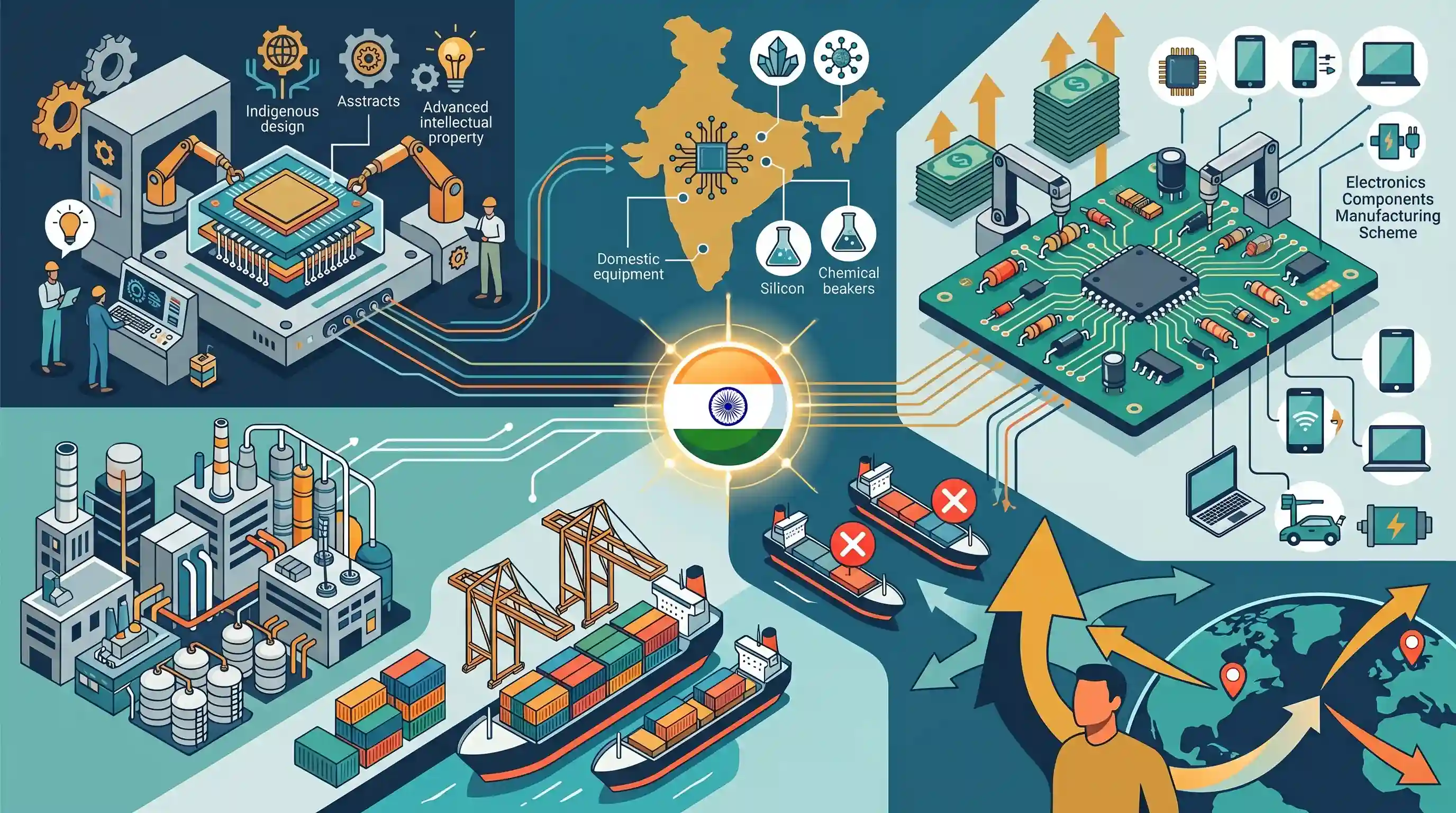
The Union Budget 2026 announced the launch of the India Semiconductor Mission (ISM) 2.0, transitioning India's strategy from basic fabrication towards indigenous production of semiconductor equipment, materials, and full-stack intellectual property (IP). Emphasizing broader industrial self-reliance and supply chain resilience, the Budget also proposed a new Scheme for Container Manufacturing, the establishment of three dedicated chemical parks, and a significant boost to the Electronics Components Manufacturing Scheme with an increased outlay of ₹40,000 crore. These measures reflect a comprehensive push to reduce import dependency and position India as a pivotal node in global high-tech manufacturing.
Key Points
- Budget 2026 announced the launch of India Semiconductor Mission (ISM) 2.0, focusing on equipment, materials, and building full-stack Indian intellectual property (IP).
- A Scheme for Container Manufacturing has been proposed to foster a globally competitive ecosystem and strengthen logistics and supply chains.
- The outlay for the Electronics Components Manufacturing Scheme is proposed to be increased to ₹40,000 crore from the initial ₹22,919 crore.
- Three dedicated chemical parks will be established to enhance domestic production of critical chemicals and reduce import dependency.
- As of August 2025, 10 semiconductor manufacturing and packaging projects involving ₹1.6 lakh crore investment have been approved across six states.
Important Terms
India Semiconductor Mission (ISM) 2.0

The second phase of India's semiconductor strategy, launched in Budget 2026, shifting focus from fabrication to indigenous production of equipment, materials, and full-stack intellectual property.
UPSC context
GS Paper III: Industrial Policy and Science & Technology. Tests knowledge of technological indigenization and strategic autonomy.
Electronics Components Manufacturing Scheme (ECMS)
A scheme aimed at building a domestic electronics ecosystem; Budget 2026 nearly doubled its outlay to ₹40,000 crore to capitalize on high investment momentum.
UPSC context
GS Paper III: Indian Economy and Industrial Growth. Tests understanding of manufacturing incentives and import substitution.
Container Manufacturing Assistance Scheme (CMAS)
A ₹10,000 crore initiative announced in Budget 2026 to create a globally competitive domestic container production ecosystem, targeting 1 million TEUs annual capacity.
UPSC context
GS Paper III: Infrastructure and Logistics. Tests knowledge of maritime self-reliance and supply chain resilience.
Dedicated Chemical Parks
A cluster-based initiative to establish three plug-and-play industrial zones with shared infrastructure, designed to reduce import dependency in the chemicals sector.
UPSC context
GS Paper III: Changes in Industrial Policy. Tests knowledge of cluster-based development and sectoral growth.
India Semiconductor Mission (ISM)
The foundational 2021 national mission (ISM 1.0) with a ₹76,000 crore outlay focused on establishing a semiconductor and display manufacturing ecosystem in India.
UPSC context
GS Paper III: Science & Technology. Essential background for semiconductor policy evolution.
Prelims Trap
"India Semiconductor Mission (ISM) 2.0 primarily focuses on establishing new pure-play semiconductor fabrication plants (fabs)."
ISM 2.0 represents a transition from basic fabrication (fabs) and packaging towards building an ecosystem for semiconductor equipment, raw materials, and indigenous IP.
Static Concepts Connected
What are the key stages in the semiconductor manufacturing value chain?
- Design (Fabless): Creating the IC architecture and logic. It is highly R&D and Intellectual Property (IP) intensive.
- Fabrication (Foundry): The actual manufacturing of chips on silicon wafers. Highly capital intensive and requires ultra-pure materials.
- Packaging: Assembly, Testing, Marking, and Packaging (ATMP/OSAT) of the manufactured chips before final integration into electronics.
What defines 'Plug-and-Play' infrastructure in industrial and chemical parks?
- Ready Utilities: Pre-acquired land with functional baseline utilities like stable power, water supply, and common effluent treatment plants (CETP).
- Regulatory Ease: Pre-approved zoning, environmental, and statutory clearances, drastically reducing the gestation period for businesses to start operations.
- Lowered Capex: Allows manufacturers to bypass heavy initial infrastructure setup, focusing capital strictly on operational machinery and production.
Cross-Topic Patterns
Semiconductor materials & Critical Minerals
ISM 2.0's push for domestic semiconductor raw materials directly connects to India's strategic acquisition and mining of critical minerals like gallium, germanium, and high-purity silicon.
Container manufacturing & National Logistics Policy
Domestic container manufacturing reduces forex drain and vulnerabilities in global shipping, anchoring the National Logistics Policy's goal to lower domestic logistics costs to global averages.
Chemical Parks as API building blocks
The three new chemical parks address upstream supply chain gaps in specialty chemicals, serving as crucial backward linkages for the existing PLI schemes in pharmaceuticals (APIs) and electronics.

Expect a Prelims question distinguishing ISM 2.0's focus on IP and equipment from ISM 1.0's fab focus, linked with critical minerals.
Linked PYQs · 3
Linked PYQs · 3
- 2025MainsGS3
India aims to become a semiconductor manufacturing hub. What are the challenges faced by the semiconductor industry in India? Mention the salient features of the India Semiconductor Mission.
- 2025MainsGS3
Discuss the rationale of the Production Linked Incentive (PLI) scheme. What are its achievements? In what way can the functioning and outcomes of the scheme be improved?
- 2023MainsGS3
Faster economic growth requires increased share of the manufacturing sector in GDP, particularly of MSMEs. Comment on the present policies of the Government in this regard.
