Government announces India Semiconductor Mission 2.0 in Budget
Source:The Hindu ↗
Why It Matters
The article is vital for UPSC aspirants as it details India's evolving strategy in the high-tech manufacturing domain, moving from basic fabrication to creating a complete semiconductor ecosystem under ISM 2.0. This aligns directly with GS-3 topics on Science & Technology indigenization, changes in industrial policy, and Atmanirbhar Bharat, showcasing how the government is tackling supply chain vulnerabilities and import dependencies in critical sectors.
Summary
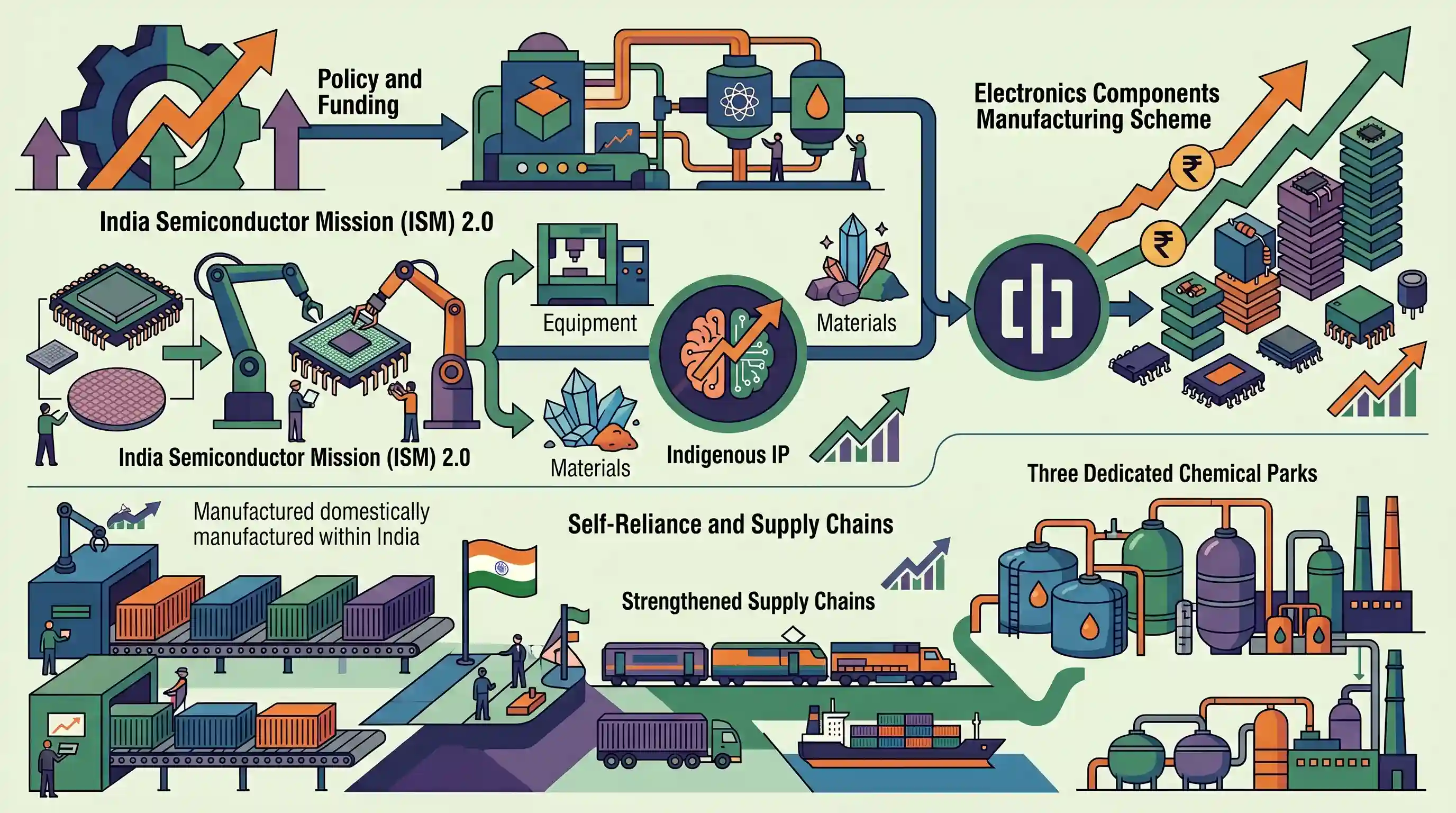
The Union Budget 2026-27 introduced the India Semiconductor Mission (ISM) 2.0, designed to enhance the country's semiconductor ecosystem by focusing on the production of equipment and materials, and developing indigenous Intellectual Property (IP). Finance Minister Nirmala Sitharaman highlighted that the outlay for the Electronics Components Manufacturing Scheme will be increased to Rs 40,000 crore due to strong investment commitments. Furthering the self-reliance agenda, the budget also proposed schemes to boost domestic container manufacturing and to establish three dedicated chemical parks, thereby strengthening India's supply chains and reducing import dependency.
Key Points
- Finance Minister Nirmala Sitharaman announced the launch of India Semiconductor Mission (ISM) 2.0 in the Union Budget 2026-27.
- ISM 2.0 will shift focus towards producing semiconductor equipment and materials, developing full-stack Indian Intellectual Property (IP), and strengthening entire supply chains.
- The budget proposes to increase the outlay for the Electronics Components Manufacturing Scheme from Rs 22,919 crore to Rs 40,000 crore.
- As of August 2025, India has approved 10 semiconductor manufacturing and packaging projects worth ₹1.6 lakh crore across six states.
- Other initiatives include a new scheme for container manufacturing and the establishment of three dedicated chemical parks to reduce import dependencies.
Important Terms
India Semiconductor Mission (ISM) 2.0

The second phase of India's semiconductor strategy (Budget 2026-27), shifting focus from fabrication setup to producing manufacturing equipment, materials, and domestic intellectual property.
UPSC context
GS Paper 3: IT & Electronics. Tests understanding of 'Technological Sovereignty' and value-chain deepening in industrial policy.
Electronics Components Manufacturing Scheme (ECMS)
A MeitY initiative to boost domestic production of electronic components and sub-assemblies; Budget 2026-27 increased its outlay to ₹40,000 crore to reduce import dependency.
UPSC context
GS Paper 3: Indian Economy. Relevant for manufacturing sector growth and reducing trade deficits in high-tech imports.
India Semiconductor Mission (ISM)
Nodal agency under Digital India Corporation launched in 2021 to build a sustainable semiconductor and display ecosystem through financial incentives and strategic partnerships.
UPSC context
GS Paper 3: Sci & Tech. Tests knowledge of institutional frameworks for critical emerging technologies.
Indigenous Intellectual Property (IP)
Locally owned patents, designs, and copyrights for chip architectures and software, aimed at ending reliance on foreign licenses and securing the 'physical layer' of the digital economy.
UPSC context
GS Paper 3: IPR Issues. Tests ability to link intellectual property with national security and economic autonomy.
Import Substitution
An economic strategy replacing foreign imports with domestic production to foster self-reliance, reduce foreign exchange outflow, and protect against global supply chain disruptions.
UPSC context
GS Paper 3: Indian Economy. Critical for discussions on Aatmanirbhar Bharat and industrial policy evolution.
Prelims Trap
India Semiconductor Mission 2.0 primarily focuses on setting up semiconductor fabrication (fab) units in India.
ISM 2.0 specifically shifts the policy focus beyond mere fabrication/packaging units towards producing semiconductor equipment, raw materials, and developing indigenous Intellectual Property.
Static Concepts Connected
What is the difference between Semiconductor Fabs and OSAT/ATMP facilities?
- Fab (Fabrication): The advanced manufacturing facility where raw silicon wafers are processed and printed into complex integrated circuits (chips).
- OSAT / ATMP: Outsourced Assembly and Test. These units cut, package, and test the already-manufactured chips before market distribution.
Which key materials are essential for semiconductor manufacturing?
- Base Substrates: High-purity silicon or next-generation compound materials like Silicon Carbide (SiC) and Gallium Nitride (GaN).
- Critical Minerals: Gallium, Germanium, and Indium, the supply chains of which are heavily concentrated and vulnerable to geopolitical shocks.
- Chemicals & Gases: Photoresists, ultra-pure water, hydrofluoric acid, and neon gas, which are crucial for lithography and etching processes.
Cross-Topic Patterns
Critical minerals, China controls & ISM 2.0
ISM 2.0's focus on semiconductor materials directly counters China's export restrictions on gallium and germanium. UPSC often links industrial policy to geopolitical chokepoints.
Logistics, Containers & Export Competitiveness
Budget 2026 links domestic container manufacturing with freight cost reduction. This integrates infrastructure self-reliance (Make in India) with improving India's global export logistics.

Expect a 2026 Prelims multi-statement question contrasting ISM 1.0 (OSAT/Fabs) with ISM 2.0 (IP, materials, and equipment manufacturing).
Linked PYQs · 3
Linked PYQs · 3
- 2025MainsGS3
India aims to become a semiconductor manufacturing hub. What are the challenges faced by the semiconductor industry in India? Mention the salient features of the India Semiconductor Mission.
- 2023MainsGS3
Faster economic growth requires increased share of the manufacturing sector in GDP, particularly of MSMEs. Comment on the present policies of the Government in this regard.
- 2017MainsGS3
Account for the failure of manufacturing sector in achieving the goal of labour-intensive exports. Suggest measures for more labour-intensive rather than capital-intensive exports.
