International Big Cat Alliance and Environmental Diplomacy
Source:The Hindu ↗
Why It Matters
This article highlights a significant intersection of the Union Budget, global environmental diplomacy, and biodiversity conservation. The creation and operationalization of the IBCA is a highly probable topic for both Prelims (species mapping, IBCA structure) and Mains (India's soft power through environmental leadership, conservation strategies).
Summary
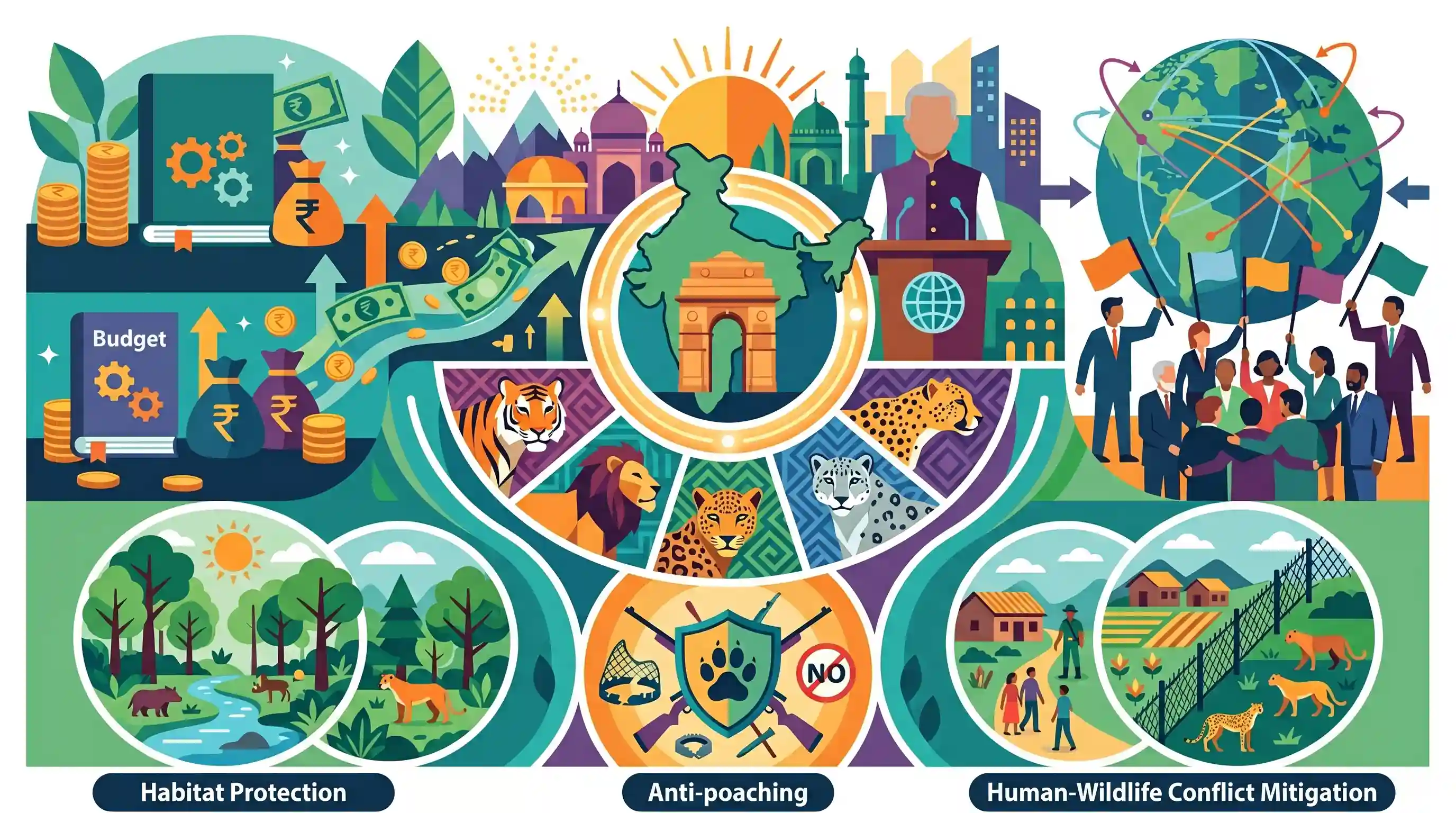
The Union Budget 2026-27 announced that India will host the inaugural Global Big Cat Summit later this year. Coordinated under the International Big Cat Alliance (IBCA)—an initiative launched by PM Narendra Modi to conserve seven major big cat species—the summit will convene leaders and ministers from 95 range countries. The event underscores India’s growing leadership in environmental diplomacy and global wildlife conservation, backed by targeted budgetary allocations, to advance international cooperation on habitat protection, anti-poaching measures, and human-wildlife conflict mitigation.
Key Points
- India will host the first-ever Global Big Cat Summit in 2026, as announced by Finance Minister Nirmala Sitharaman during the Union Budget 2026-27 presentation.
- The summit is organized under the International Big Cat Alliance (IBCA), a treaty-based initiative launched by India to conserve seven major big cat species globally (tiger, lion, leopard, snow leopard, cheetah, jaguar, and puma).
- The event will gather leaders and ministers from 95 range countries to strategize on anti-poaching, habitat connectivity, and mitigating human-wildlife conflict.
- This initiative cements India's role as a global leader in environmental diplomacy, leveraging its successful domestic models like Project Tiger for international biodiversity conservation.
Important Terms
International Big Cat Alliance (IBCA)

A treaty-based intergovernmental organization launched by India in 2023 to protect seven big cat species through global cooperation in habitat restoration and illegal trade prevention.
UPSC context
GS Paper III (Environment) and GS Paper II (International Relations); tests India's leadership in environmental diplomacy and conservation.
Global Big Cat Summit
The inaugural international conference announced in Budget 2026, convening leaders from 95 range countries to coordinate strategies for big cat conservation and human-wildlife conflict mitigation.
UPSC context
GS Paper III (Conservation); tests knowledge of global wildlife governance and India's multilateral environmental initiatives.
Project Tiger
India's flagship conservation program launched in 1973 to ensure a viable population of Bengal tigers; it established a network of over 50 protected tiger reserves.
UPSC context
GS Paper III (Biodiversity and Conservation); fundamental topic for wildlife management and institutional frameworks like NTCA.
Project Cheetah
The world’s first intercontinental large carnivore translocation project, launched in 2022 to reintroduce cheetahs—declared extinct in India in 1952—starting at Kuno National Park.
UPSC context
GS Paper III (Environment); focuses on species reintroduction strategies and restoration of grassland ecosystems.
National Tiger Conservation Authority (NTCA)
A statutory body under the Ministry of Environment, Forest and Climate Change, established in 2005 to provide professional management and oversight to India's tiger reserves.
UPSC context
GS Paper III (Conservation); tests knowledge of statutory bodies and executive implementation of wildlife laws.
Umbrella Species
Species whose conservation indirectly protects many other species in the same habitat; big cats serve as indicators of healthy, biodiverse ecosystems.
UPSC context
GS Paper III (Environment); foundational concept in ecosystem-based conservation and wildlife biology.
Prelims Trap
"All seven major big cat species conserved under the International Big Cat Alliance (IBCA) are naturally found in India."
India hosts only five (tiger, lion, leopard, snow leopard, and cheetah). Jaguars and pumas are native to the Americas. UPSC often traps students by conflating IBCA's global scope with Indian endemism.
Static Concepts Connected
What is the conservation status of the 5 big cats found in India?
- Tiger & Lion: Both the Royal Bengal Tiger and the Asiatic Lion (endemic to Gir, Gujarat) are listed as Endangered by the IUCN and protected under WPA Schedule I.
- Snow Leopard: Listed as Vulnerable by IUCN; functions as a critical indicator species for fragile high-altitude Himalayan ecosystems.
- Cheetah: The Asiatic cheetah is Critically Endangered (extinct in India); the recently reintroduced African cheetahs are Vulnerable.
- Leopard: Listed as Vulnerable; a highly adaptable species increasingly facing severe human-wildlife conflict outside protected areas.
What major treaty-based environmental alliances have been spearheaded by India?
- ISA (2015): International Solar Alliance, co-founded with France, headquartered in Gurugram to scale solar energy deployment primarily in tropical countries.
- CDRI (2019): Coalition for Disaster Resilient Infrastructure, promoting climate resilience and disaster risk reduction in global infrastructure development.
- GBA (2023): Global Biofuels Alliance, launched at the G20 Summit in New Delhi to foster global collaboration for advancing sustainable biofuel adoption.
Cross-Topic Patterns
Environmental Diplomacy as Soft Power
IBCA joins ISA, CDRI, and GBA as a pillar of India's environmental diplomacy, leveraging domestic successes like Project Tiger to lead global agenda-setting among 95 range countries.
Wildlife Treaties & Domestic Acts
The IBCA connects directly to CITES (international trade) and the Wildlife (Protection) Amendment Act, 2022, emphasizing India's strategy to align domestic legal frameworks with global conservation mandates.

Expect a 2026 prelims question mixing IBCA species, their IUCN statuses, and India's treaty-based leadership vs UN-led bodies.
Linked PYQs · 4
Linked PYQs · 4
- 2020PrelimsGS1
Among the following Tiger Reserves, which one has the largest area under "Critical Tiger Habitat"?
- 2017PrelimsGS1
In India, if a species of tortoise is declared protected under Schedule I of the Wildlife (Protection) Act, 1972, what does it imply?
- 2022MainsGS2
‘Clean energy is the order of the day.’ Describe briefly India's changing policy towards climate change in various international fora in the context of geopolitics.
- 2024PrelimsGS1
Consider the following pairs (Country — Animal found in its natural habitat): 1. Brazil — Indri 2. Indonesia — Elk 3. Madagascar — Bonobo How many of the pairs given above are correctly matched?
