Union Budget 2026 introduces new Income Tax Act from April
Source:The Hindu ↗
Why It Matters
The Union Budget is the foundational document for India's economic policymaking. For UPSC candidates, the Budget reveals critical trends in capital expenditure, direct and indirect taxation reforms, and the government's strategic focus on futuristic sectors like semiconductors, AI, and biopharmaceuticals. This information directly maps to GS3 requirements for analyzing economic growth, investment models, and technology missions.
Summary
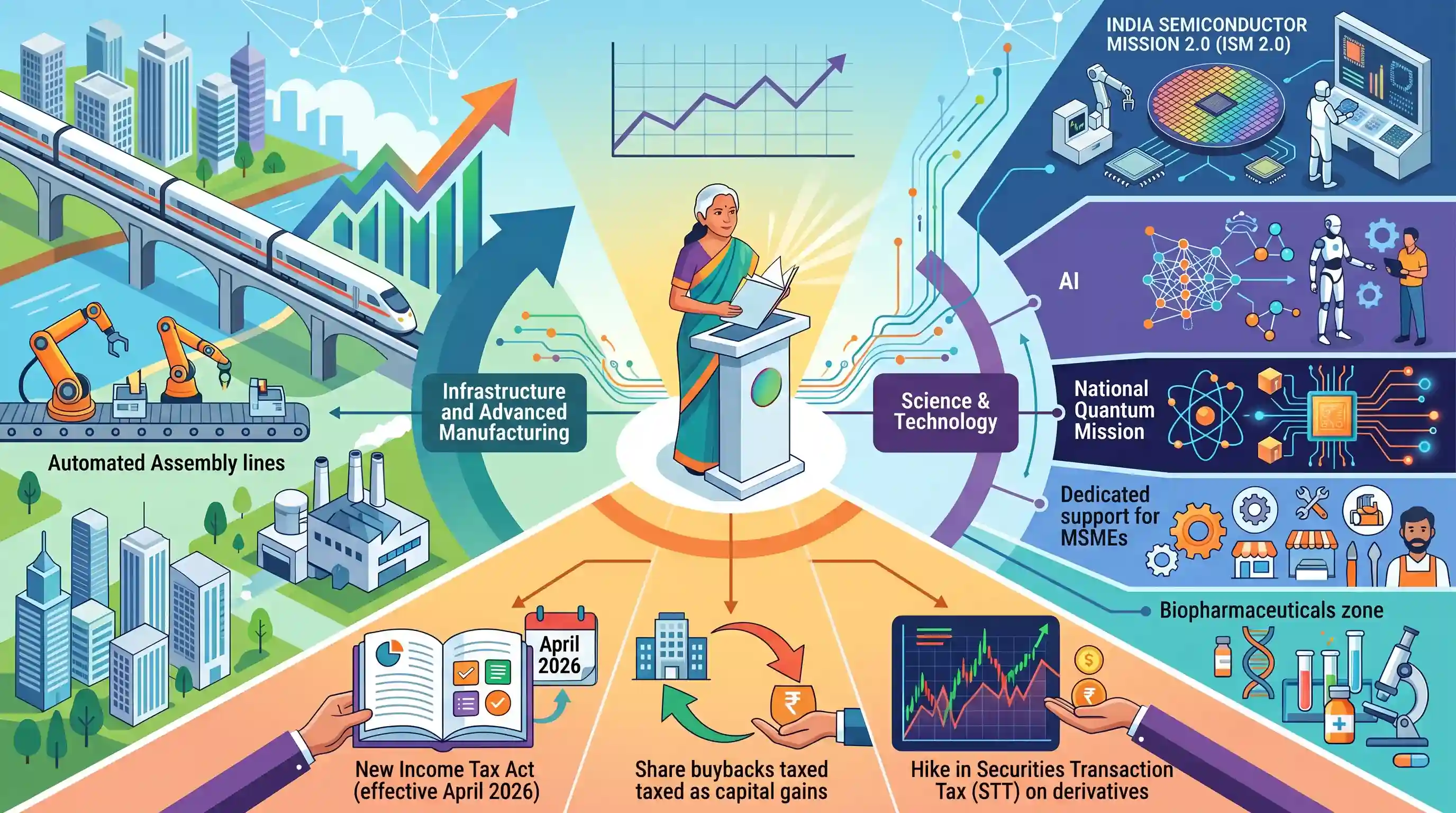
Finance Minister Nirmala Sitharaman's Union Budget 2026-27 speech emphasized a robust push for infrastructure, advanced manufacturing, and deep tech, alongside sweeping tax reforms. Key macroeconomic highlights include an increased capital expenditure outlay of ₹12.2 lakh crore and the announcement of a new Income Tax Act effective April 2026. The budget introduces stringent tax measures, such as taxing share buybacks as capital gains and hiking the Securities Transaction Tax (STT) on derivatives. On the technology and industry front, the government announced the India Semiconductor Mission (ISM) 2.0, significant investments in AI (Bharat-VISTAAR), the National Quantum Mission, and dedicated funds for MSMEs and biopharmaceuticals.
Key Points
- Capital expenditure for FY27 is pegged at a record ₹12.2 lakh crore, signalling continued reliance on infrastructure for economic multiplier effects.
- A new Income Tax Act will be implemented from April 1, 2026, overhauling direct taxation. Share buybacks will now be taxed as capital gains.
- The Securities Transaction Tax (STT) on futures and options has been hiked significantly to curb speculative trading.
- Technology and manufacturing receive a major boost through India Semiconductor Mission 2.0, a ₹10,000 crore MSME growth fund, and rare earth processing corridors.
- Emerging technologies take center stage with outlays for the National Quantum Mission and Bharat-VISTAAR for Artificial Intelligence.
- A ₹10,000 crore biopharmaceuticals push over 5 years aims to strengthen health infrastructure and clinical trials.
Important Terms
Union Budget 2026-27

India's annual financial statement (Article 112) for fiscal 2026-27, emphasizing a ₹12.2 lakh crore capital expenditure outlay, semiconductor manufacturing, and structural direct tax reforms.
UPSC context
GS Paper III: Indian Economy; tests understanding of fiscal policy, resource mobilization, and government spending priorities.
Income Tax Act, 2025
A comprehensive direct tax overhaul replacing the 1961 Act. Effective April 2026, it streamlines 819 sections into 536 and replaces 'Assessment Year' with a unified 'Tax Year.'
UPSC context
GS Paper III: Government Budgeting; tests awareness of tax structure simplification and direct tax reforms.
India Semiconductor Mission (ISM) 2.0
The second phase of India’s semiconductor strategy focused on manufacturing equipment, materials, and domestic Intellectual Property (IP), backed by a ₹1,000 crore allocation for FY 2026-27.
UPSC context
GS Paper III: Science & Technology; relevant to indigenization of technology and industrial growth.
Bharat-VISTAAR
A multilingual, AI-driven platform (Virtually Integrated System to Access Agricultural Resources) that integrates AgriStack and ICAR data to provide farmers with localized, real-time advisory services.
UPSC context
GS Paper III: Agriculture/IT; tests applications of AI in agriculture and digital public infrastructure.
MSME (Micro, Small and Medium Enterprises)
Enterprises essential for employment; Budget 2026 introduced a ₹10,000 crore SME Growth Fund for equity support and increased the Self-Reliant India (SRI) Fund by ₹2,000 crore.
UPSC context
GS Paper III: Economy; tests knowledge of industrial growth, job creation, and credit accessibility.
National Quantum Mission (NQM)
A strategic mission (2023–2031) to establish India as a global hub in quantum computing, communication, and sensing through R&D and specialized Thematic Hubs (T-Hubs).
UPSC context
GS Paper III: Science & Technology; tests awareness of frontier technologies and India’s R&D capabilities.
Prelims Trap
"The Securities Transaction Tax (STT) is an indirect tax levied by SEBI to regulate derivative trading."
STT is actually a Direct Tax governed by the Central Government (CBDT), not an indirect tax or SEBI regulatory fee, despite being collected through exchanges.
Static Concepts Connected
What is the macroeconomic multiplier effect of Capital Expenditure?
- CapEx Multiplier: Generates higher long-term economic output (often >2.5x) by creating productive physical/digital assets and crowding-in private investment.
- RevEx Multiplier: Yields lower returns (often <1.0x) as it primarily funds immediate consumption (salaries, subsidies, pensions) without building long-term productive capacity.
What are the core features of the Securities Transaction Tax (STT)?
- Direct Tax: It is a direct tax under the purview of the Central Government, levied on the trading of securities on recognized domestic stock exchanges.
- Scope & Purpose: Applies to equities, derivatives (futures & options), and equity-oriented mutual funds, primarily designed to curb tax evasion and excessive speculation.
Cross-Topic Patterns
CapEx Multiplier + Strategic Tech Autonomy
Record ₹12.2 lakh crore capital expenditure directly synergizes with ISM 2.0 and rare earth processing corridors, expanding 'infrastructure' from traditional roads to deep-tech geopolitical decoupling.
Financial Stability + Direct Taxation
Hiking the STT to curb derivative speculation shows fiscal policy complementing the RBI's monetary and regulatory efforts to manage systemic risks in India's booming retail financial markets.

STT mechanics, capital gains on buybacks, and the CapEx multiplier are highly likely to form a composite Economy Prelims question in 2026.
Linked PYQs · 5
Linked PYQs · 5
- 2021MainsGS3
“Investment in infrastructure is essential for more rapid and inclusive economic growth.” Discuss in the light of India's experience.
- 2023MainsGS3
Faster economic growth requires increased share of the manufacturing sector in GDP, particularly of MSMEs. Comment on the present policies of the Government in this regard.
- 2025MainsGS3
India aims to become a semiconductor manufacturing hub. What are the challenges faced by the semiconductor industry in India? Mention the salient features of the India Semiconductor Mission.
- 2023MainsGS3
Introduce the concept of Artificial Intelligence (AI). How does Al help clinical diagnosis? Do you perceive any threat to privacy of the individual in the use of Al in healthcare?
- 2022PrelimsGS1
Which one of the following situations best reflects "Indirect Transfers" often talked about in media recently with reference to India?
