Budget 2026 proposes integrated package for textile and MSME sectors
Source:The Hindu ↗
Why It Matters
The article outlines vital economic reforms and budget allocations targeting MSMEs and the textile industry—two of India's largest employment-generating sectors. It provides concrete examples of government schemes (like TReDS integration and Samarth 2.0) that can be cited in GS3 answers on industrial policy, economic growth, and employment.
Summary
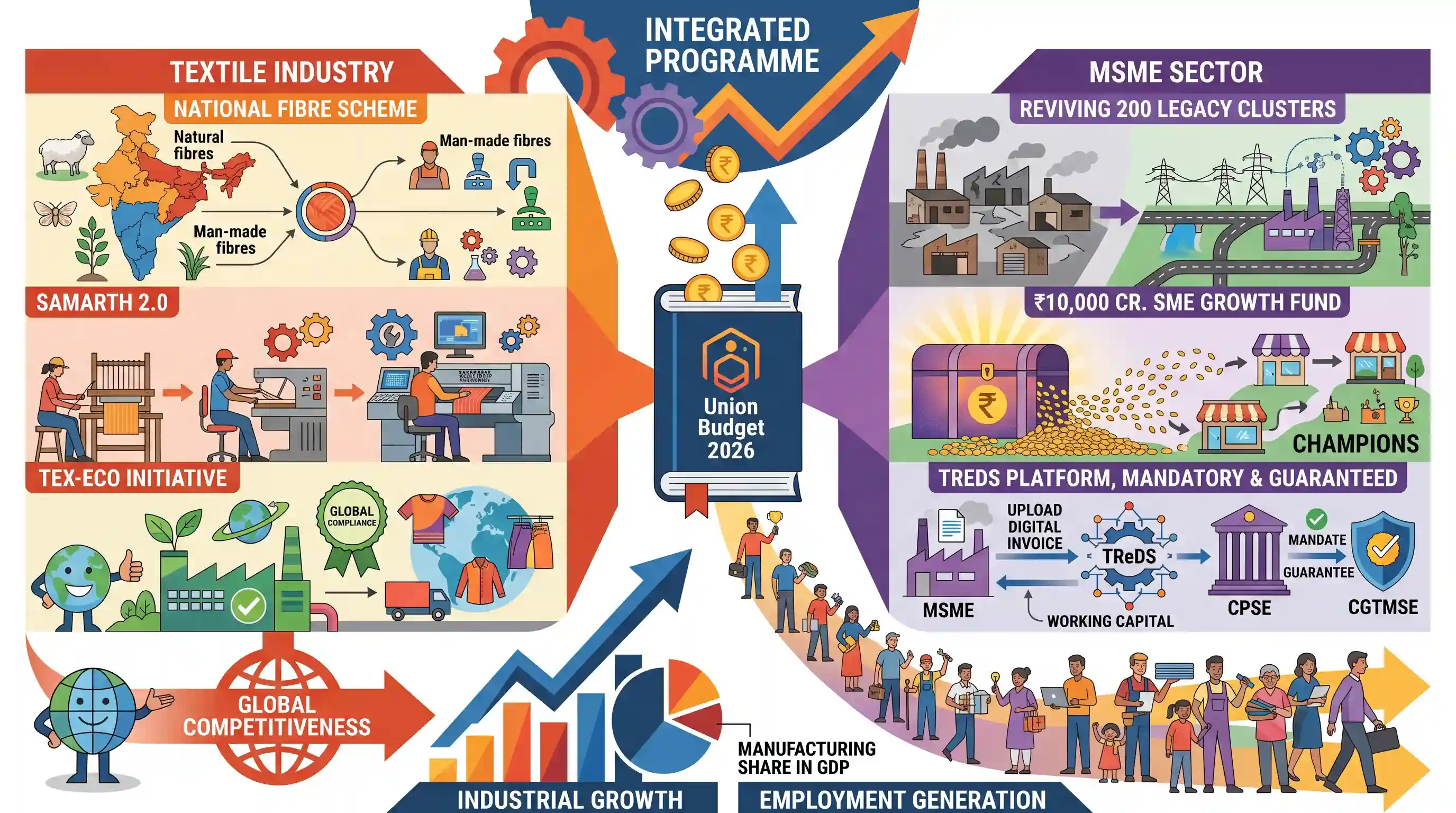
The Union Budget 2026 proposes a comprehensive integrated programme to boost India's labour-intensive textile and MSME sectors, significantly increasing their financial allocations. Key measures for textiles include the National Fibre Scheme, Samarth 2.0 for upskilling, and the Tex-Eco Initiative to ensure global competitiveness. For MSMEs, the budget focuses on reviving 200 legacy industrial clusters, launching a ₹10,000 crore SME Growth Fund, and easing working capital constraints by mandating CPSEs to use the TReDS platform backed by CGTMSE guarantees. These steps aim to enhance manufacturing share in GDP and spur employment generation.
Key Points
- The Union Budget 2026-27 doubled the allocation for MSMEs and increased the textile sector allocation by nearly 25%.
- A comprehensive package for the textile sector was announced, including the National Fibre Scheme, mega technical textile parks, and Samarth 2.0 for skilling.
- For MSME rejuvenation, the government will revive 200 legacy industrial clusters and set up a ₹10,000 crore SME Growth Fund.
- TReDS platform usage has been made mandatory for CPSEs to settle MSME purchases, supported by credit guarantees from CGTMSE and integration with the GeM portal.
- A new Income Tax Act is proposed to come into effect on April 1, 2026.
Important Terms
Trade Receivables Discounting System (TReDS)

An RBI-regulated digital platform where MSMEs can auction their trade receivables (invoices) to financiers to get immediate cash, resolving delayed payment issues from corporate and government buyers.
UPSC context
GS Paper-III: Indian Economy and industrial growth; tests knowledge of digital financial infrastructure for MSME liquidity.
SME Growth Fund
A ₹10,000 crore fund proposed in Budget 2026 to provide equity-based growth capital to high-potential MSMEs, helping them scale into globally competitive "champion" enterprises.
UPSC context
GS Paper-III: Industrial Policy; relevant for understanding equity-support mechanisms to address the "missing middle" in Indian industry.
CGTMSE (Credit Guarantee Fund Trust for Micro and Small Enterprises)
A joint initiative by the MSME Ministry and SIDBI that provides collateral-free credit guarantees to lenders for loans extended to micro and small enterprises.
UPSC context
GS Paper-III: Banking and Economy; significant for credit inclusion and reducing risk perception in MSME lending.
Samarth 2.0
An upgraded version of the textile skilling scheme aimed at modernizing the ecosystem through industry-academic partnerships to ensure a job-ready workforce for the textile value chain.
UPSC context
GS Paper-III: Employment and Industrial Growth; tests understanding of sectoral human capital development.
National Fibre Scheme
A strategic proposal to achieve self-reliance in the production of natural fibres (silk, wool, jute), man-made fibres, and technical textiles to strengthen raw material security.
UPSC context
GS Paper-III: Industry and Resources; relevant for import substitution and "Atmanirbhar Bharat" in the textile sector.
Tex-Eco Initiative
A budget initiative promoting environmentally sustainable and globally competitive textile manufacturing, aligning Indian production with international green standards and export requirements.
UPSC context
GS Paper-III: Economy and Environment; tests awareness of green industrialization and sustainable export strategies.
Prelims Trap
Samarth 2.0 provides upskilling for workers across the entire textile value chain, including traditional spinning and weaving.
Samarth 2.0 explicitly excludes the spinning and weaving segments from its upskilling mandate, focusing instead on other parts of the organized value chain and technical textiles.
Static Concepts Connected
What is the TReDS platform and how does it function?
- Core Purpose: An RBI-regulated electronic platform facilitating the financing and discounting of trade receivables of MSMEs through multiple financiers.
- Key Participants: Involves MSME sellers, corporate or government buyers (like CPSEs), and financiers such as banks and NBFCs.
- Mechanism: Buyers upload invoices, which financiers bid on. MSMEs get immediate liquidity, resolving severe working capital constraints.
What distinguishes Technical Textiles from conventional apparel textiles?
- Function over Form: Manufactured primarily for technical performance and functional properties rather than aesthetic or decorative characteristics.
- Diverse Applications: Used extensively across crucial sectors including agriculture (agro-textiles), healthcare (medical-textiles), and infrastructure (geo-textiles).
Cross-Topic Patterns
DPI bridging MSME credit gaps
Integrating TReDS with GeM showcases India's Digital Public Infrastructure evolving to solve structural B2B liquidity and working capital issues for MSMEs.
Green mandates and export competitiveness
The 'Tex-Eco Initiative' demonstrates how domestic industrial policy is pivoting to shield Indian textile exports from emerging global ESG barriers like the EU's Carbon Border Adjustment Mechanism (CBAM).

A multi-statement Prelims question will likely combine TReDS regulatory mechanics (RBI) with the exact exclusions of Samarth 2.0.
Linked PYQs · 2
Linked PYQs · 2
- 2023MainsGS3
Faster economic growth requires increased share of the manufacturing sector in GDP, particularly of MSMEs. Comment on the present policies of the Government in this regard.
- 2017MainsGS3
Account for the failure of manufacturing sector in achieving the goal of labour-intensive exports. Suggest measures for more labour-intensive rather than capital-intensive exports.
