Union Budget Educational Reforms and Learner-Centric Funding Shift
Source:The Hindu ↗
Why It Matters
This article provides a critical analysis of the government's fiscal prioritization and policy direction in the education sector. The shift towards learner-centric funding, the massive boost to innovation labs (Atal Tinkering Labs), and the focus on bridging the education-to-employment gap are highly relevant for GS Paper 2 (Education, Human Resources) and GS Paper 3 (Employment, Skilling, Demographic Dividend). Candidates must understand these budgetary trends to critically evaluate the implementation of the National Education Policy (NEP) 2020.
Summary
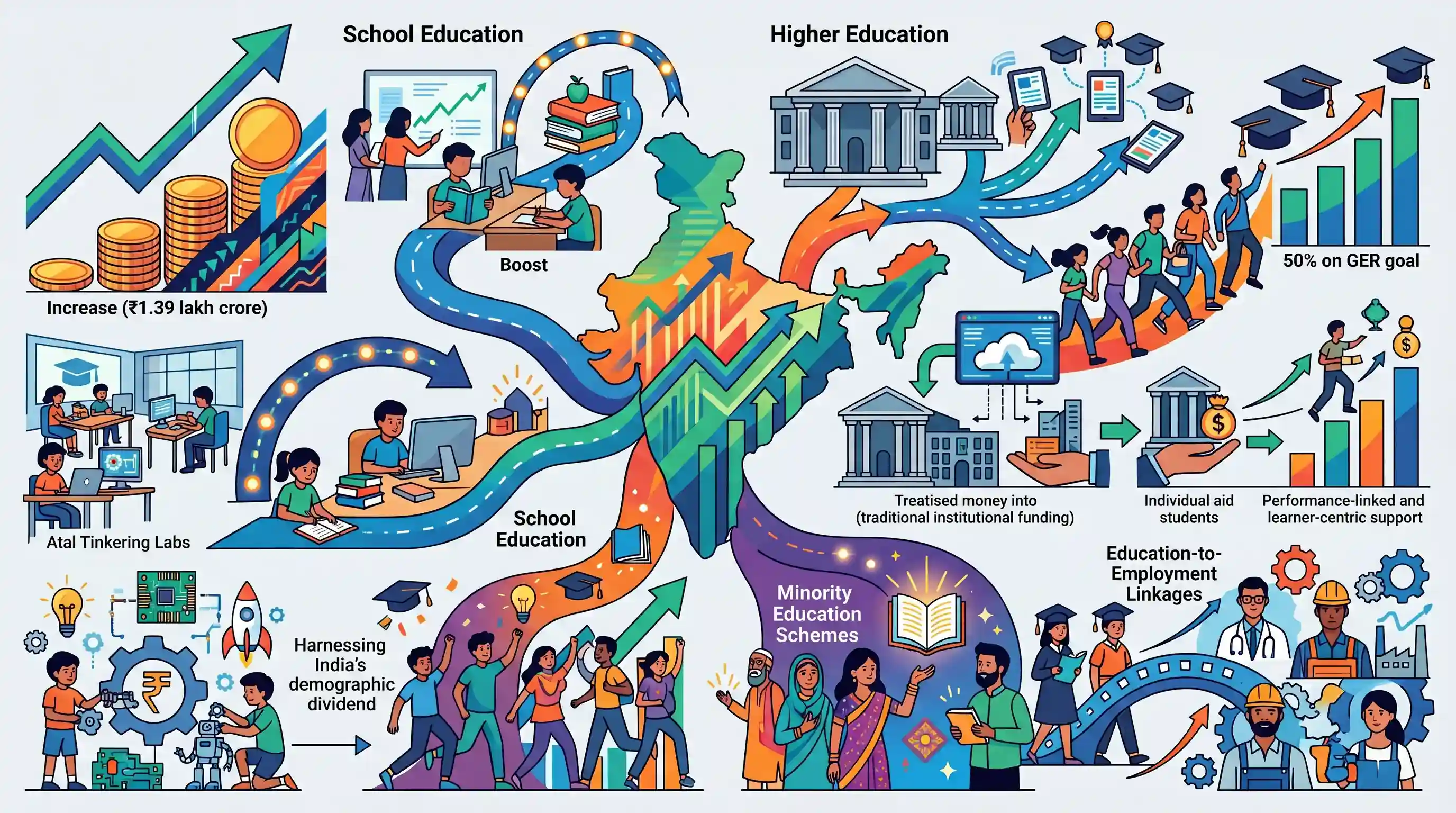
The article analyzes the consequences of the Union Budget 2026-27 for the education sector, which saw its allocation rise to ₹1.39 lakh crore. While school education and initiatives like Atal Tinkering Labs received major financial boosts, higher education faces a potential paradigm shift. The government aims to reach a 50% Gross Enrolment Ratio (GER) while simultaneously acknowledging the 'creative destruction' brought by edtech platforms. Future policies may pivot towards performance-linked funding and learner-centric financial support over traditional institution funding. Additionally, the budget emphasizes minority education schemes and improving education-to-employment linkages to harness India's demographic dividend.
Key Points
- The Union Budget 2026-27 has allocated ₹1.39 lakh crore to the Education Ministry, reflecting a 14.21% increase over the previous year's revised estimates.
- A significant portion of the increased funds is directed towards the Department of School Education and Literacy, with the budget for Atal Tinkering Labs surging from ₹500 crore to ₹3,200 crore.
- The Economic Survey highlights potential 'creative destruction' in higher education, where traditional Higher Education Institutions (HEIs) face competition from emerging edtech platforms.
- Policy signals suggest a shift from institution-centric to learner-centric support and the introduction of performance-linked funding for HEIs to achieve a 50% Gross Enrolment Ratio (GER).
- ₹3,400 crore has been allocated for the educational, skilling, and infrastructure development of six minority communities, alongside the creation of a high-power panel to improve education-to-employment pathways.
Important Terms
National Education Policy (NEP) 2020

India's third major education reform, replacing the 1986 policy. It focuses on pillars of access, equity, quality, affordability, and accountability, aiming for holistic, multidisciplinary education and increased technology integration.
UPSC context
GS Paper 2: Social Justice (Education). Essential for questions on educational reforms and long-term human resource development targets.
Gross Enrolment Ratio (GER)
A statistical measure of education system coverage, calculated as total enrollment (regardless of age) divided by the population of the official school-age group. NEP 2020 targets 50% for higher education by 2035.
UPSC context
GS Paper 2: Social Justice. A key metric used to evaluate the inclusivity and reach of Indian education.
Demographic Dividend
The economic growth potential resulting from shifts in a population's age structure, specifically when the share of the working-age population (15-64) is larger than the non-working-age population.
UPSC context
GS Paper 3: Economy (Growth & Development) and GS Paper 1 (Population). Tests the link between human capital and economic output.
Atal Tinkering Labs (ATL)
Workspaces established in schools under NITI Aayog’s Atal Innovation Mission (AIM) to foster curiosity and innovation. They provide hands-on experience in STEM fields like robotics, IoT, and 3D printing.
UPSC context
GS Paper 2 & 3: Government Schemes and Science & Technology. Relevant for initiatives promoting indigenous innovation and technical skills.
Performance-linked Funding
A governance mechanism where financial grants to institutions are tied to measurable outcomes such as research quality, teaching standards, and student employability rather than traditional fixed allocations.
UPSC context
GS Paper 2: Governance. Relates to institutional autonomy and accountability in the higher education regulatory framework.
NITI Aayog
The premier policy think tank of the Indian government, providing both directional and policy inputs. It administers major schemes like the Atal Innovation Mission and evaluates educational performance.
UPSC context
GS Paper 2: Statutory/Regulatory Bodies. Central to questions on cooperative federalism and evidence-based policymaking in social sectors.
Prelims Trap
"Atal Tinkering Labs (ATLs) are a flagship scheme launched and administered by the Union Ministry of Education."
ATLs are a flagship initiative of the Atal Innovation Mission (AIM) under NITI Aayog, not the Ministry of Education.
Static Concepts Connected
What is Gross Enrolment Ratio (GER) and what is the NEP 2020 target?
- Definition: Total enrolment in higher education (typically 18-23 years) expressed as a percentage of the eligible population in that age group.
- NEP 2020 Target: NEP 2020 aims to increase the GER in higher education (including vocational education) to 50% by 2035.
What is the economic concept of 'Creative Destruction'?
- Schumpeter's Theory: A concept by Joseph Schumpeter describing how new innovations continually dismantle long-standing practices and existing economic structures to make way for the new.
- Education Context: In the current budget/survey context, it refers to traditional Higher Education Institutions (HEIs) facing systemic disruption and competition from agile edtech platforms.
Cross-Topic Patterns
EdTech & Digital Public Infrastructure
The 'creative destruction' in higher education relies on India's Digital Public Infrastructure (DPI) like DIKSHA, SWAYAM, and APAAR, merging digital governance with critical social sector outcomes.
Performance-linked funding & Governance
Shifting HEI funding from unconditional grants to performance-linked models reflects broader governance reforms pushing for outcome-based budgeting in the social sector.

Expect a multi-statement prelims question confusing Atal Tinkering Labs' nodal agency (NITI Aayog) and NEP 2020 GER targets (50% by 2035).
Linked PYQs · 5
Linked PYQs · 5
- 2023MainsGS2
Skill development programmes have succeeded in increasing human resources supply to various sectors. In the context of the statement analyse the linkages between education, skill and employment.
- 2020MainsGS2
National Education Policy 2020 is in conformity with the Sustainable Development Goal-4 (2030). It intends to restructure and reorient education system in India. Critically examine the statement.
- 2014MainsGS3
While we flaunt India's demographic dividend, we ignore the dropping rates of employability. What are we missing while doing so? Where will the jobs that India desperately needs come from? Explain.
- 2021MainsGS2
Has digital illiteracy, particularly in rural areas, coupled with lack of Information and Communication Technology (ICT) accessibility hindered socio-economic development? Examine with justification.
- 2021MainsGS2
“Earn while you learn' scheme needs to be strengthened to make vocational education and skill training meaningful.” Comment.
