Union Budget allocations and policy shifts for the education sector
Source:The Hindu ↗
Why It Matters
Highlights a crucial policy shift in Indian education funding—moving from traditional institutional grants to a market-driven, learner-centric model involving edtech. This is critical for GS2 (Education Policies) as it questions how the state plans to achieve its 50% GER target while fostering 'creative destruction' in higher education.
Summary
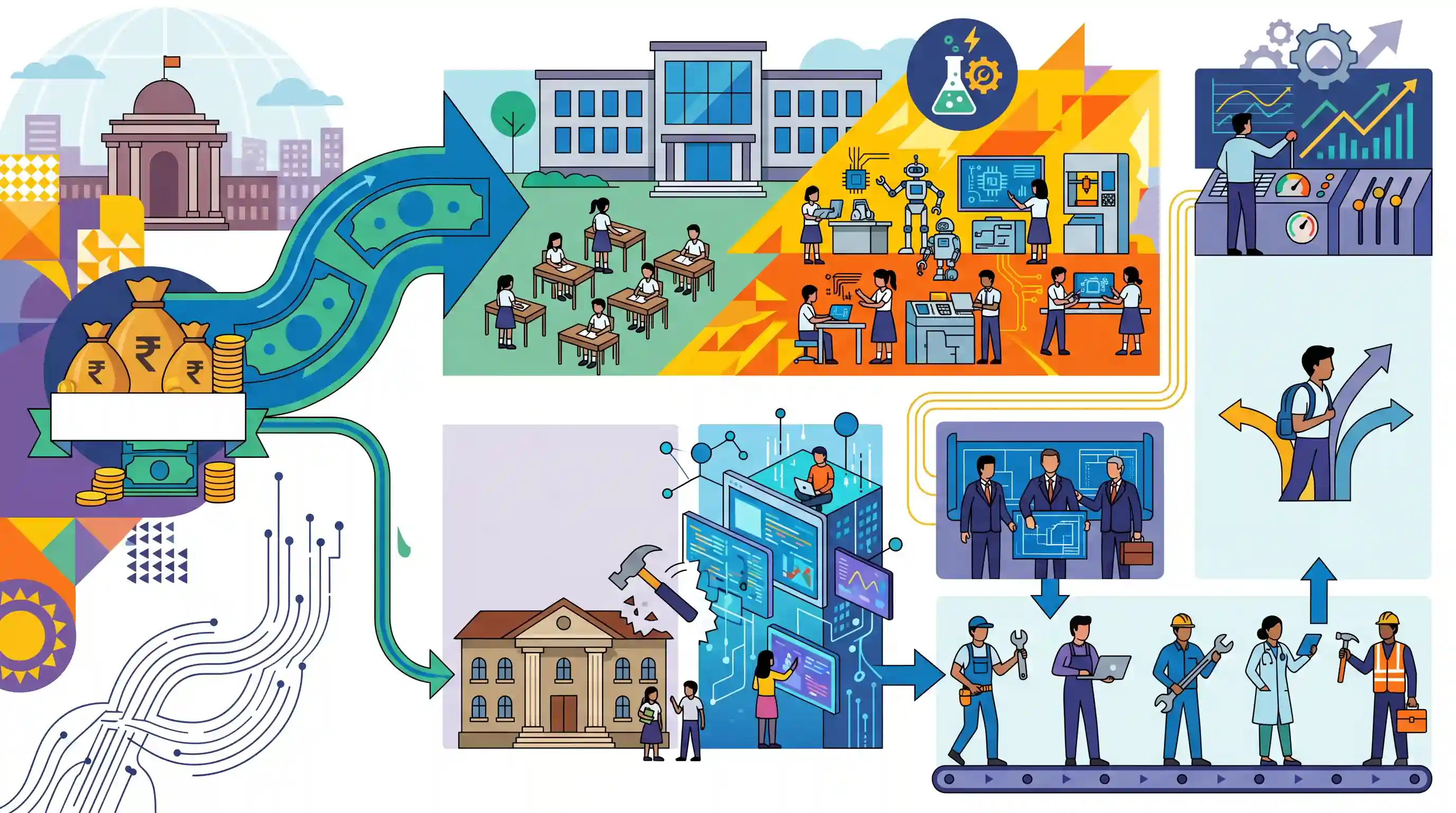
The Union Budget 2026-27 allocates ₹1.39 lakh crore to the Education Ministry, predominantly favouring school education and initiatives like Atal Tinkering Labs. In contrast, traditional higher education institutions saw negligible increases despite a 50% Gross Enrolment Ratio (GER) target. Highlighting a paradigm shift, the Economic Survey suggests a transition toward "learner-centric support" and performance-linked funding, fueled by the "creative destruction" of traditional colleges by edtech platforms. Furthermore, the establishment of a high-power panel to study education-to-employment pathways indicates a growing focus on skill development.
Key Points
- The Union Education Ministry's allocation for FY 2026-27 is ₹1.39 lakh crore, reflecting a 14.21% increase over revised estimates.
- School education received a major boost, with funding for Atal Tinkering Labs jumping significantly from ₹500 crore to ₹3,200 crore.
- Mainstream higher education (traditional colleges and universities) received minimal budgetary commitments, despite a government target of 50% Gross Enrolment Ratio (GER).
- The Economic Survey highlights 'creative destruction' in higher education, anticipating that traditional institutions will face stiff competition from edtech platforms.
- The government is exploring a shift from institution-centric funding to learner-centric support, emphasizing performance-linked funding where students directly choose their content providers.
- A high-power panel has been established to review and enhance education-to-employment pathways.
Important Terms
National Education Policy (NEP) 2020

A comprehensive framework aimed at making India a 'global knowledge superpower' by introducing a 5+3+3+4 school structure and multidisciplinary higher education, replacing the 1986 policy.
UPSC context
GS Paper II (Social Justice/Education). Tests understanding of policy shifts, vocational integration, and institutional restructuring for human capital development.
Gross Enrolment Ratio (GER)
A statistical measure expressing total student enrolment at a specific education level as a percentage of the official school-age population for that level, regardless of the students' actual ages.
UPSC context
GS Paper II (Social Justice). Crucial for interpreting educational accessibility and progress toward NEP targets like 50% higher education GER by 2035.
Atal Tinkering Labs (ATL)
Hands-on school workspaces established under NITI Aayog's Atal Innovation Mission (AIM) to foster curiosity, creativity, and STEM skills like robotics, coding, and design thinking.
UPSC context
GS Paper III (Science & Technology/Innovation). Tests knowledge of grassroots innovation ecosystems and cultivating 'neoteric innovators' at the school level.
Ministry of Education (MoE)
The nodal Union ministry responsible for formulating national policies and overseeing the departments of School Education and Literacy and Higher Education (renamed from MHRD in 2020).
UPSC context
GS Paper II (Governance). Fundamental for understanding the administrative framework of social sector development and human resource management.
National Institute of Public Finance and Policy (NIPFP)
An autonomous research institute under the Ministry of Finance that provides independent analysis on public economics, taxation, and fiscal policy to Central and State governments.
UPSC context
GS Paper III (Economy/Budgeting). Relevant for analyzing fiscal trends, education expenditure, and the efficiency of public spending in social sectors.
Department of School Education and Literacy
A wing of the MoE overseeing primary, secondary, and adult education, responsible for the universalization of education and major schemes like Samagra Shiksha.
UPSC context
GS Paper II (Social Justice). Focuses on specific executive arms managing foundational literacy and the bulk of educational budgetary allocations.
Prelims Trap
"The Economic Survey's 'creative destruction' in education refers to replacing outdated school syllabi."
It actually refers to agile EdTech platforms disrupting traditional brick-and-mortar higher education institutions, not school infrastructure or syllabi.
Static Concepts Connected
What are the key quantitative targets of NEP 2020 regarding GER?
- Higher Education: Increase Gross Enrolment Ratio (GER) in higher education (including vocational education) to 50% by 2035.
- School Education: Achieve 100% GER in preschool to secondary level by 2030.
What is the mandate and nodal agency of Atal Tinkering Labs (ATLs)?
- Nodal Agency: ATLs are established under the Atal Innovation Mission (AIM), which is an initiative of NITI Aayog.
- Objective: To foster curiosity, creativity, and STEM (Science, Technology, Engineering, Math) skills in school students (Class 6-12).
- Vision: To cultivate one million 'neoteric innovators' across India.
Cross-Topic Patterns
Creative Destruction & Schumpeterian Economics
The Economic Survey borrows Schumpeter’s economic concept to describe EdTech disrupting higher ed. Expect GS3 questions linking technological disruption to social sector outcomes.
Skill Deficit vs. Demographic Dividend
The 'education-to-employment' panel directly addresses the India Skills Report findings of low graduate employability, linking GS2 Education to GS3 Demographic Dividend.

'Creative destruction' in EdTech (Economic Survey) is a prime target for a 2026 prelims hybrid Economy/Social Sector question.
Linked PYQs · 3
Linked PYQs · 3
- 2023MainsGS2
Skill development programmes have succeeded in increasing human resources supply to various sectors. In the context of the statement analyse the linkages between education, skill and employment.
- 2015MainsGS2
The quality of higher education in India requires major improvements to make it internationally competitive. Do you think that the entry of foreign educational institutions would help improve the quality of higher and technical education in the country? Discuss.
- 2020MainsGS2
National Education Policy 2020 is in conformity with the Sustainable Development Goal-4 (2030). It intends to restructure and reorient education system in India. Critically examine the statement.
