Education sector sees higher allocations and edtech shifts in Budget
Source:The Hindu ↗
Why It Matters
The article highlights a potential paradigm shift in government education policy—moving from institution-centric funding to learner-centric, performance-linked models driven by EdTech. This policy evolution is critical for GS-2 (Social Sector/Services relating to Education, Human Resources) and intersects with GS-3 (Employment and Skill Development).
Summary
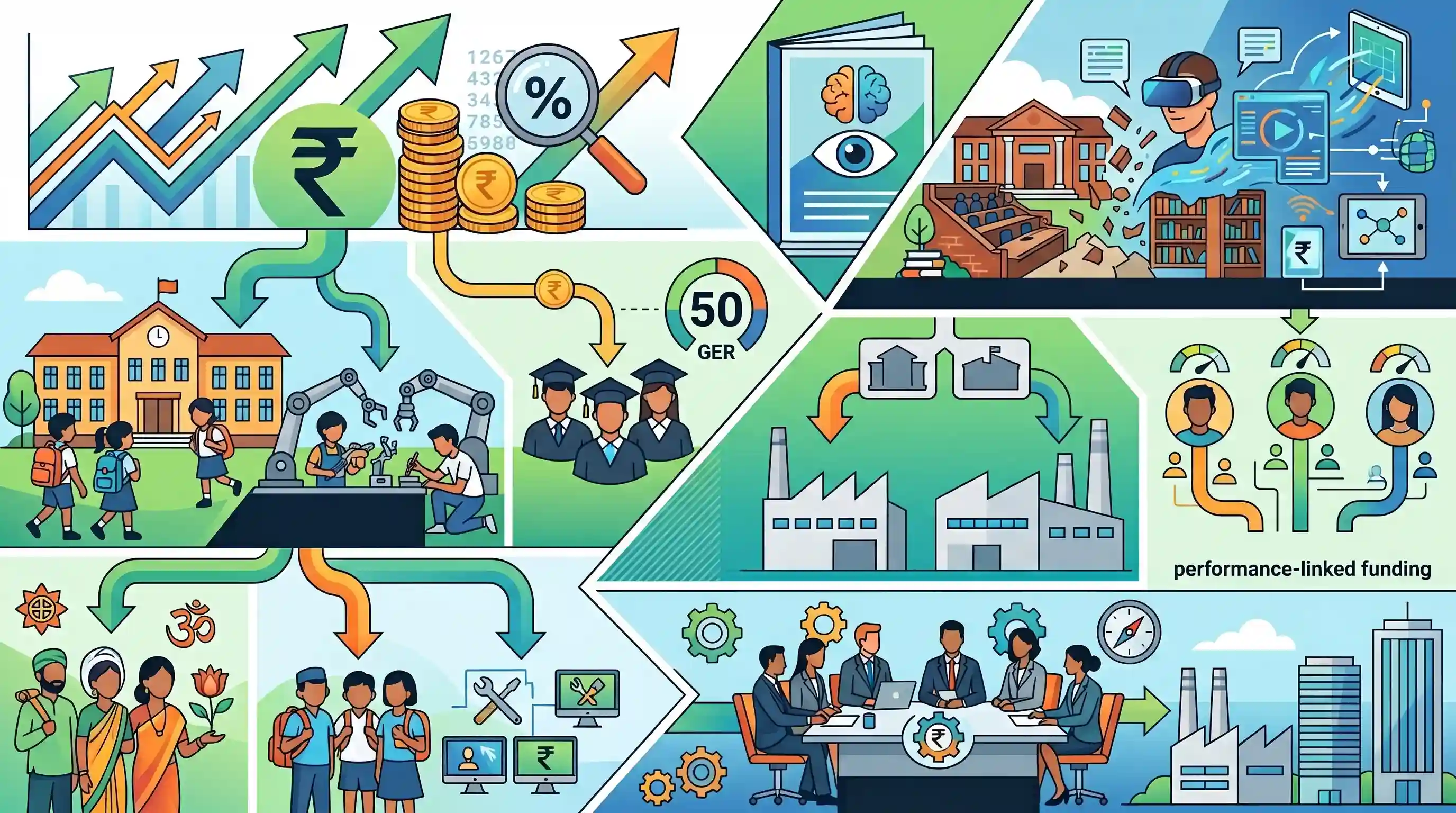
The Union Budget 2026-27 increases the Education Ministry's allocation by 14.21% to ₹1.39 lakh crore, largely benefiting school education and boosting Atal Tinkering Labs funding to ₹3,200 crore. However, mainstream higher education lacks significant new commitments despite a 50% Gross Enrolment Ratio (GER) target. Notably, the Economic Survey signals 'creative destruction' in higher education driven by edtech, proposing a paradigm shift toward learner-centric, performance-linked funding over traditional institution-based support. The Budget also allocates ₹3,400 crore for minority educational and skill schemes and establishes a high-power panel to enhance education-to-employment pathways.
Key Points
- The FY 2026-27 Union Budget allocated ₹1.39 lakh crore to the Education Ministry (a 14.21% increase), focusing heavily on School Education and Literacy.
- Funding for Atal Tinkering Labs jumped significantly from ₹500 crore to ₹3,200 crore.
- Despite the goal of a 50% Gross Enrolment Ratio (GER), core higher education institutions received no major new budgetary commitments.
- The Economic Survey predicts "creative destruction" in higher education, suggesting a shift to learner-centric, performance-linked funding where edtech competes with traditional universities.
- The Budget includes ₹3,400 crore for educational and skill development schemes for six minorities and announces a high-power panel to improve education-to-employment pathways.
Important Terms
Atal Tinkering Labs (ATL)

A flagship NITI Aayog initiative under the Atal Innovation Mission (AIM) that provides workspaces for school students to learn STEM concepts and develop an innovation mindset.
UPSC context
Relevant for GS Paper 2 (Education) and GS Paper 3 (Innovation and Science & Technology). Tests awareness of government-led grassroots innovation.
Gross Enrolment Ratio (GER)
A statistical measure of the total enrolment in a specific level of education (primary, secondary, or tertiary) as a percentage of the eligible age-group population.
UPSC context
Key metric for GS Paper 2 (Social Justice/Education). Tests knowledge of National Education Policy (NEP) 2020 targets (50% by 2035).
Creative Destruction
A Schumpeterian economic theory where new innovations (like EdTech) disrupt and eventually replace established, less efficient market structures or traditional institutional models.
UPSC context
Relevant for GS Paper 3 (Economics). Tests understanding of structural shifts in the economy driven by technology and digitisation.
Performance-linked Funding
A governance model where government grants to educational institutions are determined by measurable outcomes—such as research quality and graduation rates—rather than simply student enrolment numbers.
UPSC context
Significant for GS Paper 2 (Governance/Education). Focuses on fiscal accountability and quality-focused reforms in higher education.
Annual Financial Statement
The constitutional term for the Union Budget, mandated under Article 112, representing the President's estimate of the government's receipts and expenditures for a financial year.
UPSC context
Fundamental for GS Paper 2 (Polity) and GS Paper 3 (Budgeting). Essential for understanding the legislative procedure for passing the budget.
Prelims Trap
"Atal Tinkering Labs (ATLs) are a flagship initiative of the Union Education Ministry funded under the recent Budget."
While the Education Ministry's budget increased, Atal Tinkering Labs (ATLs) are a flagship initiative of the Atal Innovation Mission under NITI Aayog, not the Ministry of Education.
Static Concepts Connected
What is the Gross Enrolment Ratio (GER) and the NEP 2020 target?
- Definition: Total enrolment in a specific level of education, regardless of age, expressed as a percentage of the eligible official school-age population corresponding to the same level.
- NEP Target: The National Education Policy (NEP) 2020 aims to increase the GER in Higher Education (including vocational education) from 26.3% (2018) to 50% by 2035.
What is "Creative Destruction" in economics?
- Origin: Coined by Joseph Schumpeter in 1942.
- Mechanism: The incessant process of industrial mutation that continuously revolutionizes the economic structure from within, destroying the old one and creating a new one.
- Current Application: The Economic Survey uses it to describe how learner-centric EdTech models might disrupt and replace traditional, rigid brick-and-mortar higher education institutions.
Cross-Topic Patterns
EdTech, DPI & Demographic Dividend
The shift towards "learner-centric" EdTech funding aligns with India's broader push for Digital Public Infrastructure (e.g., DIKSHA, SWAYAM) to skill the youth bulge and bypass physical infrastructure bottlenecks.
Minority Skilling & Labour Markets
The ₹3,400 crore allocation ties into the ongoing evolution of minority welfare, shifting from purely academic scholarships to market-linked skilling and livelihood schemes (like Seekho aur Kamao and Nai Manzil).

Expect a Mains question evaluating if 'creative destruction' via EdTech can realistically substitute traditional universities for 50% GER.
Linked PYQs · 5
Linked PYQs · 5
- 2015MainsGS2
The quality of higher education in India requires major improvements to make it internationally competitive. Do you think that the entry of foreign educational institutions would help improve the quality of higher and technical education in the country? Discuss.
- 2023MainsGS2
Skill development programmes have succeeded in increasing human resources supply to various sectors. In the context of the statement analyse the linkages between education, skill and employment.
- 2016MainsGS2
Demographic Dividend in India will remain only theoretical unless our manpower becomes more educated, aware, skilled and creative." What measures have been taken by the government to enhance the capacity of our population to be more productive and employable?
- 2021MainsGS2
“Earn while you learn' scheme needs to be strengthened to make vocational education and skill training meaningful.” Comment.
- 2023MainsGS2
“Development and welfare schemes for the vulnerable, by its nature, are discriminatory in approach.” Do you agree? Give reasons for your answer.
