School Education Budget Allocation and Atal Tinkering Labs
Source:The Hindu ↗
Why It Matters
Government budgeting directly shapes public service delivery. The shift in focus from traditional higher education institutions to school-level innovation (Atal Tinkering Labs) and edtech integration highlights evolving policy priorities that are crucial for GS Paper 2 (Issues relating to development and management of Social Sector/Services relating to Education, Human Resources).
Summary
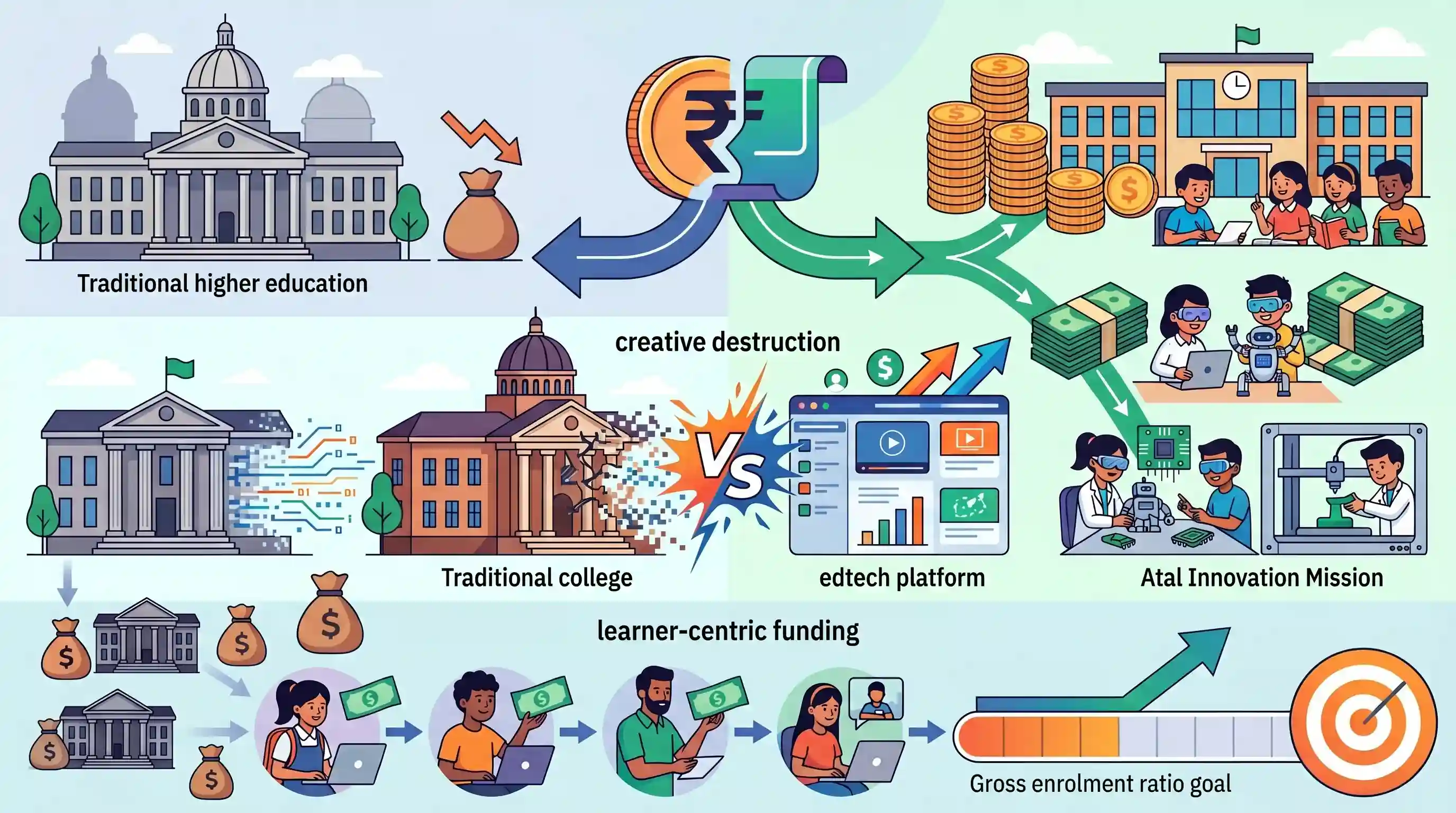
The Union Budget 2026-27 signals a strategic shift in India's education sector, significantly boosting allocations for school education and innovation hubs like Atal Tinkering Labs, while leaving traditional higher education institutions with limited financial support. The government appears to be leaning into the 'creative destruction' model highlighted in the Economic Survey, expecting traditional colleges to compete with edtech platforms. This shift points toward an upcoming transition from institution-centric to learner-centric funding, fundamentally altering how higher education and skill development are supported to achieve the 50% Gross Enrolment Ratio goal.
Key Points
- The Union Budget 2026-27 allocated ₹1.39 lakh crore to the Education Ministry, a 14.21% increase over the previous year's revised estimates.
- A major share of the increased funding was directed towards the Department of School Education and Literacy.
- Funding for Atal Tinkering Labs saw a massive jump from ₹500 crore to ₹3,200 crore to foster innovation at the school level.
- Despite the target of achieving a 50% Gross Enrolment Ratio (GER) in higher education by 2035, there was no significant budgetary push for traditional higher educational institutions.
- The Economic Survey predicts 'creative destruction' in higher education, forecasting fierce competition between edtech platforms and traditional universities, leading to a shift towards learner-centric funding.
Important Terms
Union Budget 2026-27

The annual financial statement for FY 2026-27, emphasizing "Yuva Shakti" with a ~14% increase in education funding, focusing on employability, girls' hostels, and AI-driven skill development.
UPSC context
GS-III (Economy; Budgeting). Tests understanding of fiscal priorities and developmental roadmaps for critical sectors like education.
Atal Tinkering Labs (ATL)
Innovation workspaces in schools established under NITI Aayog to foster curiosity and "neoteric" skills (robotics, IoT, 3D printing) among students from Grade VI to XII.
UPSC context
GS-II (Education) & GS-III (S&T). Relevant for questions on grassroots innovation and human resource development.
Atal Innovation Mission (AIM)
NITI Aayog's flagship initiative (launched 2016) to promote an innovation and entrepreneurship ecosystem through schools (ATLs), universities (AICs), and industries to achieve a "Viksit Bharat."
UPSC context
GS-II (Governance) & GS-III (Innovation). Tests knowledge of institutional frameworks for fostering entrepreneurship.
Gross Enrolment Ratio (GER)
The percentage of students enrolled in a specific level of education relative to the eligible age-group population; NEP 2020 targets 50% for higher education by 2035.
UPSC context
GS-II (Social Justice; Education). A key metric for assessing inclusivity and reach of India’s higher education system.
Creative Destruction
Schumpeterian economic concept where innovation replaces outdated processes; Budget 2026 applies this to education, where edtech and innovation hubs challenge traditional institutional models for better outcomes.
UPSC context
GS-III (Economy). Tests the ability to link economic theory with sector-specific policies and innovation-led growth.
Department of School Education and Literacy (DSEL)
The wing of the Union Education Ministry responsible for elementary and secondary schooling; in Budget 2026, it received ~60% of education funds, largely via education cess.
UPSC context
GS-II (Governance/Education). Relevant for understanding organizational funding and the role of the education cess.
Prelims Trap
The massive Budget allocation for Atal Tinkering Labs is administered by the Higher Education Department to boost university research.
Atal Tinkering Labs target school-level innovation (Class 6-12), not higher education. Furthermore, the Atal Innovation Mission is a flagship initiative of NITI Aayog, not the Ministry of Education.
Static Concepts Connected
What are the key Gross Enrolment Ratio (GER) targets under NEP 2020?
- Higher Education: Aims to increase GER in higher education (including vocational education) from 26.3% (in 2018) to 50% by 2035.
- School Education: Aims to achieve 100% GER in preschool to secondary level by 2030, ensuring universal access to school education.
What is the Atal Innovation Mission (AIM) and what are its core components?
- Nodal Agency: A flagship initiative set up by NITI Aayog to promote innovation and entrepreneurship across the country.
- Atal Tinkering Labs: Dedicated workspaces in schools (Class 6-12) where students learn innovation skills and develop ideas using 3D printers, robotics, and IoT.
- Atal Incubation Centres: Institutions established to foster world-class startups and add value to the innovation ecosystem at the university, NGO, SME, and corporate levels.
Cross-Topic Patterns
Creative Destruction in EdTech and Governance
The Economic Survey applying Schumpeter's "creative destruction" to EdTech disrupting traditional universities signals UPSC's rising interest in how digital public infrastructure and platform economics reshape legacy social sectors.
DBT and Learner-Centric Education Funding
Moving from institutional block grants to "learner-centric funding" mirrors the broader governance shift toward Direct Benefit Transfers (DBT) and demand-side financing like e-RUPI in public service delivery.

Expect a 2026 multi-statement Prelims question mixing NITI Aayog's Atal Innovation Mission, NEP 2020 GER targets, and e-learning schemes.
Linked PYQs · 3
Linked PYQs · 3
- 2023MainsGS2
Skill development programmes have succeeded in increasing human resources supply to various sectors. In the context of the statement analyse the linkages between education, skill and employment.
- 2015MainsGS2
The quality of higher education in India requires major improvements to make it internationally competitive. Do you think that the entry of foreign educational institutions would help improve the quality of higher and technical education in the country? Discuss.
- 2019PrelimsGS1
Atal Innovation Mission is set up under the
