Budget 2026 removes customs duty on critical cancer medications
Source:The Hindu ↗
Why It Matters
Budgetary allocations directly reflect state priorities in social justice and governance. This budget's focus on affordable drugs for non-communicable and rare diseases, coupled with investments in clinical trials and mental health, provides crucial fodder for UPSC answers dealing with the state's role in mitigating healthcare marketization and enhancing universal health coverage.
Summary
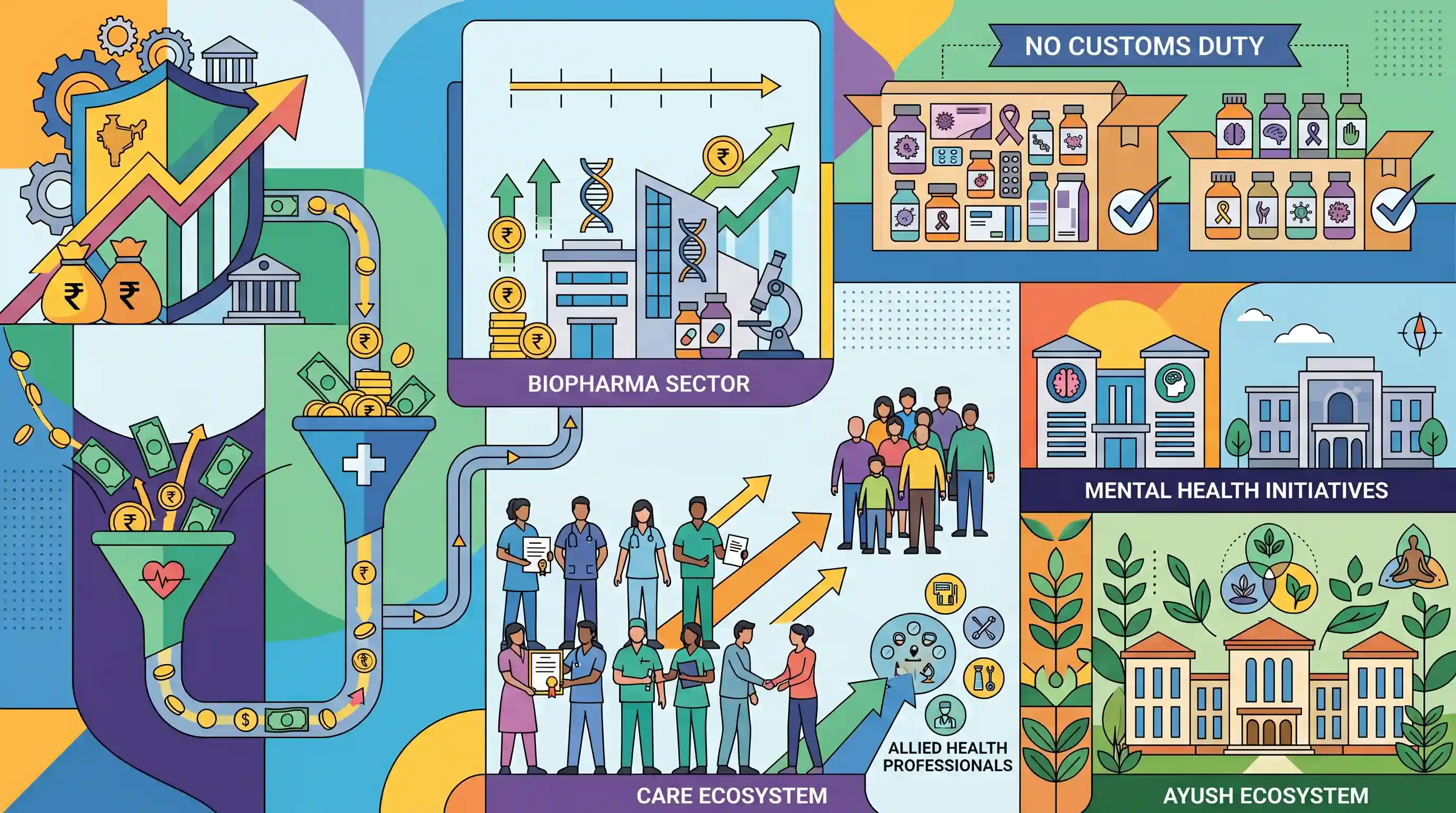
The Union Budget 2026-27 introduces substantial interventions to make life-saving healthcare more affordable and accessible. By removing customs duties on critical cancer and rare disease medications, the government aims to lower out-of-pocket expenditure for severe ailments. Concurrently, the budget outlines an aggressive expansion of healthcare infrastructure and research capabilities, featuring a ₹10,000 crore biopharma investment, new NIPERs, and national mental health institutes. Increased allocations for Ayushman Bharat PM-JAY, alongside targeted skill-building for Allied Health Professionals and caregivers, highlight a strategic shift towards strengthening both specialized medical research and foundational healthcare delivery across India.
Key Points
- Basic customs duty has been completely removed on 17 imported cancer medications, and import duty exemption has been extended to medicines for 7 additional rare diseases for personal use.
- The biopharma sector will receive a ₹10,000 crore investment over five years, alongside the creation of 3 new NIPERs and a nationwide network of 1,000 accredited clinical trial sites.
- The Health Ministry’s overall budget has been raised to ₹1.05 lakh crore, with ₹9,500 crore specifically earmarked for the Ayushman Bharat PM-JAY scheme.
- To boost healthcare human resources, the government aims to train 1.5 lakh caregivers and add 1 lakh Allied Health Professionals (AHPs) over the next five years.
- Significant infrastructure pushes include three new All India Institutes of Ayurveda and two new national mental health institutes in Ranchi and Tezpur to decentralize specialized care.
Important Terms
Union Budget 2026-27

The 'Annual Financial Statement' (Article 112) of India. The 2026-27 budget emphasizes healthcare through tax exemptions, pharmaceutical research investments, and human resource development in the medical sector.
UPSC context
GS Paper II (Government Policies) & III (Indian Economy). Tests knowledge of fiscal policy and social sector priorities.
Ayushman Bharat PM-JAY
The world's largest government-funded health assurance scheme providing ₹5 lakh annual coverage per family for secondary and tertiary care. It targets the bottom 40% of the population.
UPSC context
GS Paper II (Social Justice/Health). Crucial for questions on Universal Health Coverage (UHC) and reducing out-of-pocket expenditure.
Customs Duty
A tax imposed on imported goods. In Budget 2026-27, the removal of this duty on 17 cancer and 7 rare disease drugs directly targets the reduction of healthcare costs for patients.
UPSC context
GS Paper III (Economy). Tests understanding of indirect taxes and trade policy as tools for public welfare.
Biopharma Shakti (SHAKTI)
A ₹10,000 crore budgetary initiative aimed at making India a global biopharma hub. It focuses on biologicals, biosimilars, and R&D for non-communicable diseases like diabetes and cancer.
UPSC context
GS Paper III (Science & Technology/Economy). Relevant for topics on industrial growth, biotechnology, and self-reliance (Atmanirbhar Bharat).
National Institutes of Pharmaceutical Education and Research (NIPER)
Institutes of National Importance (INI) under the Ministry of Chemicals and Fertilizers that provide leadership in pharmaceutical sciences and research to boost high-value drug production in India.
UPSC context
GS Paper II (Education/Health). Tests awareness of institutional frameworks for scientific research and human capital development.
Allied Health Professionals
A diverse healthcare workforce—including physiotherapists, technicians, and nutritionists—distinct from doctors and nurses. They provide critical diagnostic, therapeutic, and rehabilitative services in multidisciplinary teams.
UPSC context
GS Paper II (Social Sector/Health). Tests understanding of healthcare human resources and the 'Continuum of Care' model.
National Institute of Mental Health and Neurosciences (NIMHANS)
An Institute of National Importance in Bengaluru that serves as the apex center for mental health and neurosciences. It is the nodal hub for India's Tele-MANAS mission.
UPSC context
GS Paper II (Social Justice). Relevant for mental health policy, regional healthcare parity, and specialized medical education.
All India Institutes of Ayurveda
Premier autonomous institutes under the Ministry of AYUSH that integrate traditional Ayurvedic knowledge with modern scientific standards to improve global health outcomes and research.
UPSC context
GS Paper II (Health). Tests knowledge of traditional medicine systems and their integration into the national public health framework.
Prelims Trap
"National Institutes of Pharmaceutical Education and Research (NIPER) operate under the Ministry of Health and Family Welfare."
NIPERs are statutory Institutes of National Importance that actually fall under the Ministry of Chemicals and Fertilizers, not the Ministry of Health.
Static Concepts Connected
What are the key features of the National Policy for Rare Diseases, 2021?
- Classification: Classifies diseases into 3 groups based on treatability and cost constraints.
- Financial Support: Provides up to ₹50 lakh per patient for treatment at Centers of Excellence under the Rashtriya Arogya Nidhi.
- Crowdfunding Mechanism: Includes a digital portal to facilitate voluntary corporate and individual donations for treatment costs.
How does Out-of-Pocket Expenditure (OOPE) impact India's healthcare landscape?
- Definition: Direct payments made by individuals to healthcare providers at the time of service, bypassing insurance.
- Catastrophic Burden: Currently at ~39.4% of Total Health Expenditure, OOPE is the primary driver of medical impoverishment in India.
- Mitigation Strategy: Targeted through schemes like PM-JAY and customs duty exemptions on critical imported drugs.
Cross-Topic Patterns
Customs waivers as health policy
Using tariff tools (customs duty removal) to bypass domestic manufacturing constraints for life-saving drugs is a recurring theme bridging international trade policy and domestic health governance.
Allied Healthcare and Demographic Dividend
Expanding Allied Health Professionals (AHPs) links health sector demands directly to the Skill India mission, targeting the caregiver export market for aging Western demographics.

Expect a Prelims question combining NIPERs' nodal ministry (Chemicals/Fertilizers) with the National Policy for Rare Diseases provisions.
Linked PYQs · 3
Linked PYQs · 3
- 2024MainsGS2
In a crucial domain like the public healthcare system the Indian State should play a vital role to contain the adverse impact of marketisation of the system. Suggest some measures through which the State can enhance the reach of public healthcare at the grassroots level.
- 2021MainsGS2
“Besides being a moral imperative of a Welfare State, primary health structure is a necessary precondition for sustainable development.” Analyze.
- 2020MainsGS2
In order to enhance the prospects of social development, sound and adequate health care policies are needed particularly in the fields of geriatric and maternal health care. Discuss.
