Customs Duty Exemptions on Cancer Drugs and Rare Diseases
Source:The Hindu ↗
Why It Matters
The Budget introduces critical interventions directly relevant to GS2 (Healthcare and Human Resources) and GS3 (Biotechnology and Pharmaceuticals). The focus on mental health infrastructure, domestic biopharma manufacturing, and affordability of critical life-saving drugs represents a major shift toward addressing complex public health and tertiary care challenges.
Summary
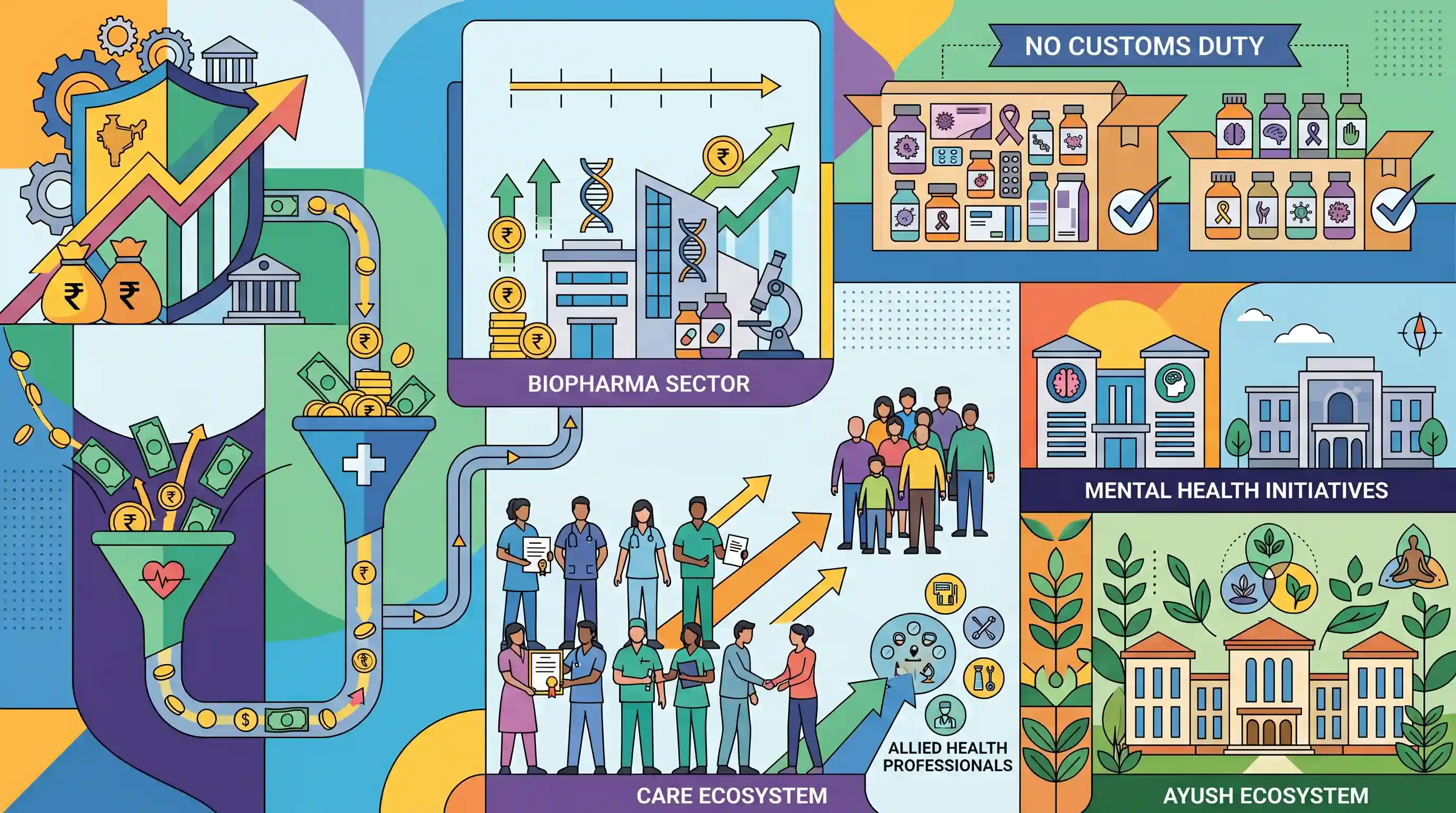
The Union Budget 2026-27 has introduced significant interventions in the healthcare and pharmaceutical sectors. In a move to provide immediate relief, the government has fully exempted basic customs duty on 17 cancer medicines and added seven more rare diseases to the import duty exemption list. The Budget allocated ₹1.05 lakh crore to the Health Ministry and proposed a major ₹10,000 crore investment in the biopharma sector over the next five years. Addressing the need for robust care ecosystems, the government plans to train 1.5 lakh multi-skilled caregivers and expand the Allied Health Professionals workforce. Significant infrastructural developments include establishing two new national mental health institutes, a new NIMHANS campus in North India, and three new All India Institutes of Ayurveda to bolster the AYUSH ecosystem.
Key Points
- Basic customs duty has been completely removed on 17 cancer-related drugs, and import duty exemption has been extended to seven additional rare diseases.
- The government proposed a ₹10,000 crore investment in the biopharma sector over five years to boost India's pharmaceutical industry.
- The Health Ministry has been allocated ₹1.05 lakh crore for FY 2026-27, with Ayushman Bharat PM-JAY receiving ₹9,500 crore.
- Mental healthcare access will be expanded with the establishment of two new national mental health institutes in Ranchi and Tezpur, and a second NIMHANS campus in North India.
- The budget focuses on expanding the allied health workforce, aiming to train 1.5 lakh caregivers and upgrade existing institutions for Allied Health Professionals (AHPs).
- The AYUSH ecosystem will see the establishment of three new All India Institutes of Ayurveda, with the ministry's allocation rising to ₹4,408.93 crore.
Important Terms
Ayushman Bharat PM-JAY

The world's largest government-funded health assurance scheme, providing ₹5 lakh annual cover per family for secondary and tertiary care hospitalization to poor and vulnerable families.
UPSC context
GS Paper II (Health/Governance); tests understanding of Universal Health Coverage and social welfare schemes.
National Skills Qualifications Framework (NSQF)
A competency-based framework that organizes qualifications according to levels (1-10) of knowledge, skills, and aptitude, bridging the gap between vocational and academic education.
UPSC context
GS Paper II/III (Skill Development/Economy); tests human resource policy and workforce employability.
National Institute of Mental Health and Neurosciences (NIMHANS)
India's apex multidisciplinary center for mental health education, research, and clinical care; designated as an Institute of National Importance under the Ministry of Health.
UPSC context
GS Paper II (Health); focuses on institutional frameworks for mental health and specialized healthcare infrastructure.
Ministry of AYUSH
A dedicated Union ministry responsible for developing education, research, and propagation of traditional medicine systems: Ayurveda, Yoga, Naturopathy, Unani, Siddha, Sowa-Rigpa, and Homoeopathy.
UPSC context
GS Paper II (Health/Education); relevant for integrated medicine and traditional knowledge protection.
National Institutes of Pharmaceutical Education and Research (NIPER)
A group of autonomous institutes of national importance focused on advanced pharmaceutical education and research to support India's pharmaceutical industry.
UPSC context
GS Paper II/III (Pharma/Economy); tests R&D policy and pharmaceutical sector growth strategies.
Ministry of Health and Family Welfare (MoHFW)
The primary government body responsible for national health policies, family planning, medical education regulation, and the implementation of national health missions.
UPSC context
GS Paper II (Governance); tests structure and functioning of executive ministries in social sectors.
Prelims Trap
"Customs duty exemptions on rare disease drugs are administered as a sub-component of Ayushman Bharat PM-JAY."
Rare disease financial support and import exemptions operate under the National Policy for Rare Diseases (NPRD) and Rashtriya Arogya Nidhi, which are entirely separate from PM-JAY.
Static Concepts Connected
What is the National Policy for Rare Diseases (NPRD), 2021?
- Classification: Categorizes rare diseases into three groups based on whether they require one-time curative treatment, long-term care, or definitive treatment.
- Financial Support: Provides up to ₹50 lakh for treatment at Centers of Excellence under the Rashtriya Arogya Nidhi (RAN) scheme.
- Crowdfunding: Features a digital portal to facilitate voluntary corporate and individual donations for expensive rare disease treatments.
What distinguishes 'Biopharma' from traditional pharmaceuticals?
- Biological Origin: Biopharmaceuticals are derived from living organisms (cells, bacteria, yeast) rather than synthesized from chemical compounds.
- Structural Complexity: They involve large, complex molecules (like monoclonal antibodies) making them much harder to replicate (biosimilars) than traditional generics.
- Targeted Efficacy: Highly effective in targeted therapy for conditions like cancers and autoimmune diseases, driving modern pharmaceutical growth.
Cross-Topic Patterns
Biopharma + API Dependency
The ₹10,000 Cr biopharma investment aims to shift India from low-margin generic manufacturing to high-value innovation, reducing over-reliance on Chinese Active Pharmaceutical Ingredients (APIs).
Mental Health + Demographic Dividend
Establishing new NIMHANS campuses addresses India's rising mental health burden (DALYs), which directly impacts workforce productivity and the demographic dividend.
Care Economy + Women's Employment
Training 1.5 lakh multi-skilled caregivers formalizes the 'care economy', creating significant organized-sector employment opportunities, a sector predominantly driven by women.

Biopharma definitions and the National Policy for Rare Diseases are prime targets for a multi-statement Prelims question in 2026.
Linked PYQs · 3
Linked PYQs · 3
- 2020MainsGS2
In order to enhance the prospects of social development, sound and adequate health care policies are needed particularly in the fields of geriatric and maternal health care. Discuss.
- 2021MainsGS2
“Besides being a moral imperative of a Welfare State, primary health structure is a necessary precondition for sustainable development.” Analyze.
- 2021MainsGS3
What are the research and developmental achievements in applied biotechnology? How will these achievements help to uplift the poorer sections of the society?
