Budget 2026 prioritizes industrial expansion to drive employment
Source:The Hindu ↗
Why It Matters
The Union Budget outlines the government's economic vision and spending priorities. Its focus on industrial growth, capital expenditure, and schemes like PLI directly intersects with core GS3 syllabus themes such as industrial policy, infrastructure, and employment generation. Understanding these dynamics is essential for analyzing India's trajectory toward inclusive growth and evaluating government macroeconomic interventions.
Summary
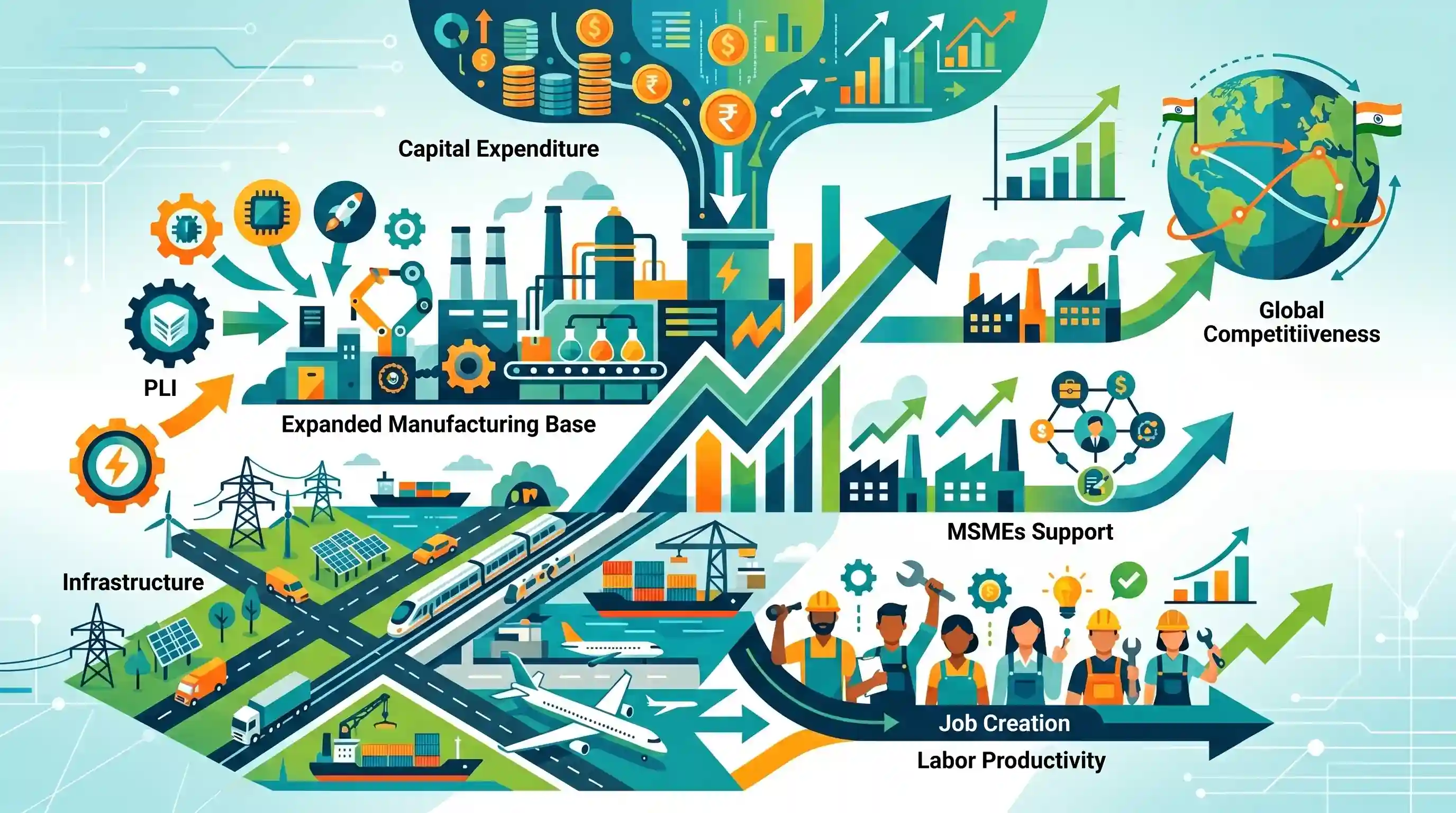
The Union Budget 2026 lays a strong emphasis on industrial growth as a primary engine for India's macroeconomic development. By sustaining its focus on capital expenditure, infrastructure, and flagship manufacturing programs like the Production Linked Incentive (PLI) scheme, the government aims to significantly expand the domestic manufacturing base. Crucially, the budget's policy direction links industrial expansion with job creation, seeking to support MSMEs and improve labor productivity. This approach addresses the dual challenges of ensuring inclusive economic growth and enhancing India's competitiveness in global supply chains.
Key Points
- The Union Budget 2026-27 prioritizes capital expenditure to stimulate robust industrial growth and comprehensive infrastructure development.
- A central economic strategy involves expanding India's manufacturing base through initiatives like the Production Linked Incentive (PLI) scheme to enhance domestic output and global export share.
- Promoting the Micro, Small and Medium Enterprises (MSME) sector is highlighted as essential for widespread employment generation and inclusive economic progress.
- The budget reflects a policy imperative to align large-scale capital investments with labor productivity to create more jobs and mitigate the risks of 'jobless growth'.
Important Terms
Union Budget

Known constitutionally as the 'Annual Financial Statement' (Article 112), it details the government’s estimated receipts and expenditures, reflecting its fiscal policy and developmental priorities for the upcoming financial year.
UPSC context
GS Paper III: Government Budgeting. Tests understanding of fiscal management, resource mobilization, and macroeconomic policy frameworks.
Production Linked Incentive (PLI) Scheme
A performance-based incentive program offering financial rewards to domestic and foreign companies based on their incremental production and sales within India to boost global competitiveness in strategic sectors.
UPSC context
GS Paper III: Industrial Growth. Tests knowledge of manufacturing incentives and strategies to integrate India into global supply chains.
Capital Expenditure (Capex)
Government spending on the creation, acquisition, or upgrading of long-term physical assets like infrastructure, characterized by a high 'multiplier effect' that stimulates private investment and overall economic productivity.
UPSC context
GS Paper III: Mobilization of Resources. Tests understanding of public investment as a catalyst for long-term growth and infrastructure development.
MSMEs
Micro, Small, and Medium Enterprises, classified by investment and turnover limits, which act as the 'backbone' of the economy by significantly contributing to employment, GDP, and total exports.
UPSC context
GS Paper III: Employment and Inclusive Growth. Tests awareness of the sector’s socio-economic role and challenges in balanced regional development.
Make in India
A flagship national initiative launched in 2014 to transform India into a global manufacturing hub by facilitating investment, fostering innovation, protecting intellectual property, and building best-in-class manufacturing infrastructure.
UPSC context
GS Paper III: Industrial Policy. Tests knowledge of reforms aimed at increasing manufacturing's GDP share and improving ease of doing business.
Prelims Trap
Jobless growth refers to an economic stagnation where both GDP growth and employment generation decline simultaneously.
Jobless growth actually means real GDP is growing, but it is driven by capital-intensive sectors or automation, failing to generate proportional employment.
Static Concepts Connected
How does Capital Expenditure differ from Revenue Expenditure in Government Budgeting?
- Capital Expenditure: Money spent on creating physical/financial assets or reducing liabilities. It has a high macroeconomic multiplier and builds long-term productive capacity.
- Revenue Expenditure: Recurring expenses that neither create assets nor reduce liabilities (e.g., salaries, interest payments, subsidies), offering limited long-term economic multipliers.
What are the structural features of the Production Linked Incentive (PLI) scheme?
- Incremental Sales: Provides a direct financial incentive (usually 4-6%) based on incremental sales of targeted goods manufactured domestically over a designated base year.
- Supply Chain Integration: Designed to attract large-scale foreign investment, nurture domestic champion sectors, and integrate India into global supply chains.
Cross-Topic Patterns
Demographic Dividend & Industrial Policy
Transitioning surplus agricultural labor to manufacturing requires MSME growth and PLI expansion, linking GS1 population dynamics directly to GS3 macroeconomic strategies.
DPI and MSME Formalization
Budgetary support for MSMEs increasingly relies on Digital Public Infrastructure (Udyam, TReDS, OCEN) to solve the chronic credit-gap problem and fuel labor-intensive growth.

Capex multiplier, PLI's incremental sales criteria, and jobless growth anomalies are highly likely to form a core GS3 prelims question.
Linked PYQs · 5
Linked PYQs · 5
- 2025MainsGS3
Discuss the rationale of the Production Linked Incentive (PLI) scheme. What are its achievements? In what way can the functioning and outcomes of the scheme be improved?
- 2021MainsGS3
“Investment in infrastructure is essential for more rapid and inclusive economic growth.” Discuss in the light of India's experience.
- 2021MainsGS3
Distinguish between Capital Budget and Revenue Budget. Explain the components of both these Budgets.
- 2022MainsGS3
Economic growth in the recent past has been led by increase in labour productivity." Explain this statement. Suggest the growth pattern that will lead to creation of more jobs without compromising labour productivity.
- 2015MainsGS3
Success of 'Make in India' programme depends on the success of 'Skill India' programme and radical labour reforms." Discuss with logical arguments.
