Gender Budgeting and Social Sector Outlays in Union Budget
Source:Indian Express ↗
Why It Matters
It demonstrates the difference between mere budget allocation and actual welfare outcomes, making it a critical case study for GS Paper 2 topics like 'Welfare schemes for vulnerable sections' and 'Issues relating to development and management of Social Sector/Services relating to Health, Education, Human Resources.'
Summary
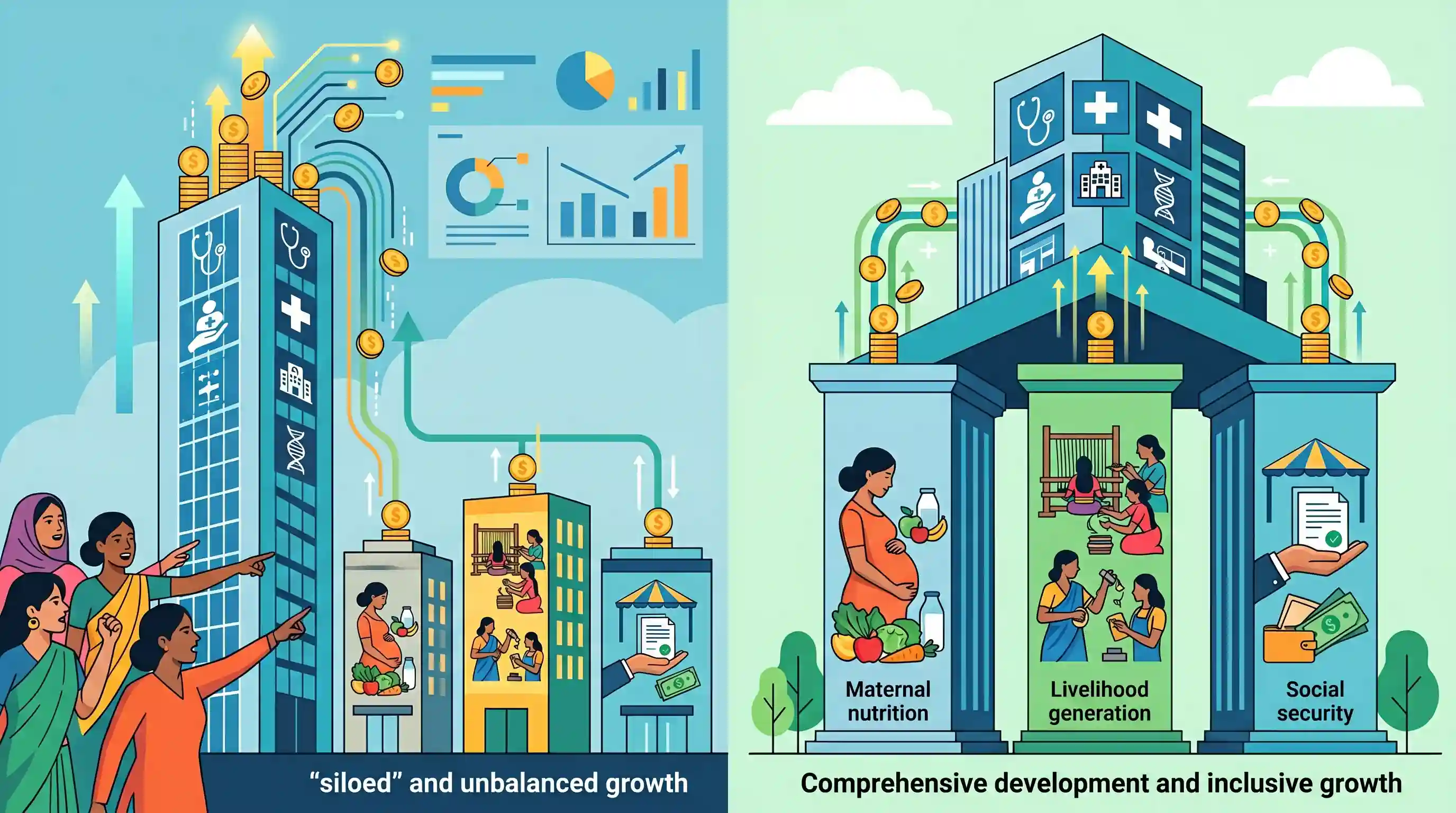
Women’s rights advocates have pointed out that despite an increased health outlay in the 2026-27 Budget, funding for dedicated women's welfare and empowerment schemes remains stagnant. This disparity exposes gaps in effective Gender Budgeting and underscores the argument that public health improvements cannot be achieved in silos. Comprehensive development and inclusive growth require robust, parallel investments in the broader social determinants of health, including maternal nutrition, livelihood generation, and social security for women.
Key Points
- The 2026-27 Budget introduces a higher overall outlay for the health sector, indicating a policy focus on strengthening healthcare infrastructure.
- Despite the increased health budget, women's groups emphasize that core allocations for women's welfare, empowerment, and safety schemes have stagnated in real terms.
- Activists stress that comprehensive development requires addressing the social determinants of health—such as nutrition, livelihood, and financial security—rather than relying solely on medical outlays.
- The situation highlights the limitations in the current implementation of Gender Budgeting, calling for outcome-focused financial tracking to ensure inclusive growth.
Important Terms
Gender Budgeting

A fiscal tool that integrates gender perspectives into the budgeting process to ensure public resources promote gender equality and empower women. It involves creating a dedicated Gender Budget Statement (GBS).
UPSC context
GS Paper 3 (Economy) and GS Paper 2 (Governance); tests understanding of inclusive growth and gender-responsive fiscal policy.
National Health Mission (NHM)
A flagship initiative launched to provide universal, affordable, and quality healthcare. It subsumes the Rural and Urban Health Missions, focusing significantly on reproductive, maternal, neonatal, and child health (RMNCH+A).
UPSC context
GS Paper 2 (Social Justice - Health); tests knowledge of government interventions in the social sector and health infrastructure.
Social Justice
The fair distribution of wealth, opportunities, and privileges within society. It aims to rectify historical inequalities through affirmative action and targeted welfare for vulnerable groups like women and minorities.
UPSC context
GS Paper 1 (Society) and GS Paper 2 (Governance); a core constitutional objective and frequent theme in Mains essays.
Welfare Schemes
Targeted government programs designed to provide a social safety net and uplift vulnerable sections (e.g., women, elderly, SC/STs). They focus on livelihoods, nutrition, and financial inclusion.
UPSC context
GS Paper 2 (Government Policies); tests critical analysis of scheme performance, implementation gaps, and impact on the marginalized.
Women’s Empowerment
The process of enhancing women's social, economic, and political status to ensure they have the agency to make life choices and participate equally in development.
UPSC context
GS Paper 2 (Issues related to Women); a primary lens for analyzing development indicators and legislative reforms.
Prelims Trap
"The Gender Budget is a separate, dedicated parallel fund established annually under the Union Budget."
Gender budgeting is merely an analytical accounting mechanism to track expenditure across various ministries. It is not a separate parallel budget or fund.
Static Concepts Connected
What is the structural framework of India's Gender Budget?
- Part A schemes: Programs with 100% allocation specifically targeted at women, such as schemes for women's safety or dedicated working women's hostels.
- Part B schemes: Programs where at least 30% of the financial allocation is earmarked for women, such as PM Awas Yojana or MGNREGA.
How does Output Budgeting differ from Outcome Budgeting?
- Output Budgeting: Measures physical targets achieved or funds disbursed, such as the number of clinics built or scholarships distributed.
- Outcome Budgeting: Evaluates the actual socio-economic impact or qualitative end-result of an intervention, such as a measurable decline in maternal mortality rates.
Cross-Topic Patterns
Social Determinants of Health
UPSC frequently links health outcomes not just to medical infrastructure, but to non-medical welfare interventions like maternal nutrition, sanitation, and women's financial autonomy.
Multidimensional Poverty & Gender
Stagnant welfare allocations impact MPI indicators directly. UPSC tests this overlap by connecting women's livelihood schemes (like SHGs) to broader national poverty alleviation targets.

Expect a Prelims question on Gender Budget (Part A vs B) and a Mains question on the shift from output-based to outcome-based tracking.
Linked PYQs · 4
Linked PYQs · 4
- 2024MainsGS3
Examine the pattern and trend of public expenditure on social services in the post-reforms period in India. To what extent this has been in consonance with achieving the objective of inclusive growth?
- 2021MainsGS2
“Though women in post-Independent India have excelled in various fields, the social attitude towards women and feminist movement has been patriarchal." Apart from women education and women empowerment schemes, what interventions can help change this milieu?
- 2021MainsGS2
“Besides being a moral imperative of a Welfare State, primary health structure is a necessary precondition for sustainable development.” Analyze.
- 2020MainsGS2
In order to enhance the prospects of social development, sound and adequate health care policies are needed particularly in the fields of geriatric and maternal health care. Discuss.
