Budget 2026-27 Priorities Balancing Growth Capex And Fiscal Deficit
Source:The Hindu ↗
Why It Matters
Understanding the nuances of budget making, capital vs revenue expenditure, and fiscal consolidation is central to the UPSC GS-3 syllabus, especially for evaluating the government's economic management.
Summary
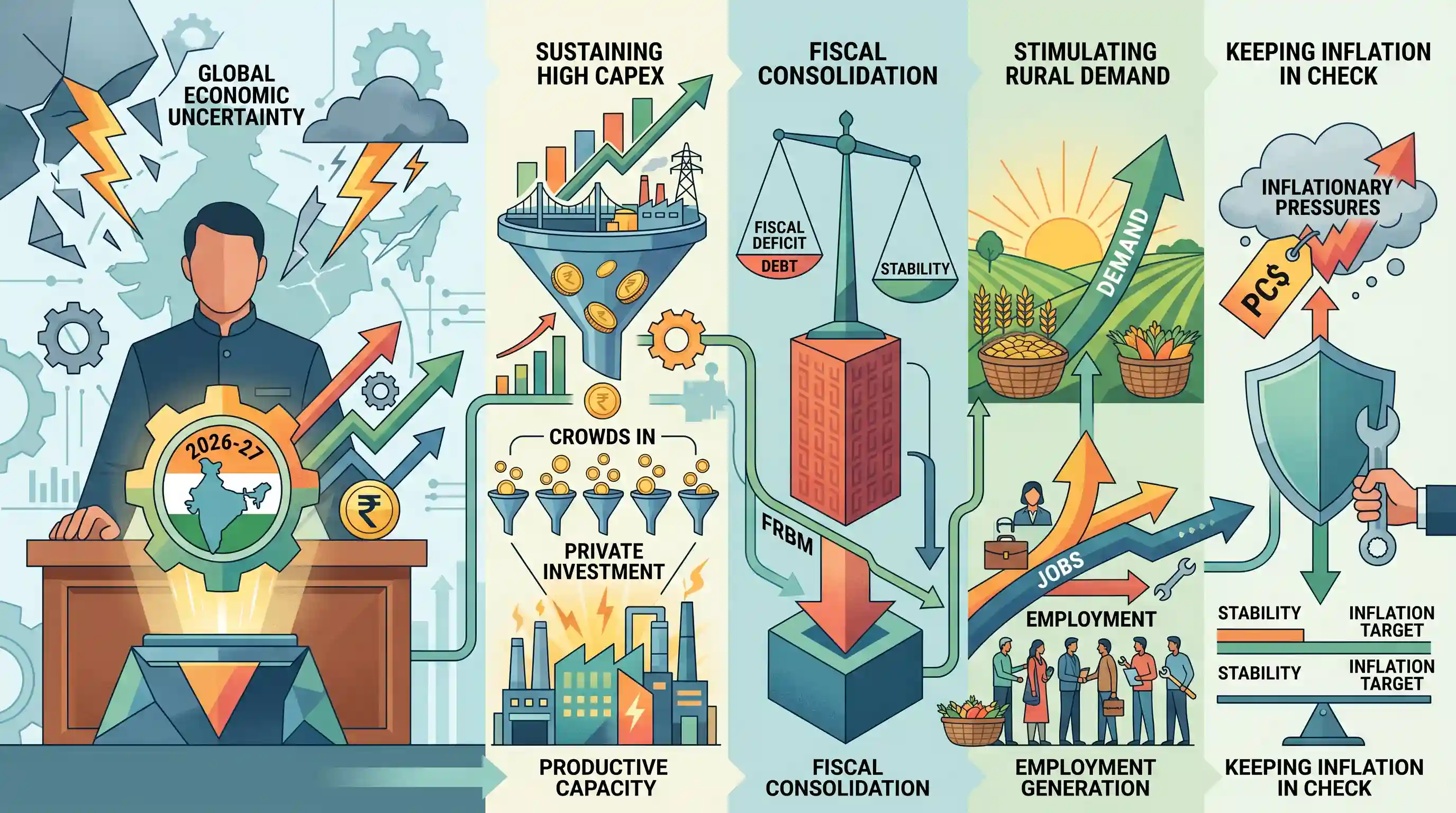
As preparations for the Union Budget 2026-27 begin, economic discourse highlights the necessity of maintaining India's growth momentum amidst global economic uncertainties. A key priority is sustaining high levels of capital expenditure to crowd in private investment, thereby expanding productive capacity. Simultaneously, the government must adhere to its fiscal consolidation commitments, charting a clear glide path for reducing the fiscal deficit under the FRBM framework. Policymakers face the dual challenge of stimulating rural demand and employment generation while keeping inflationary pressures in check to ensure long-term macroeconomic stability.
Key Points
- The upcoming Union Budget 2026-27 needs to balance growth momentum with strict fiscal consolidation to maintain macroeconomic stability.
- Sustaining capital expenditure (capex) remains critical for structural economic growth and to crowd in private investment.
- The government must ensure adherence to the fiscal deficit glide path to keep borrowing costs manageable and maintain investor confidence.
- Targeted interventions are required to boost rural consumption, generate employment, and manage persistent inflationary pressures.
Important Terms
Fiscal Responsibility and Budget Management (FRBM) Act

A 2003 law mandating fiscal discipline by setting targets for deficit reduction and debt-to-GDP ratios to ensure long-term macroeconomic stability.
UPSC context
GS Paper III: Essential for topics on Government Budgeting and fiscal consolidation frameworks.
Union Budget
Constitutionally known as the Annual Financial Statement (Article 112), it details the government's estimated receipts and expenditure for a financial year.
UPSC context
GS Paper III: Core topic for Indian Economy, covering resource mobilization and development planning.
Fiscal Deficit
The excess of the government's total expenditure over its total non-borrowed receipts, indicating the total borrowing requirement for the year.
UPSC context
GS Paper III: A primary indicator of fiscal health and macroeconomic stability frequently tested in Prelims.
Capital Expenditure (Capex)
Government spending on asset creation (e.g., infrastructure), which increases productive capacity and generates long-term economic returns.
UPSC context
GS Paper III: Critical for understanding growth drivers and investment-led economic models.
Crowding In
A phenomenon where increased public investment (like infrastructure) improves the business environment, thereby encouraging and increasing private sector investment.
UPSC context
GS Paper III: Tests conceptual understanding of the multiplier effect and public-private synergy.
Fiscal Glide Path
The planned multi-year roadmap for the steady reduction of the fiscal deficit toward a sustainable target (e.g., 4.5% by FY26).
UPSC context
GS Paper III: Relevant for questions on fiscal consolidation and long-term debt sustainability.
Prelims Trap
Increased government spending inevitably leads to the 'crowding out' of private sector investment.
This ignores expenditure quality. While revenue expenditure can 'crowd out', capital expenditure on physical infrastructure lowers business costs, actively 'crowding in' private investment.
Static Concepts Connected
What differentiates Capital Expenditure from Revenue Expenditure?
- Asset Creation: Capital expenditure creates physical or financial assets, or reduces government liabilities. Revenue expenditure does neither.
- Routine vs Structural: Revenue spending manages daily operations like salaries, pensions, and subsidies. Capex builds long-term productive infrastructure capacity.
What are the core mechanisms of the FRBM Act?
- Fiscal Glide Path: A legally mandated, multi-year timeline to progressively reduce the gross fiscal deficit and revenue deficit as a percentage of GDP.
- Escape Clause: Permits government deviation from fiscal targets (up to 0.5% of GDP) during severe structural shocks, natural calamities, or national security crises.
Cross-Topic Patterns
Fiscal expansion vs RBI's MPC mandate
Uncalibrated fiscal stimulus to boost rural demand can trigger structural food inflation, directly undermining the RBI Monetary Policy Committee's inflation-targeting mandate.
Deficit management & global sovereign ratings
Deviating from the FRBM glide path risks sovereign rating downgrades, which increases external sovereign borrowing costs and can trigger FPI outflows.

Expect a statement-based question linking the 'crowding-in' effect of public capex to the FRBM glide path and private investment trends.
Linked PYQs · 4
Linked PYQs · 4
- 2021MainsGS3
Distinguish between Capital Budget and Revenue Budget. Explain the components of both these Budgets.
- 2019MainsGS3
The public expenditure management is a challenge to the Government of India in the context of budget making during the post-liberalization period. Clarify it.
- 2013MainsGS3
What were the reasons for the introduction of Fiscal Responsibility and Budget Management (FRBM) Act, 2003 ? Discuss critically its salient features and their effectiveness.
- 2025MainsGS3
Explain how the Fiscal Health Index (FHI) can be used as a tool for assessing the fiscal performance of states in India. In what way would it encourage the states to adopt prudent and sustainable fiscal policies?
