Foreign Aid Allocations and Regional Strategic Connectivity
Source:Indian Express ↗
Why It Matters
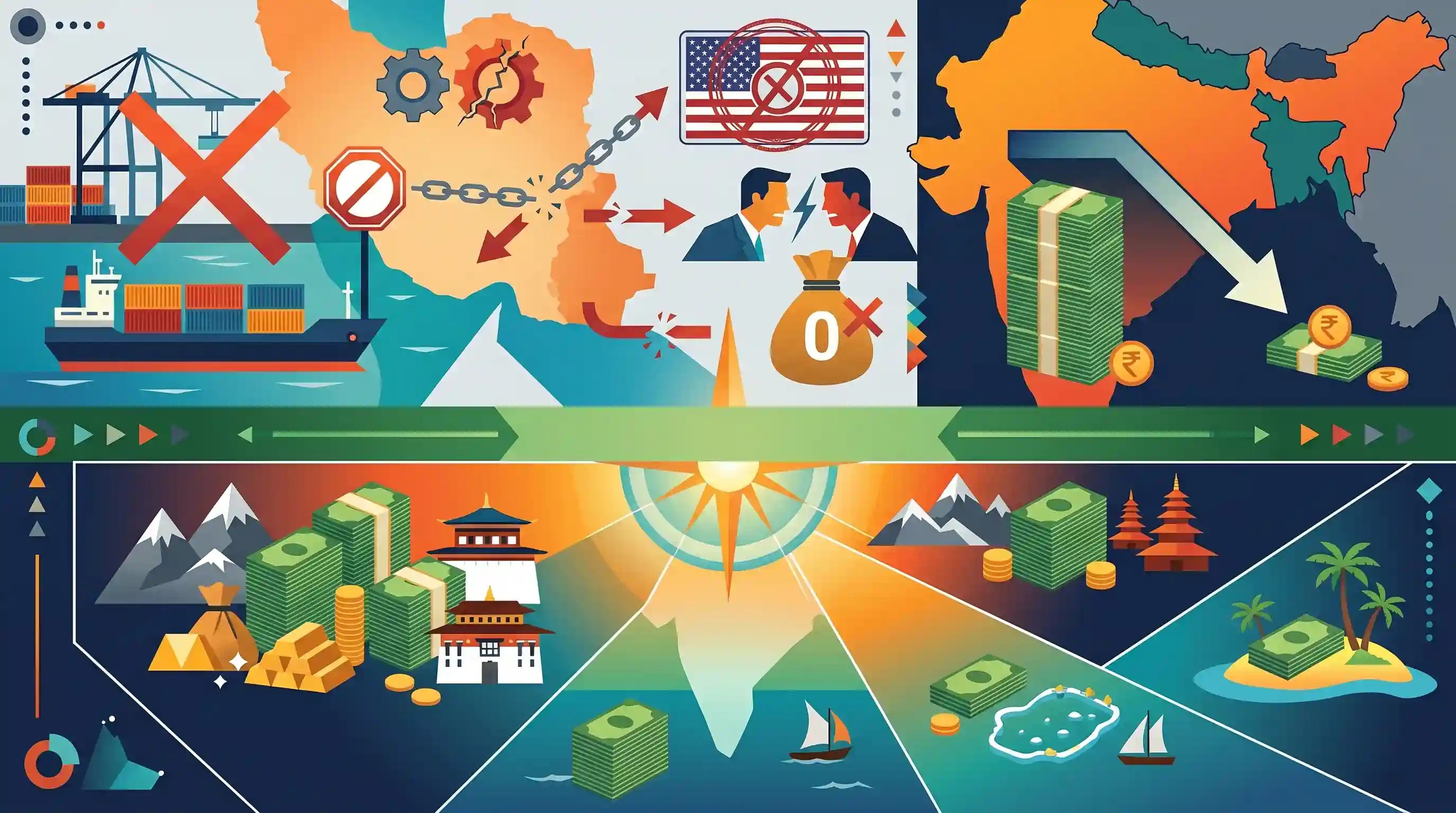
The budget allocations for the MEA serve as a diplomatic barometer. The defunding of the Chabahar project illustrates how international pressures (US sanctions) constrain India's strategic connectivity ambitions in Central Asia. The altered foreign aid distributions also reflect the real-time health of India's bilateral relationships in its immediate neighbourhood.
Summary
The Union Budget 2026-27 reflects notable shifts in India's foreign policy and development assistance, prominently marked by a zero allocation for the Chabahar port project in Iran. This halt follows the impending end of a US sanctions waiver and strained ties, stopping an annual commitment that historically supported connectivity in Sistan-Balochistan. Furthermore, development aid to Bangladesh has been slashed by half to Rs 60 crore. Meanwhile, the 'Neighbourhood First' policy remains strong for other nations, with Bhutan taking the lion's share of foreign aid (Rs 2,288 crore), followed by Nepal, Mauritius, and the Maldives.
Key Points
- The Ministry of External Affairs (MEA) has been allocated Rs 22,118 crore in the Union Budget 2026-27.
- India has cut its funding for the Chabahar port project in Iran to zero, down from Rs 400 crore (revised estimate) last year, due to US economic sanctions and strained bilateral ties.
- The six-month exemption granted by the US to India for the Chabahar project ends on April 26, 2026.
- Development assistance to Bangladesh has been slashed by half to Rs 60 crore from Rs 120 crore amid strained relations.
- Bhutan receives the largest share of foreign aid (Rs 2,288 crore), followed by Nepal (Rs 800 crore), and Mauritius and Maldives (Rs 550 crore each).
Important Terms
Union Budget 2026-27

India's annual financial statement for fiscal year 2026-27, detailing government revenue and expenditure, emphasizing fiscal consolidation, infrastructure, and a recalibrated 'Neighbourhood First' foreign aid strategy.
UPSC context
GS Paper III (Economy) and GS Paper II (Polity/Budgeting). Essential for understanding fiscal policy and sectoral allocations.
Ministry of External Affairs (MEA)
The government agency responsible for India's foreign relations, managing overseas development assistance (ODA) and diplomatic missions, with a 2026-27 outlay of ₹22,118 crore.
UPSC context
GS Paper II (International Relations). Relevant for institutional framework of foreign policy and diplomacy.
Chabahar Port
A strategic deep-sea port in Iran's Sistan-Balochistan province, providing India a transit route to Afghanistan and Central Asia bypassing Pakistan; currently facing zero budget allocation due to US sanctions.
UPSC context
GS Paper II (International Relations/Strategic Interests). Tests knowledge of regional connectivity and India-Iran-US trilaterals.
Neighbourhood First Policy
A core Indian foreign policy priority focusing on building stable, cooperative ties with immediate neighbours through development assistance, connectivity, and cultural diplomacy.
UPSC context
GS Paper II (Foreign Policy). Fundamental concept for India's regional engagement and 'BIMSTEC' vs 'SAARC' dynamics.
US Sanctions
Economic and trade penalties imposed by the United States on foreign entities (e.g., Iran), impacting India's strategic projects like Chabahar following the expiration of the 2026 sanctions waiver.
UPSC context
GS Paper II (Global Groupings/Agreements). Focuses on secondary sanctions (CAATSA) and their impact on India's strategic autonomy.
Overseas Development Assistance (ODA)
Financial or technical support provided by one country to another to promote economic development and welfare; in India, primarily routed through the MEA as grants or loans.
UPSC context
GS Paper II (International Relations). Tests India's role as a regional leader and donor in the Global South.
Strategic Autonomy
The ability of a nation to pursue its national interests and foreign policy independently without being overly influenced or constrained by other powerful states or global pressures.
UPSC context
GS Paper II (International Relations). A recurring theme in India's balancing act between major powers like US, Russia, and Iran.
Prelims Trap
"India's foreign aid is primarily directed towards managing crisis-hit maritime neighbours like Maldives."
Bhutan consistently receives the absolute majority of India's foreign development assistance, dwarfing the allocations for Maldives, Nepal, or Bangladesh.
Static Concepts Connected
What is the strategic utility of the Chabahar Port for India?
- Bypassing Pakistan: Provides direct sea-land access to Afghanistan and Central Asian Republics (CARs) without crossing Pakistani territory.
- Countering Gwadar: Positioned in Iran's Sistan-Balochistan province, it serves as a strategic counterweight to China's presence at Pakistan's Gwadar port.
- INSTC Gateway: Serves as a vital maritime node integrating with the broader International North-South Transport Corridor (INSTC).
How do US secondary sanctions operate?
- Financial Exclusion: They threaten third-country entities (like Indian firms) with exclusion from the US financial system if they trade with sanctioned nations like Iran.
- Waiver Dependency: Forces strategic international projects to operate on fragile, temporary US sanction waivers (e.g., the 6-month exemption for Chabahar).
Cross-Topic Patterns
Budget as a diplomatic signaling tool
The slashing of aid to Bangladesh alongside zero-allocation to Iran shows India explicitly linking MEA budget outlays to bilateral political climates, moving away from unconditional grants.
Chabahar stalling vs. IMEC prioritization
With Iranian connectivity stalled by US sanctions, India's geoeconomic focus may pivot heavier toward the US-backed India-Middle East-Europe Economic Corridor (IMEC).

Expect a 2026 Prelims question arranging India's neighbors by foreign aid volume, or mapping Chabahar's proximity to Gwadar and the Gulf.
Linked PYQs · 4
Linked PYQs · 4
- 2012MainsGS2
How have the US sanctions against Iran affected India's bilateral relations with Iran?
- 2024MainsGS2
Discuss the geopolitical and geostrategic importance of Maldives for India with a focus on global trade and energy flows. Further also discuss how this relationship affects India's maritime security and regional stability amidst international competition ?
- 2018MainsGS2
A number of outside powers have entrenched themselves in Central Asia, which is a zone of interest to India. Discuss the implications, in this context, of India's joining the Ashgabat Agreement, 2018.
- 2018MainsGS2
In what ways would the ongoing US-Iran Nuclear Pact Controversy affect the national interest of India? How should India respond to this situation?
