CII proposals for Union Budget 2026-27 to spur investment growth
Source:The Hindu ↗
Why It Matters
Pre-budget memoranda from major industry bodies highlight structural bottlenecks and map potential policy interventions. Understanding these proposals helps aspirants grasp practical applications of macroeconomic concepts like capital vs. revenue expenditure, counter-cyclical fiscal policy vs. FRBM targets, and the mobilization of foreign and domestic resources through models like NIIF, NIP, and FDI.
Summary
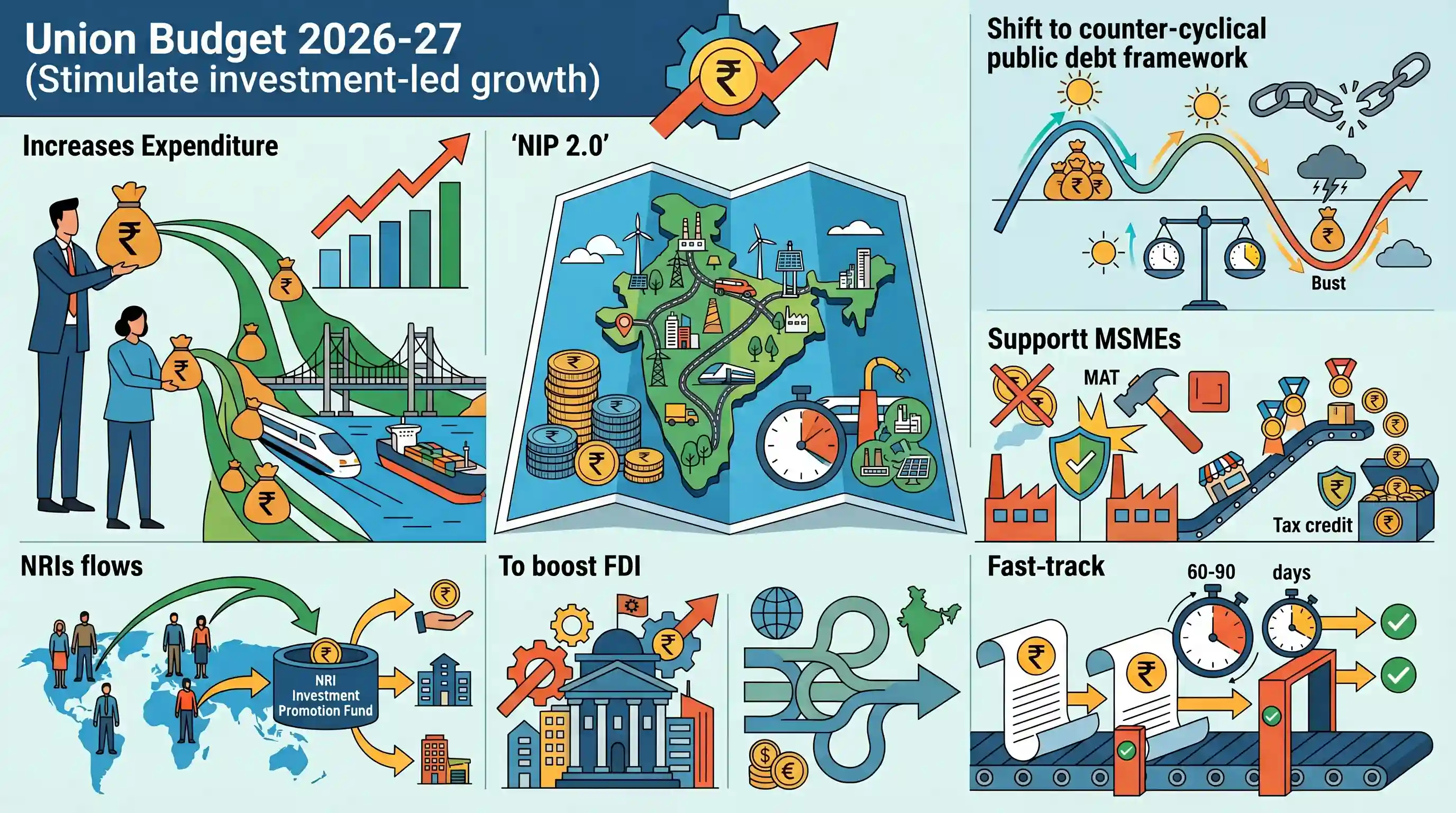
The Confederation of Indian Industry (CII) has outlined crucial reform proposals for the upcoming Union Budget 2026-27 to stimulate investment-led growth. Key recommendations include increasing Central and State capital expenditure, launching a ₹150 lakh crore National Infrastructure Pipeline (NIP) 2.0 (2026-32), and shifting from rigid annual deficit targets to a counter-cyclical public debt framework. Additionally, CII proposed performance-based tax credits, shielding MSMEs' accelerated depreciation benefits from the Minimum Alternate Tax (MAT), and establishing an NRI Investment Promotion Fund. To boost foreign investments, the industry body urged strengthening the National Investment and Infrastructure Fund (NIIF), simplifying External Commercial Borrowings (ECBs), and ensuring deemed approvals for large FDI proposals within 60-90 days.
Key Points
- The Confederation of Indian Industry (CII) has proposed comprehensive reforms for the Union Budget 2026-27 focused on spurring investment-led economic growth.
- CII recommended a 12% increase in Central capital expenditure and a 10% hike in capex support for States, alongside launching a ₹150 lakh crore National Infrastructure Pipeline (NIP) 2.0 for 2026-32.
- To enhance fiscal stability, CII suggested adopting an economic-cycle-based public debt framework (counter-cyclical policy) instead of inflexible annual deficit rules.
- Proposed tax incentives include incremental tax credits for hitting investment milestones and reinstating accelerated depreciation benefits for MSMEs and manufacturing without triggering the Minimum Alternate Tax (MAT).
- To attract foreign capital, CII pitched strengthening the NIIF, creating an NRI Investment Promotion Fund (with up to 49% government stake), and implementing single-window deemed approvals for large FDI proposals within 60-90 days.
Important Terms
National Infrastructure Pipeline (NIP) 2.0

A multi-year roadmap for infrastructure spending proposed to succeed the original NIP (2019-25), targeting ₹150 lakh crore investment between 2026-32 to drive sustained economic growth.
UPSC context
GS Paper 3: Infrastructure and Economic Development. Tests knowledge of long-term capital formation and public-private partnership models.
Minimum Alternate Tax (MAT)
A provision under the Income Tax Act (Section 115JB) ensuring that companies making significant book profits pay a minimum tax, regardless of exemptions or deductions.
UPSC context
GS Paper 3: Government Budgeting and Taxation. Tests understanding of tax fairness and corporate tax structures.
Fiscal Responsibility and Budget Management (FRBM) Act
A 2003 legislation establishing financial discipline by setting targets for fiscal and revenue deficits. Recent debates focus on shifting to a debt-to-GDP anchor.
UPSC context
GS Paper 3: Fiscal Policy and Budgeting. Tests knowledge of debt sustainability and institutional fiscal frameworks.
National Investment and Infrastructure Fund (NIIF)
India's first sovereign-anchored investment fund (Alternative Investment Fund Category II) designed to catalyze international and domestic institutional capital into the infrastructure sector.
UPSC context
GS Paper 3: Investment Models. Tests understanding of sovereign wealth funds and mobilizing long-term capital.
Confederation of Indian Industry (CII)
A non-government industry-led organization in India that advocates for policy reforms and business growth through engagement with government and global stakeholders.
UPSC context
GS Paper 2 & 3: Role of pressure groups and industrial policy. Tests awareness of stakeholders in economic policy.
External Commercial Borrowings (ECB)
Loans raised by Indian entities from non-resident lenders, regulated to manage foreign debt and ensure external sector stability.
UPSC context
GS Paper 3: External Sector and Debt. Tests understanding of capital account management and global financing.
Sovereign Investment Strategy Council (SIFC)
A new governance body proposed by CII to oversee NIIF operations and align its investment roadmap with India's national economic priorities.
UPSC context
GS Paper 3: Institutional reforms in investment. Tests knowledge of emerging proposals to strengthen sovereign wealth governance.
Prelims Trap
"The National Investment and Infrastructure Fund (NIIF) is a 100% government-owned sovereign wealth fund."
Aspirants often confuse NIIF with a fully state-owned sovereign wealth fund. The Government of India's stake is strictly capped at 49%.
Static Concepts Connected
What is counter-cyclical fiscal policy?
- Definition: Adjusting government spending and taxes in opposition to the current economic cycle to stabilize the economy.
- During Recession: Involves expansionary measures (cutting taxes, increasing spending) to stimulate aggregate demand.
- During Boom: Involves contractionary measures (raising taxes, cutting spending) to cool inflation and build fiscal buffers.
How does the Minimum Alternate Tax (MAT) function?
- Objective: Ensures that "zero-tax companies" making substantial book profits cannot avoid tax liability completely via exemptions (like accelerated depreciation).
- Mechanism: Levied at a flat rate (currently 15%) on the book profit if the standard corporate tax calculated is lower than the MAT.
- Applicability: MAT applies to all companies, including foreign companies, unless explicitly exempted by law.
Cross-Topic Patterns
Fiscal Targeting vs. Counter-Cyclical Policy
The shift from rigid FRBM targets to a flexible counter-cyclical framework echoes the N.K. Singh Committee's recommendations on escape clauses during macroeconomic crises.
NIP 2.0 + NIIF Synergy
Financing a ₹150 lakh crore NIP requires massive patient capital, making the quasi-sovereign NIIF and liberalized External Commercial Borrowings (ECBs) critical bridges for long-term foreign investment.

Expect a GS3 mains question analyzing the shift from rigid FRBM deficit targets to counter-cyclical public debt management for NIP 2.0.
Linked PYQs · 5
Linked PYQs · 5
- 2021MainsGS3
Distinguish between Capital Budget and Revenue Budget. Explain the components of both these Budgets.
- 2013MainsGS3
What were the reasons for the introduction of Fiscal Responsibility and Budget Management (FRBM) Act, 2003 ? Discuss critically its salient features and their effectiveness.
- 2014MainsGS3
Explain how Private Public Partnership arrangements, in long gestation infrastructure projects, can transfer unsustainable liabilities to the future. What arrangements need to be put in place to ensure that successive generations' capacities are not compromised?
- 2021PrelimsGS1
Consider the following : 1. Foreign currency convertible bonds 2. Foreign institutional investment with certain conditions 3. Global depository receipts 4. Non-resident external deposits Which of the above can be included in Foreign Direct Investments?
- 2020PrelimsGS1
With reference to Foreign Direct Investment in India, which one of the following is considered its major characteristic?
