Share Buyback Taxation Reform and Capital Gains Treatment
Source:Indian Express ↗
Why It Matters
Direct tax reforms, particularly those affecting capital gains and corporate distributions, are central to GS3 (Government Budgeting, Mobilization of Resources). Understanding the distinction between dividend distribution, capital gains, and buyback taxes is crucial for both Prelims and Mains, as seen in past PYQs targeting the Long-Term Capital Gains Tax (LCGT) and Dividend Distribution Tax (DDT).
Summary
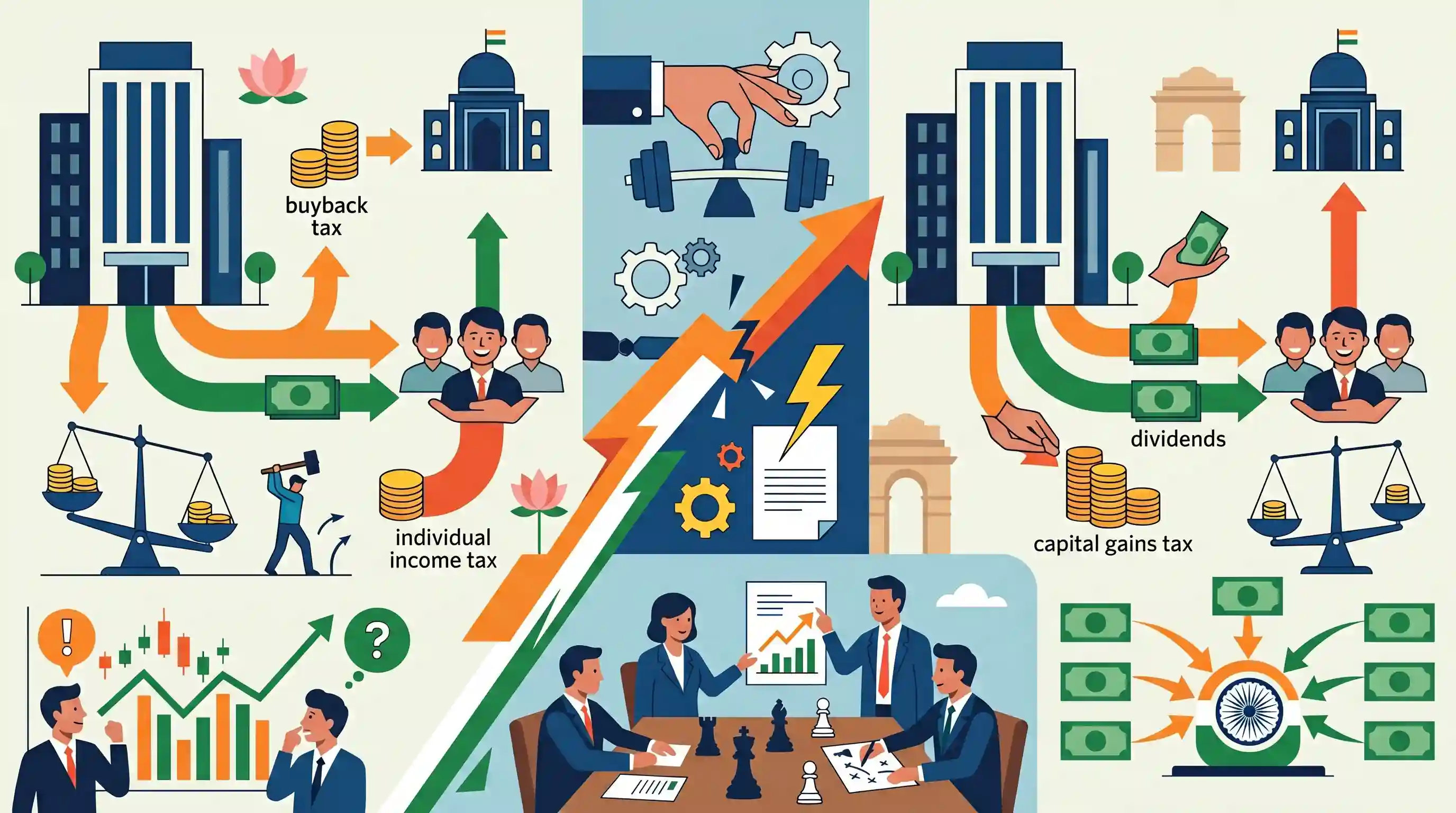
The Union Budget 2026-27 has introduced a significant direct tax reform by announcing that proceeds from share buybacks will be taxed as capital gains in the hands of shareholders. Previously, companies were required to pay a buyback tax, making buybacks a more tax-efficient route to distribute surplus cash to investors compared to dividends, which are taxed at the individual's income tax slab rates. By shifting the tax incidence from the corporation to the investor and taxing it as capital gains, the government aims to plug existing tax arbitrages and ensure parity in the taxation of different forms of equity returns. This move is expected to heavily influence future corporate finance strategies and stock market dynamics.
Key Points
- The Union Budget 2026-27 announced that proceeds from share buybacks will now be taxed as capital gains in the hands of shareholders.
- This reform shifts the tax burden of share buybacks from the corporate entity to the individual investor.
- It eliminates the tax arbitrage that previously existed between dividend payouts (taxed at the investor's slab rate) and share buybacks.
- The policy change aims to harmonize direct tax treatment across different methods of corporate capital distribution.
- Corporate boards may reassess their strategies for returning surplus cash to shareholders, potentially leading to a shift back toward dividend declarations.
Important Terms
Share Buyback

A corporate action where a company repurchases its own shares from the marketplace, reducing outstanding shares to return surplus cash to investors or improve financial ratios like Earnings Per Share (EPS).
UPSC context
GS Paper-III (Indian Economy); tests knowledge of capital market instruments, resource mobilization, and corporate finance strategies.
Capital Gains Tax
Tax levied on the profit earned from the sale of assets like stocks. Budget 2026-27 reclassifies buyback proceeds as capital gains, allowing investors to deduct their original purchase cost.
UPSC context
GS Paper-III (Economy/Taxation); fundamental for understanding direct tax regimes and their influence on investment and savings behavior.
Tax Arbitrage
The practice of exploiting differences in tax rules (e.g., lower buyback taxes vs. higher dividend taxes) to minimize tax liability on the same financial outcome.
UPSC context
GS Paper-III (Resource Mobilization); tests analytical ability regarding policy loopholes and the government's aim for tax parity across equity returns.
Dividend
A distribution of a portion of a company's earnings to its shareholders. In India, these are taxed in the hands of shareholders at their individual income tax slab rates.
UPSC context
GS Paper-III (Indian Economy); essential for comparing corporate payout methods and understanding shifts in fiscal policy since 2020.
Union Budget
The annual financial statement of the Government of India (Article 112), presenting estimated receipts and expenditures for the fiscal year to the Parliament.
UPSC context
GS Paper-II/III (Polity/Economy); central to the study of fiscal policy, legislative procedures, and macroeconomic stability.
Minority Shareholder
A retail or small investor who lacks voting control of a company. The 2026 reform aims to protect them from the "gross taxation" flaw of the 2024 regime.
UPSC context
GS Paper-III (Corporate Governance); relevant to investor protection, market equity, and the socio-economic impact of fiscal reforms.
Prelims Trap
"The tax incidence on share buybacks falls on the corporate entity repurchasing the shares."
The 2026-27 Budget explicitly shifted the tax incidence from the company to the shareholder, taxing it as capital gains in the investor's hands.
Static Concepts Connected
What is a Share Buyback and its core corporate objectives?
- Definition: A corporate action where a company purchases its own outstanding shares from the open market, thereby reducing the total number of publicly traded shares.
- Core Objectives: To return surplus cash to shareholders, consolidate promoter holding, prevent hostile takeovers, or signal to the market that the stock is undervalued.
- Financial Impact: It artificially reduces the outstanding share count, which typically increases the Earnings Per Share (EPS) and often boosts the stock price.
How do Capital Gains fundamentally differ from Dividend taxation?
- Dividend Taxation: Dividends are added to the investor's total income and taxed at their applicable income tax slab rates (following the 2020 DDT abolition).
- Capital Gains Taxation: Capital Gains (from selling shares or buybacks) are taxed based on the holding period (Short-Term vs Long-Term), often at a flat, specialized rate.
- Arbitrage elimination: Taxing buybacks as capital gains eliminates the loophole where investors used buybacks to avoid the higher slab rates applicable to dividend payouts.
Cross-Topic Patterns
Evolution of Direct Tax incidence
This mirrors the 2020 abolition of the Dividend Distribution Tax (DDT). UPSC frequently tests this macro-trend of shifting tax incidence from corporations to individual investors to plug tax arbitrage.
Revenue vs Capital Receipts classification
Though share buybacks involve capital assets, the tax collected on these capital gains is a direct tax. It is classified as a Revenue Receipt, not a Capital Receipt, for the government.

A multi-statement Prelims question comparing the tax treatment, incidence, and market impact of dividends versus share buybacks is highly probable in 2026.
Linked PYQs · 3
Linked PYQs · 3
- 2018MainsGS3
Comment on the important changes introduced in respect of the Long-term Capital Gains Tax (LCGT) and Dividend Distribution Tax (DDT) in the Union Budget for 2018-2019.
- 2022PrelimsGS1
Which one of the following situations best reflects "Indirect Transfers" often talked about in media recently with reference to India?
- 2023PrelimsGS1
Consider the following statements: Statement-I: Interest income from the deposits in Infrastructure Investment Trusts (InvITs) distributed to their investors is exempted from tax, but the dividend is taxable. Statement-II: InvITs are recognized as borrowers under the 'Securitization and Reconstruction of Financial Assets and Enforcement of Security Interest Act, 2002'. Which one of the following is correct in respect of the above statements?
