Fiscal Policy Shifts Focus to Debt to GDP Ratio Anchor
Source:Indian Express ↗
কেন এটি গুরুত্বপূর্ণ
Understanding shifts in fiscal policy anchors—such as moving from annual fiscal deficit flows to multi-year debt-to-GDP stock metrics—is essential for aspirants studying government budgeting, macroeconomic stability, and fiscal federalism in India.
সারসংক্ষেপ
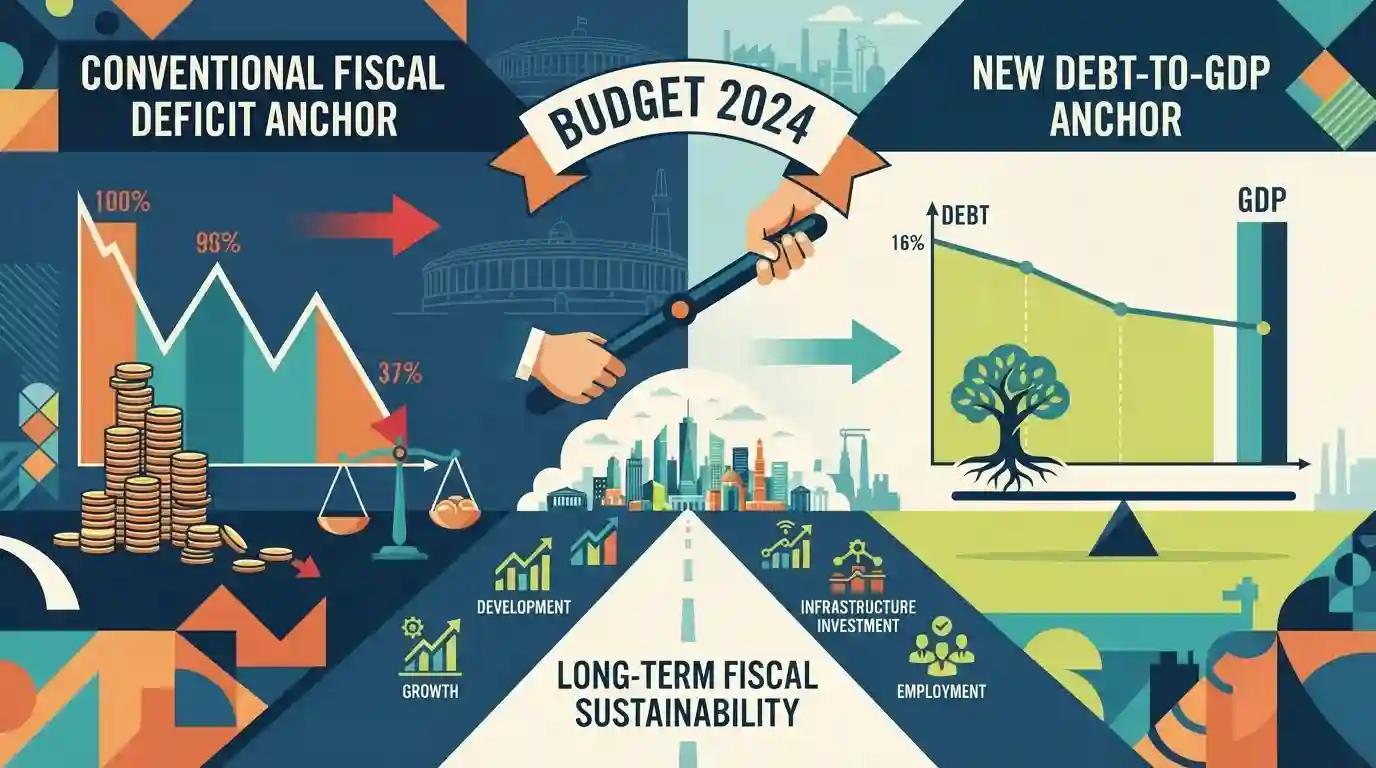
The article discusses the policy shift in Budget 2024 towards prioritizing the debt-to-GDP ratio over the conventional fiscal deficit metric as the primary anchor for India's medium-term fiscal management, aiming for long-term fiscal consolidation and debt sustainability.
মূল বিষয়
- The Union Budget shifted its core medium-term fiscal anchor policy from merely targeting the fiscal deficit to focusing on lowering the debt-to-GDP ratio.
- This shift aligns with recommendations from panels like the FRBM Review Committee (chaired by N.K. Singh) emphasizing long-term debt sustainability over short-term annual flows.
- Targeting debt-to-GDP ensures that public debt declines steadily each year, creating fiscal space, reducing sovereign risk, and managing macroeconomic stability effectively.
গুরুত্বপূর্ণ শব্দ
Fiscal Responsibility and Budget Management (FRBM) Act

A 2003 legislation enacted to institutionalize financial discipline, reduce fiscal deficit, and achieve macroeconomic stability through prudent management of public debt in India.
UPSC context
GS Paper III (Indian Economy - Government Budgeting, Fiscal Policy, and Macroeconomic Stability). Critical for questions on deficit reduction and debt targets.
Budget 2024
The annual financial statement presented by the Union government, detailing estimated receipts and expenditures, and outlining policy shifts such as prioritizing the debt-to-GDP ratio.
UPSC context
GS Paper III (Government Budgeting and Mobilization of Resources). Frequently tested for fiscal policy shifts, tax reforms, and expenditure allocations.
Ministry of Finance
A key ministry under the Government of India responsible for economic policy, taxation, financial legislation, capital markets, and formulating the annual Union Budget.
UPSC context
GS Paper II & III (Governance and Indian Economy). Relevant for administrative structures governing fiscal policy and macroeconomic management.
Government of India
The supreme executive authority of the Union of India, operating through various ministries and departments to formulate public policy and execute national development plans.
UPSC context
GS Paper II (Polity and Governance) and GS Paper III (Economy). Fundamental framework for public administration, federal fiscal policy, and governance.
সংযুক্ত স্থির ধারণা
What are the key provisions and targets under the FRBM Act, 2003?
- Initial Targets: Statutory target to eliminate revenue deficit and curb fiscal deficit, originally aiming for 3% of GDP.
- N.K. Singh Panel: N.K. Singh Committee recommended a debt-to-GDP ratio of 40% for the Centre and 20% for states.
- Escape Clauses: Allows escape clauses for national security, war, structural reforms, and severe economic downturns with output contractions.
আন্তঃবিষয় প্যাটার্ন
Fiscal Policy Shifts and Sovereign Credit Ratings
Shifting from flow variables (annual fiscal deficit) to stock variables (debt-to-GDP ratio) reflects modern macroeconomic management principles mirrored in RBI's flexible inflation targeting framework.

Expect statements combining FRBM Review Committee recommendations (N.K. Singh panel) with debt-to-GDP targets in Prelims.
সংযুক্ত PYQ · 2
সংযুক্ত PYQ · 2
- 2013MainsGS3
What were the reasons for the introduction of Fiscal Responsibility and Budget Management (FRBM) Act, 2003 ? Discuss critically its salient features and their effectiveness.
- 2018PrelimsGS1
Consider the following statements: 1. The Fiscal Responsibility and Budget Management (FRBM) Review Committee Report has recommended a debt to GDP ratio of 60% for the general (combined) government by 2023, comprising 40% for the Central Government and 20% for the State Governments. 2. The Central Government has domestic liabilities of 21% of GDP as compared to that of 49% of GDP of the State Governments. 3. As per the Constitution of India, it is mandatory for a State to take the Central Government's consent for raising any loan if the former owes any outstanding liabilities to the latter. Which of the statements given above is/are correct?
