BSPGCL Invites Bids for Solar and Battery Energy Storage Projects
Source:renewable-watch ↗
Why It Matters
Questions on state-specific infrastructure and renewable energy milestones (such as floating solar power plants) frequently appear in the BPSC Preliminary exam. Understanding Bihar's progress in expanding solar capacity and integrating Battery Energy Storage Systems (BESS) is crucial for both prelims factual questions and mains answers on sustainable development and energy security in Bihar.
Summary
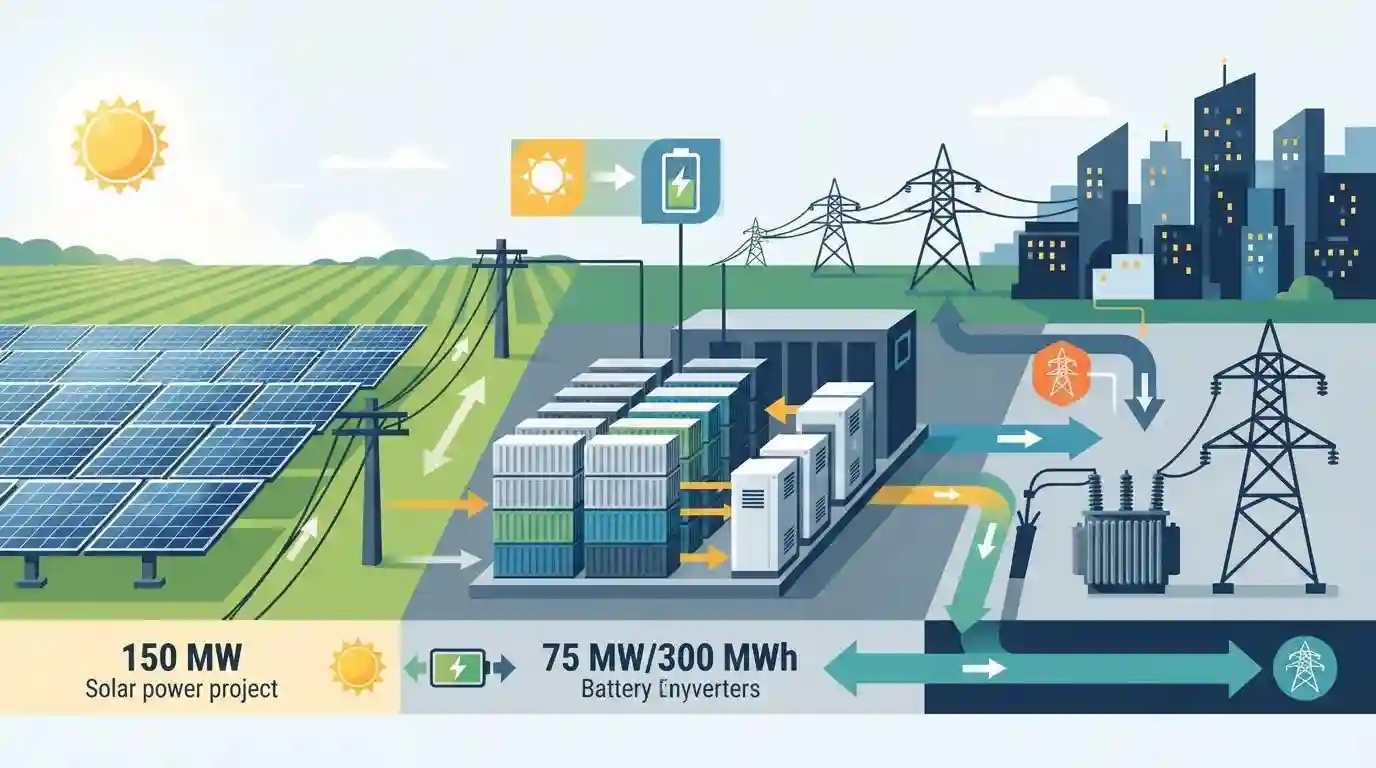
Bihar State Power Generation Company Limited (BSPGCL) has floated a tender to set up a 150 MW solar power project alongside a 75 MW/300 MWh Battery Energy Storage System (BESS). The project entails comprehensive responsibilities for developers, including land acquisition and transmission setup, and acts as a major step forward for Bihar's renewable energy infrastructure.
Key Points
- Bihar State Power Generation Company Limited (BSPGCL) has invited bids for developing 150 MW solar power projects integrated with 75 MW/300 MWh battery energy storage systems (BESS) in Bihar.
- The tender requires developers to install a BESS capacity of at least 0.5 MW/2 MWh for every 1 MW of solar project capacity.
- Developers will be responsible for land acquisition, connectivity, statutory approvals, and transmission network installations including SCADA systems.
- This initiative follows BSPGCL's recent commissioning of the first phase of a 301 MW/495 MWh solar-plus-storage project in January 2026.
Important Terms
Battery Energy Storage System (BESS)

Advanced electrochemical devices that store electricity in chemical form and discharge it during peak demand, stabilizing power grids and integrating renewable energy sources.
UPSC context
GS Paper 3 (Infrastructure/Energy) — tests renewable energy transition, grid integration, and power sector reforms.
Bihar State Power Holding Company Limited (BSPHCL)
The state-owned electricity holding company in Bihar, formed in 2012, that governs and coordinates the unbundled generation, transmission, and distribution power utilities.
UPSC context
GS Paper 3 (Infrastructure) — tests understanding of public utility unbundling, cooperative federalism, and state-level governance.
Bihar State Power Generation Company Limited (BSPGCL)
A state-owned utility under BSPHCL responsible for power generation and expanding Bihar's renewable energy capacity through solar, thermal, and hybrid clean energy projects.
UPSC context
GS Paper 3 (Infrastructure: Energy) — tests state-level initiatives in renewable capacity building and transition policies.
South Bihar Power Distribution Company Limited (SBPDCL)
A public sector utility under BSPHCL established in 2012 that is primarily responsible for distributing electricity and managing the power network across 17 districts of southern Bihar.
UPSC context
GS Paper 3 (Infrastructure: Energy) — tests consumer distribution challenges, AT&C loss reduction, and power reforms.
North Bihar Power Distribution Company Limited (NBPDCL)
A state-owned distribution utility under BSPHCL, formed in 2012, tasked with electricity distribution, infrastructure management, and consumer services across 21 districts of northern Bihar.
UPSC context
GS Paper 3 (Infrastructure: Energy) — tests electricity access, loss minimization, and rural electrification strategies.
Prelims Trap
The central Viability Gap Funding (VGF) scheme for BESS provides complete (100%) capital cost funding for state-led clean energy tenders.
The central VGF scheme only covers up to 40% of the capital cost of BESS projects to bridge viability gaps, requiring developers to secure the remaining capital.
Static Concepts Connected
What is the distinction between MW and MWh in Battery Energy Storage Systems (BESS)?
- Power Capacity (MW): Measures the maximum instantaneous rate of electricity discharge; determines how many electrical loads can be powered simultaneously.
- Energy Capacity (MWh): Measures the total volume of electricity stored; determines how long the battery can sustain its rated power output.
- Duration Ratio: A 75 MW / 300 MWh system has a 4-hour discharge duration (300 divided by 75), crucial for managing daily peak demand cycles.
Cross-Topic Patterns
Agro-photovoltaics and Land Optimization
Combining solar with fisheries ("Niche machhli, upar bijli") addresses severe land acquisition challenges in densely populated states while doubling economic output per unit of land.
Federal Financing of Energy Transition
State-level power distribution companies rely on central fiscal tools like the BESS VGF scheme to make expensive storage technologies commercially viable for local grids.

BESS deployment parameters, including MW/MWh ratios and the 40% Central VGF ceiling, are highly likely to feature in GS-3 infrastructure.
Linked PYQs · 3
Linked PYQs · 3
- 2023BPSC_PRELIMSGS1
The first ‘floating solar power plant’ has been built at which place in Bihar?
- 2023BPSC_PRELIMSGS1
India’s first floating solar power plant has been built at which place in Bihar?
- 2024-EBPSC_PRELIMSGS1
In which of the following years the Bihar state Hydroelectric power corporation was established?
