BSNL Workers Death Exposes Confined Space Occupational Hazards
Source:Indian Express ↗
Why It Matters
The incident highlights the grim reality of occupational hazards in India, specifically the dangers of confined-space entry. It is highly relevant for UPSC as it bridges the science of toxic gases with critical governance issues regarding labor rights, PSU accountability, and the enforcement of occupational safety laws.
Summary
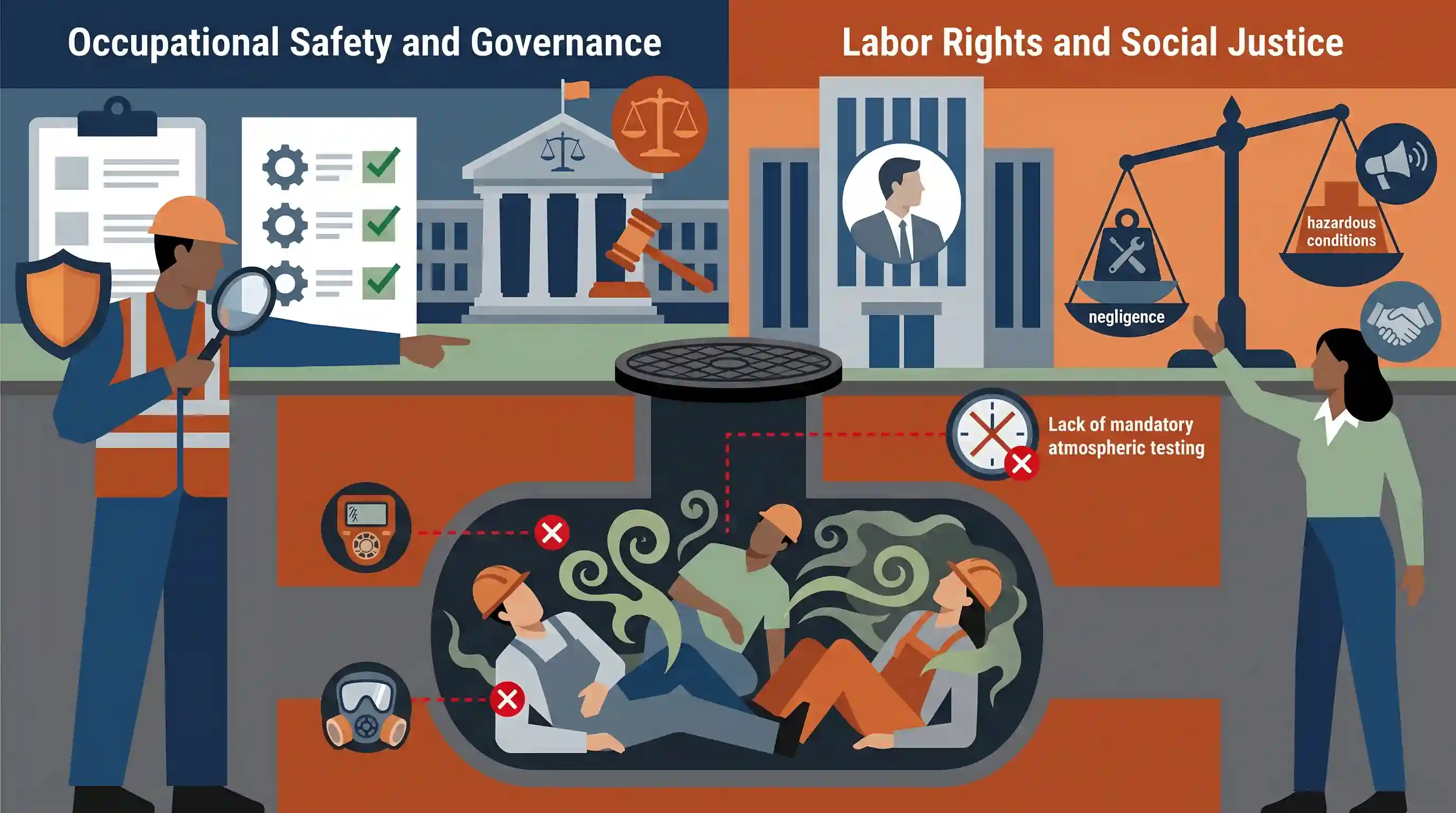
Three contract workers of Bharat Sanchar Nigam Limited (BSNL) died from inhaling toxic fumes after entering an underground optical fibre cable chamber in Pune. While not a traditional sewer, such confined underground spaces frequently become deathtraps due to the accumulation of lethal gases like hydrogen sulphide, methane, and carbon monoxide. This tragic event brings to light the severe occupational hazards faced by contract laborers, exposing a blatant lack of standard operating procedures, such as mandatory atmospheric testing and the provision of adequate safety equipment (gas monitors and breathing apparatus). The incident underscores the urgent need for strict enforcement of occupational safety regulations and greater accountability from principal employers regarding the hazardous working conditions of informal workers.
Key Points
- Three contract workers of BSNL suffocated to death due to toxic gas inhalation inside an optical fibre cable chamber in Pune.
- Although not a sewer line, closed underground utility chambers can accumulate deadly gases like hydrogen sulphide, methane, and carbon monoxide due to organic decomposition or soil seepage.
- The tragedy underscores a systemic failure in providing basic safety gear, such as gas detectors, blowers, and self-contained breathing apparatus (SCBA), for confined-space entry.
- It highlights the acute vulnerability of contract laborers and the poor enforcement of occupational safety and health standards by principal employers, including PSUs.
Important Terms
Occupational Safety, Health and Working Conditions (OSHWC) Code, 2020

A 2020 law consolidating 13 central labor statutes to simplify compliance and strengthen worker safety. It empowers the government to mandate safety standards for any hazardous work, regardless of employee count.
UPSC context
GS Paper II (Governance) and GS Paper III (Economy/Labour Reforms). Tests understanding of modern regulatory frameworks for worker protection.
Principal Employer
The entity that engages contract labor through a contractor. Under Indian law, this entity is ultimately responsible for ensuring safety, welfare, and wage compliance if the contractor fails to do so.
UPSC context
GS Paper II (Social Justice/Labour Rights). Relevant for discussions on the informalization of labor and employer accountability.
Vicarious Liability
A legal doctrine holding a superior or employer responsible for the negligence or wrongful acts of subordinates committed during their employment, based on the principle of 'respondeat superior' (let the master answer).
UPSC context
GS Paper IV (Ethics) and GS Paper II (Law). Used to analyze administrative negligence and corporate/institutional responsibility.
Section 36, Factories Act, 1948 (Confined Space Safety)
A specific safety provision prohibiting entry into enclosed spaces (tanks, chambers, pits) likely to contain toxic fumes unless atmospheric tests are conducted or breathing apparatus and safety belts are provided.
UPSC context
GS Paper III (Disaster Management/Internal Security). Tests knowledge of specific industrial safety protocols and their violation in utility deaths.
Bharatiya Nyaya Sanhita (BNS) Section 105
The new legal provision (replacing IPC Section 304-II) for culpable homicide not amounting to murder. It applies to acts causing death with knowledge of the danger but without intent to kill.
UPSC context
GS Paper II (Polity/Criminal Justice). Essential for understanding current legal changes and their application in cases of criminal negligence.
Central Public Sector Undertaking (CPSU)
A government-owned corporation where the Union Government holds a 51% or larger stake. BSNL's status as a CPSU mandates higher standards of administrative accountability and social responsibility.
UPSC context
GS Paper III (Indian Economy). Relevant for discussing the role and ethical standards of state-owned enterprises in public service.
Prelims Trap
The PEMSR Act 2013 directly penalizes deaths occurring in telecom or optical fibre utility chambers.
The PEMSR Act explicitly targets hazardous cleaning of sewers and septic tanks. Deaths in telecom/utility vaults fall under general occupational safety (OSH Code), a critical legal distinction.
Static Concepts Connected
Who bears ultimate liability for contract workers under the OSH Code 2020?
- Principal Employer liability: The core entity (e.g., a PSU or corporate body) holds primary responsibility for the health, safety, and welfare of contract workers, not just the sub-contractor.
- Default responsibility: If the immediate contractor fails to provide basic amenities or safety gear, the principal employer is legally bound to step in and provide them.
Why do non-sewage underground chambers accumulate lethal gases?
- Anaerobic decomposition: Seeped organic matter decays without oxygen, generating Methane (CH4) and Hydrogen Sulphide (H2S), which accumulate in closed utility vaults over time.
- Olfactory fatigue: H2S induces olfactory fatigue at lethal concentrations, neutralizing the victim's sense of smell and causing sudden respiratory paralysis without any warning.
- Oxygen displacement: Dense gases like CO and H2S displace oxygen in confined spaces, making them deadly without forced mechanical ventilation and gas monitors.
Cross-Topic Patterns
The semantic gap in PEMSR Act 2013
Tragedies in non-sewer utility vaults highlight how narrowly defining "sewers" under the PEMSR Act excludes vulnerable utility workers facing identical asphyxiation hazards, creating a massive legal loophole.
PSU informalization and contract labour risks
The increasing reliance of PSUs like BSNL on contract workers bypasses formal safety training, linking structural cost-cutting to severe informal sector vulnerabilities and poor OSH Code compliance.

Expect a 2026 Prelims statement differentiating the legal scope of the PEMSR Act from the OSH Code regarding confined space deaths.
Linked PYQs · 2
Linked PYQs · 2
- 2016PrelimsGS1
'Rashtriya Garima Abhiyaan' is a national campaign to
- 2022PrelimsGS1
Excess of which of the above in the environment is/are cause(s) of acid rain? 1. Carbon monoxide 2. Nitrogen oxide 3. Ozone 4. Sulphur dioxide
