BSEB Class 11 Spot Admission Begins via OFSS Portal
Source:careers360 ↗
Why It Matters
Demonstrates Bihar's adoption of e-governance in educational administration (via the OFSS portal) and touches on central-state funding dynamics in education, both of which are highly relevant for BPSC's governance and social justice sections.
Summary
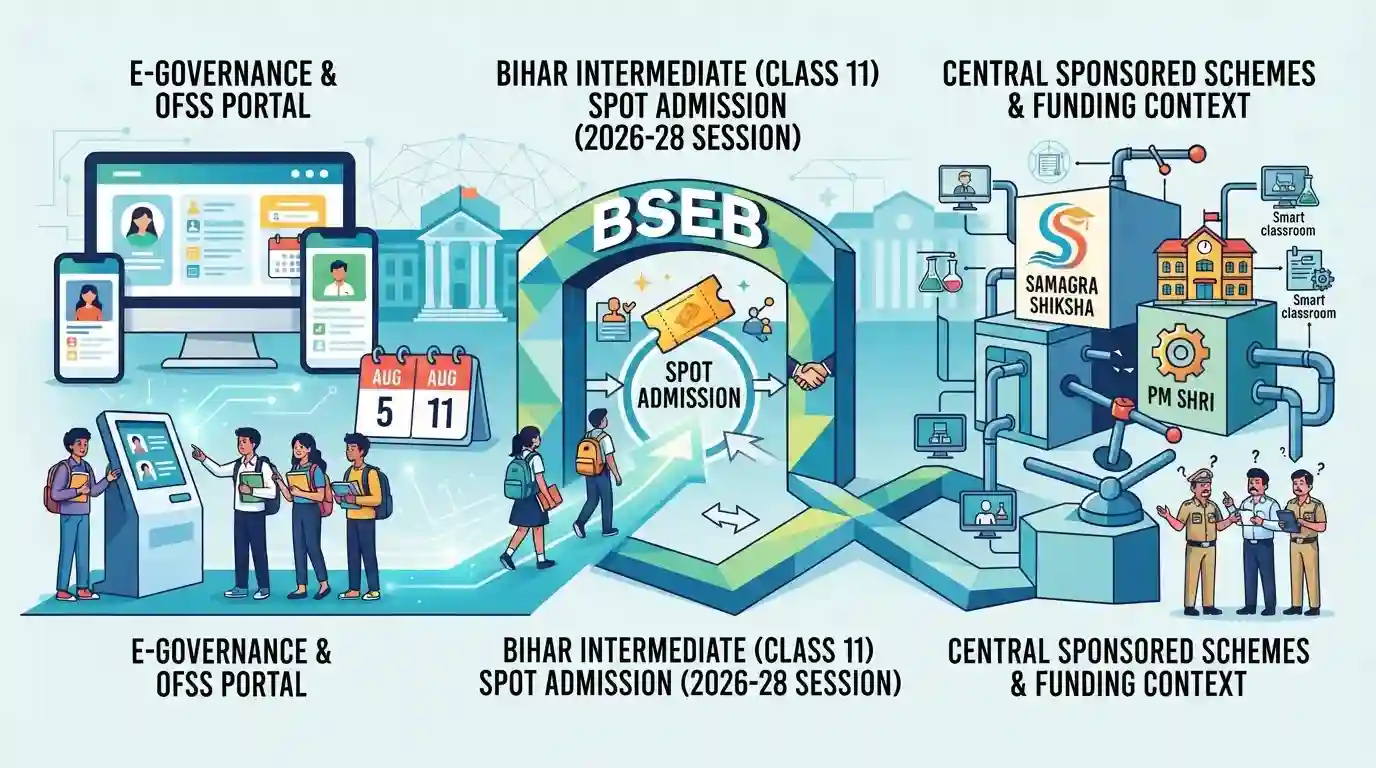
The Bihar School Examination Board (BSEB) has commenced the intermediate (class 11) spot admission process for the 2026-28 academic session. Conducted entirely through the Online Facilitation System for Students (OFSS) portal, the spot admission window runs from August 5 to August 11, 2026, offering a vital last chance for students who missed standard deadlines. The broader context of the article touches on state educational funding, including delays in central schemes like Samagra Shiksha and PM SHRI.
Key Points
- The BSEB has opened the window for intermediate (class 11) spot admissions for the 2026-28 academic session from August 5 to August 11, 2026.
- The entire spot admission process is conducted online through the Online Facilitation System for Students (OFSS) portal.
- This initiative serves as a crucial final opportunity for students who missed earlier admission phases or faced issues with merit lists.
- The article highlights ongoing conversations around education funding, particularly concerning central schemes like Samagra Shiksha and PM SHRI dues.
Important Terms
Samagra Shiksha

An integrated Centrally Sponsored Scheme of the Ministry of Education spanning pre-school to Class 12. It aims to deliver inclusive, equitable school education by subsuming Sarva Shiksha Abhiyan, Rashtriya Madhyamik Shiksha Abhiyan, and Teacher Education.
UPSC context
GS Paper II (Social Justice/Education); assesses interventions for human resource development, federal educational funding, and Sustainable Development Goal 4.
PM Schools for Rising India (PM SHRI)
A centrally sponsored scheme launched in 2022 to upgrade over 14,500 government schools into high-quality model institutions. These schools showcase the implementation of the National Education Policy (NEP) 2020 and guide neighbouring schools.
UPSC context
GS Paper II (Social Justice/Education); tests understanding of school infrastructure, federal-state fiscal coordination, and National Education Policy 2020 initiatives.
Bihar School Examination Board (BSEB)
A statutory body under the Government of Bihar established under the Bihar School Examination Act of 1952. It conducts secondary (Class 10) and senior secondary (Class 12) examinations across affiliated schools.
UPSC context
GS Paper II (State Governance); examines the structural mandates, functional efficiency, and administrative challenges of state-level secondary education boards.
Online Facilitation System for Students (OFSS)
An e-governance portal developed by the Bihar School Examination Board (BSEB). It automates and centralises the intermediate (Class 11) admission process in Bihar, making school enrolment transparent, cost-effective, and hassle-free.
UPSC context
GS Paper II (E-Governance); tests understanding of digital public service delivery, technological intervention in state administration, and citizen-centric governance models.
Prelims Trap
Samagra Shiksha is an integrated scheme designed to treat education holistically from pre-school up to higher education.
Samagra Shiksha is strictly restricted to school education (pre-school to Class 12). It does not cover higher, university, or technical education.
Static Concepts Connected
What are the key pillars and structural design of the Samagra Shiksha Scheme?
- Integrated Nature: Centrally Sponsored Scheme (CSS) launched by the Ministry of Education to treat school education holistically as a continuous process.
- Subsumed Schemes: Subsumed three erstwhile central schemes: Sarva Shiksha Abhiyan (SSA), Rashtriya Madhyamik Shiksha Abhiyan (RMSA), and Teacher Education (TE).
- Funding Pattern: Funded in a 60:40 ratio for general states, 90:10 for North-Eastern/Himalayan states, and 100% central funding for UTs without legislatures.
What is the PM SHRI Scheme and how does it support the National Education Policy 2020?
- Core Objective: A Centrally Sponsored Scheme aimed at upgrading over 14,500 schools across India to showcase NEP 2020 principles.
- Mentorship Role: To act as exemplar institutions that provide leadership and mentor neighboring schools in modern pedagogy and cognitive development.
- Key Deliverables: Emphasizes modern infrastructure including smart classrooms, green school initiatives, waste management, and experiential learning pathways.
Cross-Topic Patterns
Coercive Fiscal Federalism via CSS
Withholding Samagra Shiksha funds to enforce NEP compliance highlights how Centrally Sponsored Schemes are increasingly used by the Centre to drive state-level policy alignment, testing cooperative federalism.
E-Governance vs Educational Access
Centralized e-admission portals streamline administration but can inadvertently exclude marginalized aspirants in regions with low digital literacy, showing the limits of digital-first educational governance.

Mains 2026 may analyze how conditionalities in Centrally Sponsored Schemes like Samagra Shiksha alter the dynamics of fiscal federalism.
Linked PYQs · 4
Linked PYQs · 4
- 2024-IBPSC_PRELIMSGS1
In April, 2020 the Bihar Education Department started the following program through DD Bihar
- 2020BPSC_PRELIMSGS1
Bihar Government has introduced the Comprehensive Financial Management System (CFMS) on 1st April, 2019. This system
- 2025BPSC_PRELIMSGS1
What is the primary objective of Bihar’s Mission Daksh?
- 2018BPSC_PRELIMSGS1
Among the States of India, Bihar's rank in terms of lowest literacy rate (2011 Census) is
