Root cause analysis of ISRO satellite launch anomalies
Source:Indian Express ↗
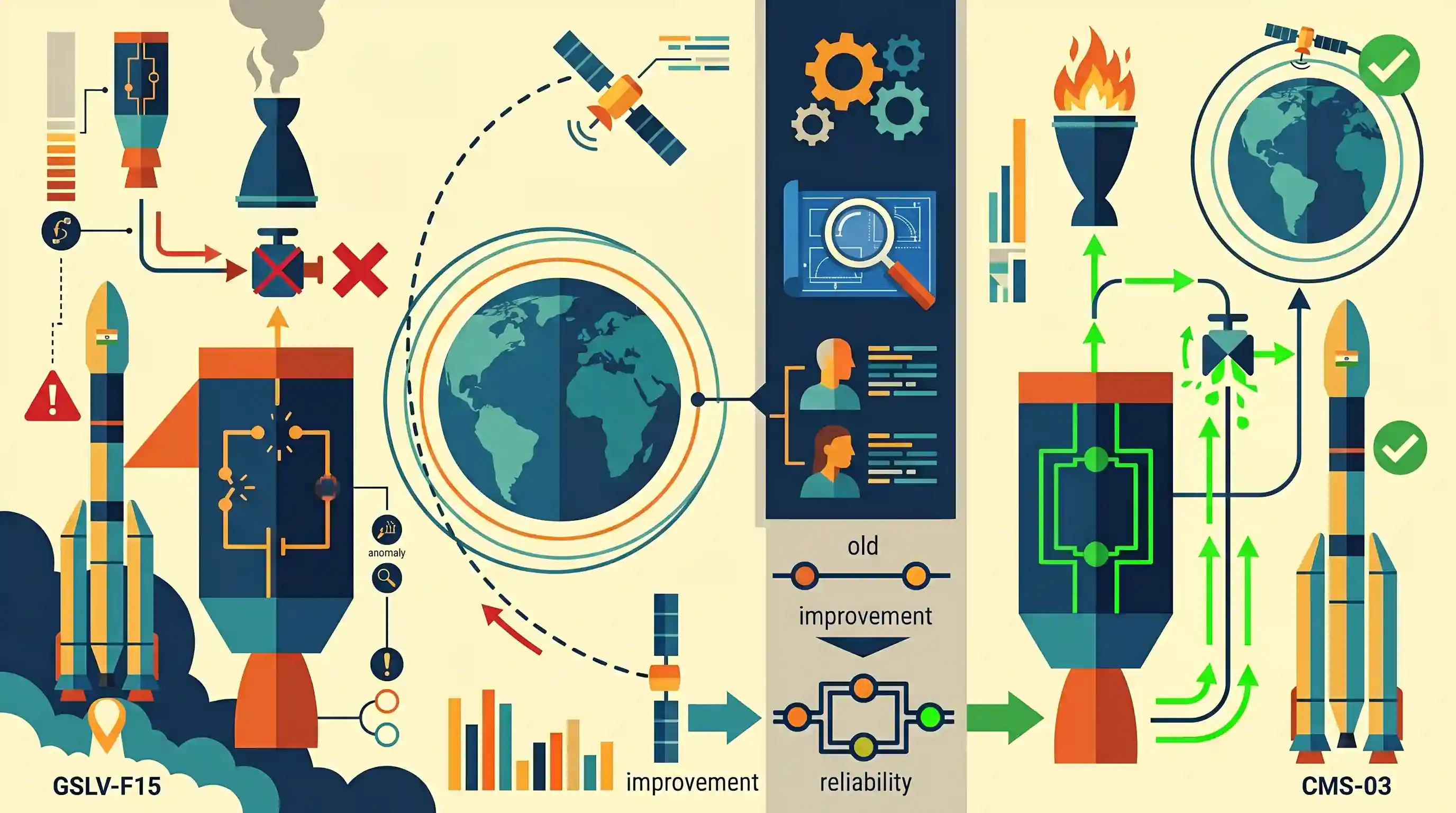
Why It Matters
Understanding the technical challenges, launch vehicle mechanisms (GSLV/PSLV), and root-cause analyses of mission failures is crucial for the Science & Technology section of GS Paper 3. It highlights ISRO's operational resilience and the importance of redundancy in critical space systems.
Summary
An inquiry committee has determined that a broken electrical circuit was the root cause of the failure of ISRO's NVS-02 navigation satellite mission in January 2025. The satellite, launched via a GSLV-F15 rocket, could not be placed in its intended circular orbit because an electrical contact disengaged, preventing a signal from reaching a pyro valve and thereby failing to ignite the engine. Following the investigation, ISRO has implemented critical recommendations to improve the redundancy and reliability of its pyro systems, successfully applying these fixes in the recent CMS-03 satellite launch.
Key Points
- ISRO's NVS-02 navigation satellite failed to reach its intended circular orbit after being launched by the GSLV-F15 rocket in January 2025.
- An inquiry committee concluded that the engine failed to ignite due to a broken electrical circuit, which stopped a signal from reaching the pyro valve on the oxidiser line.
- The failure was traced to the disengagement of electrical contacts, which kept the oxidiser line closed and prevented orbit-raising manoeuvres.
- In response, ISRO implemented recommendations to enhance the redundancy and reliability of pyro system operations, which were successfully tested in the subsequent CMS-03 launch.
- The article also notes recent anomalies with ISRO's PSLV rockets, underscoring the ongoing challenges of ensuring launch vehicle reliability.
Important Terms
NVS-02 Navigation Satellite

A second-generation Indian navigation satellite launched in 2025 to augment the NavIC constellation. It features indigenous rubidium atomic clocks and provides precise positioning and timing services across the Indian sub-continent.
UPSC context
GS III (Science & Tech); focuses on indigenization of critical technology and strategic regional navigation autonomy.
NavIC (Navigation with Indian Constellation)
India's independent regional satellite navigation system (formerly IRNSS). It provides accurate real-time positioning and timing services over India and 1,500 km beyond its borders using a constellation of seven or more satellites.
UPSC context
GS III (Indigenization of Technology); tests strategic infrastructure knowledge and self-reliance in space assets.
GSLV (Geosynchronous Satellite Launch Vehicle)
ISRO’s three-stage launch vehicle, including an indigenous cryogenic upper stage, designed for Geosynchronous Transfer Orbits. The GSLV-F15 mission marked ISRO’s landmark 100th launch from Sriharikota in January 2025.
UPSC context
GS III (Space Tech); tests understanding of India's launch vehicle hierarchy and satellite deployment capabilities.
CMS-03 Satellite Mission
A 2025 mission that launched India’s heaviest communication satellite (~4,410 kg). It successfully validated critical reliability fixes for pyro systems following the NVS-02 anomaly, enhancing maritime and civilian communications.
UPSC context
GS III (Science & Tech); highlights mission recovery, technological reliability, and heavy-lift launch milestones.
Pyro System (Spacecraft)
Pyrotechnic-actuated components, like valves, used for critical one-time operations such as engine ignition. A redundant circuit failure in NVS-02's pyro system prevented its planned orbit-raising maneuvers.
UPSC context
GS III (Science & Tech); relevant for understanding technical risks and failure-mode analysis in space missions.
LVM3 (Launch Vehicle Mark 3)
India’s most powerful launch vehicle, capable of carrying 4-ton class satellites to Geosynchronous Transfer Orbit. It was used in the LVM3-M5 mission to launch the heavy CMS-03 satellite.
UPSC context
GS III (Space Technology); tests knowledge of India’s heavy-lift capabilities and its evolution from the GSLV Mk-III.
Prelims Trap
"NavIC satellites operate in Medium Earth Orbit (MEO) to provide global coverage similar to GPS."
NavIC is a regional navigation system relying on Geostationary (GEO) and Geosynchronous (GSO) orbits. GPS is a global system operating in Medium Earth Orbit (MEO).
Static Concepts Connected
What are the key upgrades in the NVS series of NavIC satellites?
- Indigenous Clocks: Uses indigenously developed Rubidium atomic clocks for precise timing, replacing the imported units that failed in older IRNSS satellites.
- L1 Frequency Band: Introduces the L1 frequency band, which makes NavIC signals natively compatible with standard civilian consumer devices like smartphones and smartwatches.
Why do satellite orbit-raising engines require onboard oxidizers and pyro valves?
- Vacuum of Space: Unlike jet engines, spacecraft operate in a vacuum and cannot draw atmospheric oxygen. They must carry an onboard oxidizer to combust their fuel.
- Pyro Valves: These pyrotechnic valves ensure zero leakage during launch. They use explosive charges to instantly open fluid lines, allowing the oxidizer to reach the engine for ignition.
Cross-Topic Patterns
NavIC & Strategic Autonomy
The shift to secure indigenous positioning via NavIC pairs with dedicated military satellites like CMS-03 (GSAT-7R) to secure the Indian Navy's communications across the Indian Ocean Region.
Space Component Indigenisation
The transition to Indian-made Rubidium atomic clocks in NVS satellites reflects a broader strategic push to eliminate import dependencies in critical deep-space and defense technologies.

Expect a 2026 multi-statement question combining NavIC's NVS upgrades (L1 band, Rubidium clocks) with GSLV orbital injection mechanics.
Linked PYQs · 2
Linked PYQs · 2
- 2018PrelimsGS1
With reference to India's satellite launch vehicles, consider the following statements: 1. PSLVs launch the satellites useful for Earth resources monitoring whereas GSLVs are designed mainly to launch communication satellites. 2. Satellites launched by PSLV appear to remain permanently fixed in the same position in the sky, as viewed from a particular location on Earth. 3. GSLV Mk III is a four-staged launch vehicle with the first and third stages using solid rocket motors; and the second and fourth stages using liquid rocket engines. Which of the statements given above is/are correct?
- 2023MainsGS3
What is the main task of India's third moon mission which could not be achieved in its earlier mission? List the countries that have achieved this task. Introduce the subsystems in the spacecraft launched and explain the role of the Virtual Launch Control Centre' at the Vikram Sarabhai Space Centre which contributed to the successful launch from Sriharikota.
