UK Digital ID Initiative for Immigration Control and Governance
Source:Indian Express ↗
Why It Matters
The UK's policy shift toward a mandatory centralized digital ID system provides an excellent comparative case study for India's Aadhaar ecosystem. It illustrates how developed nations use e-governance to solve security and administrative challenges like illegal immigration, while navigating complex debates around data privacy, civic liberties, and state surveillance.
Summary
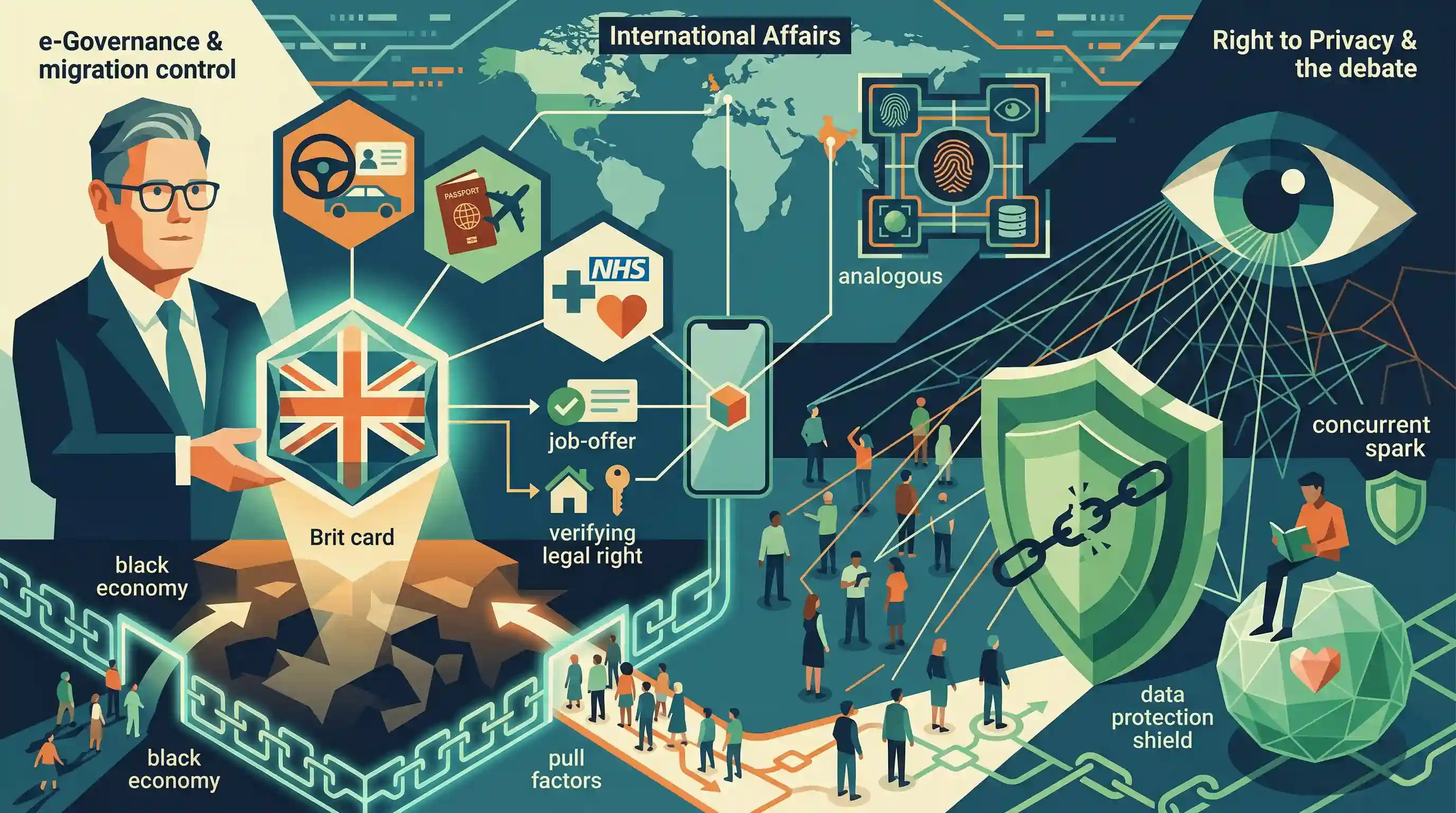
British Prime Minister Keir Starmer is planning to introduce a mandatory digital ID, dubbed the "Brit card," for all adults in the UK. Designed to clamp down on illegal immigration and visa overstaying, the ID will verify an individual's legal right to live and work in the country, thereby cutting off "pull factors" like the black economy. The digital infrastructure, which revives a similar 2006 proposal by Tony Blair, aims to eventually centralize access to driving licenses, passports, and NHS healthcare into a single app. This development highlights the growing global reliance on digital infrastructure for border control and governance—analogous to India's Aadhaar system—while sparking concurrent debates over data protection, state surveillance, and the right to privacy.
Key Points
- UK Prime Minister Keir Starmer plans to introduce a mandatory digital ID, informally known as the "Brit card," for all adults in the UK, including citizens and visa holders.
- The primary objective is to crack down on illegal immigration and visa overstaying by requiring the digital ID to verify a citizen’s right to work and rent.
- The proposed digital ID app may eventually integrate other state-issued credentials, including driving licences, passports, NHS service access, and National Insurance numbers.
- The initiative echoes a scrapped 2006 proposal by former PM Tony Blair and is estimated to cost £400 million to build, highlighting the global governance trend of centralized citizen databases similar to India's Aadhaar.
Important Terms
Brit card

The proposed mandatory digital identity scheme for UK adults designed to verify residency and employment rights via a smartphone app.
UPSC context
GS II (International Relations); examines global migration trends and comparative digital governance models between the UK and India.
Digital Identity
A digital representation of an individual's identity used for secure, paperless verification and streamlined access to public and private services.
UPSC context
GS II (Governance); essential for topics on Digital Public Infrastructure (DPI) and technological interventions in administration.
Aadhaar
India's biometric identity system, cited by UK leadership as a successful blueprint for implementing large-scale national digital identity frameworks.
UPSC context
GS II (Social Justice/Governance); tests knowledge of India's welfare delivery models and their international soft-power influence.
Pull Factors
Socio-economic factors in a destination country that attract migrants; digital IDs aim to reduce these by curbing illegal employment.
UPSC context
GS I (Geography) & II (Migration); fundamental to understanding drivers of global population movement and state-led border management.
Right to Privacy
A legal concept (fundamental under India's Article 21) at the core of debates concerning state surveillance and mandatory biometric data collection.
UPSC context
GS II (Polity); relates to the K.S. Puttaswamy judgment and the balance between national security and civil liberties.
e-Governance
The application of ICT to government processes to improve efficiency, transparency, and service delivery to citizens.
UPSC context
GS II (Administrative Reforms); essential for discussing the role of technology in enhancing bureaucratic accountability and reaching beneficiaries.
Labour Together
An influential British think tank closely linked to PM Keir Starmer that authored the proposal for the "Brit card" digital ID.
UPSC context
GS II (International Relations); highlights the role of non-state actors and think tanks in shaping sovereign policy agendas.
Prelims Trap
Digital IDs like Aadhaar are mandatory for accessing all private and public sector services.
The Supreme Court (2018) struck down Aadhaar's mandatory use by private entities, limiting its mandatory nature only to welfare schemes drawing from the Consolidated Fund of India.
Static Concepts Connected
What is the 'Doctrine of Proportionality' established in the K.S. Puttaswamy judgment?
- Legitimate aim: The state action restricting a fundamental right must have a legally valid and legitimate purpose.
- Rational nexus: The measures adopted by the state must be rationally connected to the intended objective.
- Necessity: There must be no alternative, less restrictive measure available to achieve the same goal.
- Proportionality stricto sensu: A fair balance must be maintained between the right infringed and the state's overarching objective.
What are the three foundational layers of India's Digital Public Infrastructure (India Stack)?
- Identity layer: Biometric and demographic foundation (Aadhaar, eSign, e-KYC) providing universal, paperless digital identity verification.
- Payments layer: Interoperable systems like UPI and Aadhaar Enabled Payment System ensuring seamless, high-volume financial transactions.
- Data empowerment layer: Frameworks like DigiLocker and Account Aggregators enabling secure, consent-based digital data sharing by citizens.
Cross-Topic Patterns
India's DPI Diplomacy & Soft Power
The global shift toward digital IDs mirrors India's push to export its Modular Open Source Identity Platform (MOSIP) to the Global South, serving as a distinct foreign policy tool.
Migration Pull Factors and Security
The UK's use of digital IDs to neutralize economic pull factors parallels India's internal security debates surrounding the NRC and the role of Aadhaar in verifying residency versus citizenship.

Expect a GS2 Mains question evaluating DPDP Act 2023 safeguards against state surveillance, given global trends in mandatory digital IDs.
Linked PYQs · 3
Linked PYQs · 3
- 2024MainsGS2
e-governance is not just about the routine application of digital technology in service delivery process. It is as much about multifarious interactions for ensuring transparency and accountability. In this context evaluate the role of the 'Interactive Service Model' of e-governance.
- 2024MainsGS2
Right to privacy is intrinsic to life and personal liberty and is inherently protected under Article 21 of the constitution. Explain. In this reference discuss the law relating to D.N.A. testing of child in the womb to establish its paternity.
- 2014MainsGS3
How does illegal transborder migration pose a threat to India's security? Discuss the strategies to curb this, bringing out the factors which give impetus to such migration.
