UK Prime Minister visit to China for business and diplomatic ties
Source:The Hindu ↗
Why It Matters
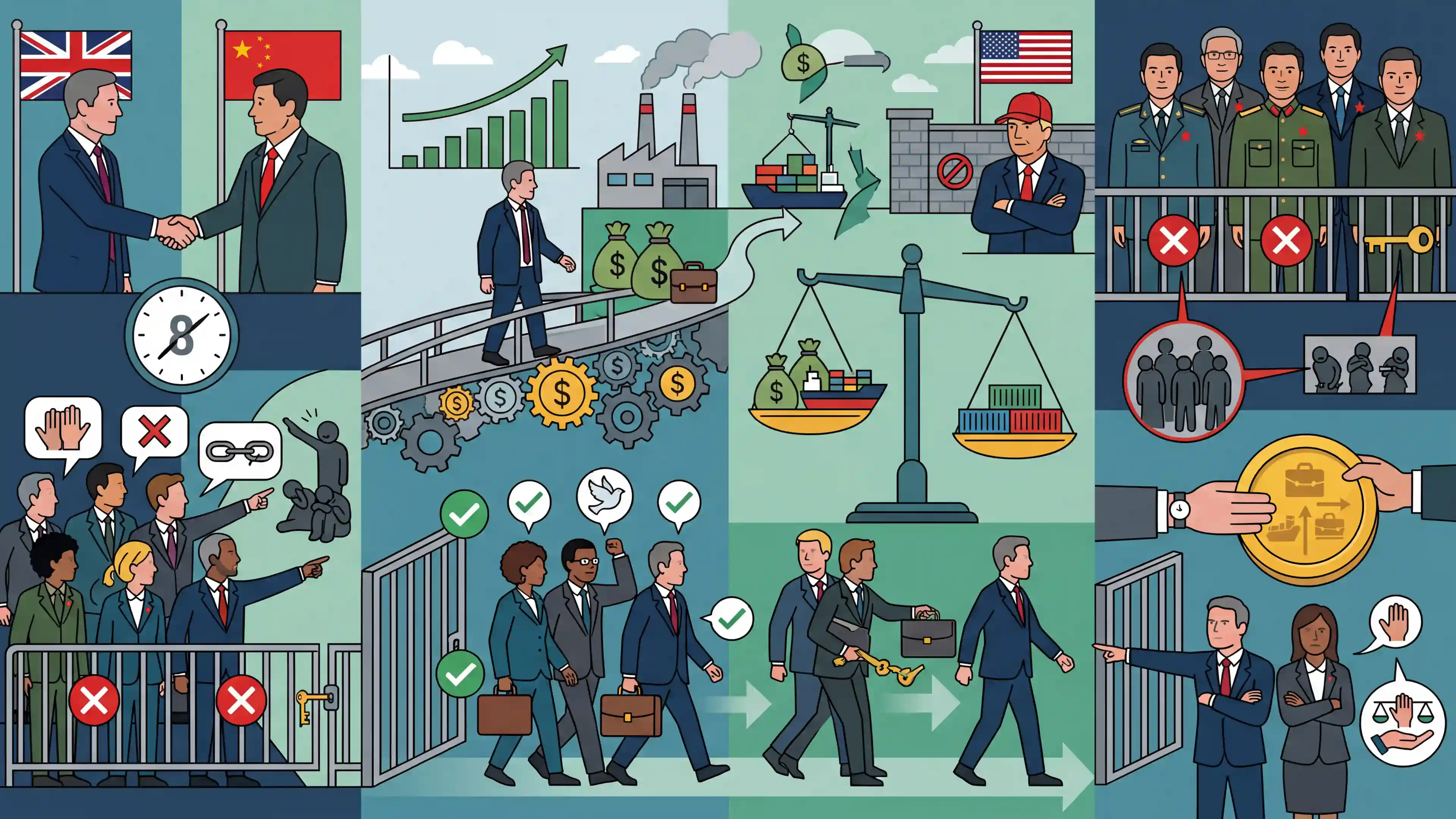
Illustrates the delicate balancing act in global diplomacy where nations attempt to decouple human rights advocacy from economic engagement, and highlights the geopolitical tension between securing trade deals and managing alliance pressures (e.g., from the US).
Summary
British Prime Minister Keir Starmer, during the first visit by a UK leader to China in eight years, announced that Beijing is lifting travel restrictions imposed on several British lawmakers. These sanctions were enacted in 2021 after the lawmakers criticized alleged human rights abuses against Uyghurs in Xinjiang. While Starmer seeks to boost UK-China business ties despite opposition from US President Donald Trump, the UK government maintains it will not reciprocate by lifting its sanctions on Chinese officials. Several of the affected British MPs have rejected the development, refusing to let their personal travel freedom act as a diplomatic bargaining chip.
Key Points
- British Prime Minister Keir Starmer announced that China will lift sanctions imposed on a group of British lawmakers in 2021.
- The sanctions were originally placed on nine Britons in retaliation for their criticism of China's alleged human rights abuses against Uyghurs in Xinjiang.
- The UK government clarified it will not lift its own sanctions against Chinese individuals in exchange.
- Some sanctioned British lawmakers rejected the move, refusing to let their status be used as a bargaining chip at the expense of justice for the Uyghur people.
- Starmer\'s visit to China, the first by a UK PM in eight years, focuses on boosting UK business opportunities despite US President Donald Trump signalling opposition to UK-China deals.
Important Terms
Economic Diplomacy

The use of a country's economic power—including trade, investment, and finance—to achieve national interests and influence foreign policy outcomes.
UPSC context
GS Paper II (IR) and GS III (Economy); tests the ability to analyze trade as a tool for geopolitical influence.
Sanctions
Coercive measures, such as travel bans, asset freezes, or trade restrictions, imposed by one state on another to force a change in political behavior.
UPSC context
GS Paper II (International Relations); focuses on diplomatic statecraft and the ethics/effectiveness of non-military coercion in global conflicts.
Uyghur Muslims
A predominantly Muslim Turkic ethnic minority group primarily living in China's Xinjiang region, whose treatment has sparked global human rights controversies.
UPSC context
GS Paper II (IR/Social Justice); relevant for human rights issues and their impact on major power relations and India’s interests.
Bilateral Relations
The diplomatic, economic, and strategic interactions and formal ties maintained between two individual sovereign states.
UPSC context
GS Paper II (International Relations); the core foundation for studying India’s foreign policy and global strategic partnerships.
Xinjiang
A strategically located autonomous region in northwest China, rich in resources and central to international debates over human rights and ethnic policy.
UPSC context
GS Paper I (Geography) and GS Paper II (IR); tests knowledge of geopolitical chokepoints and internal security challenges in major powers.
Epoch-defining Challenge
The UK government’s specific strategic designation for China, highlighting its systemic impact on global security, prosperity, and the rules-based order.
UPSC context
GS Paper II (IR); tests understanding of evolving strategic doctrines and how major powers reframe their security priorities.
Prelims Trap
Western nations, including the UK and US, maintain a unified policy of complete economic decoupling from China.
While the US and UK share security alliances, the UK is pursuing 'de-risking' (maintaining business ties while protecting supply chains) rather than strict 'decoupling'.
Static Concepts Connected
How do targeted "Magnitsky-style" sanctions differ from comprehensive embargoes?
- Targeted Approach: Focuses on specific individuals or entities (asset freezes, travel bans) rather than sanctioning an entire state's economy.
- Human Rights Focus: Specifically designed to penalize foreign officials responsible for gross human rights abuses and significant corruption.
- Minimizes Civilian Harm: Aims to punish perpetrators directly while avoiding the widespread civilian economic devastation associated with blanket trade embargoes.
Why is the Xinjiang region geopolitically strategic for China?
- CPEC Origin: Kashgar, located in Xinjiang, serves as the starting node for the China-Pakistan Economic Corridor (CPEC) linking to Gwadar port.
- BRI Gateway: It borders multiple Central Asian nations, acting as the primary overland gateway for the Belt and Road Initiative (BRI).
- Resource Base: The region holds vast mineral deposits and energy resources critical for sustaining China's industrial and economic growth.
Cross-Topic Patterns
Transatlantic rift on China policy
The UK's push for Chinese business despite US opposition shows that strategic alliances (like AUKUS/NATO) do not guarantee unified geo-economic strategies toward Beijing.
Weaponization of targeted sanctions
Both Western Magnitsky-style sanctions and China's tit-for-tat retaliations highlight how individual lawmakers and their travel rights are increasingly used as diplomatic bargaining chips.

Expect a 2026 Prelims map question on Xinjiang's borders (CPEC origin) or a Mains question on the 'De-risking vs Decoupling' debate.
Linked PYQs · 1
Linked PYQs · 1
- 2024MainsGS2
‘The West is fostering India as an alternative to reduce dependence on China's supply chain and as a strategic ally to counter China's political and economic dominance.’ Explain this statement with examples.
