Gulf of Aden Maritime Attacks and Global Supply Chain Security
Source:Indian Express ↗
Why It Matters
The ongoing conflict in the Red Sea and Gulf of Aden underscores the vulnerability of vital Sea Lines of Communication (SLOCs). For India, maintaining maritime security is crucial for energy imports and global trade. The involvement of Indian operators in vessels allegedly bypassing international sanctions adds diplomatic complexity and highlights challenges in regulating maritime commerce.
Summary
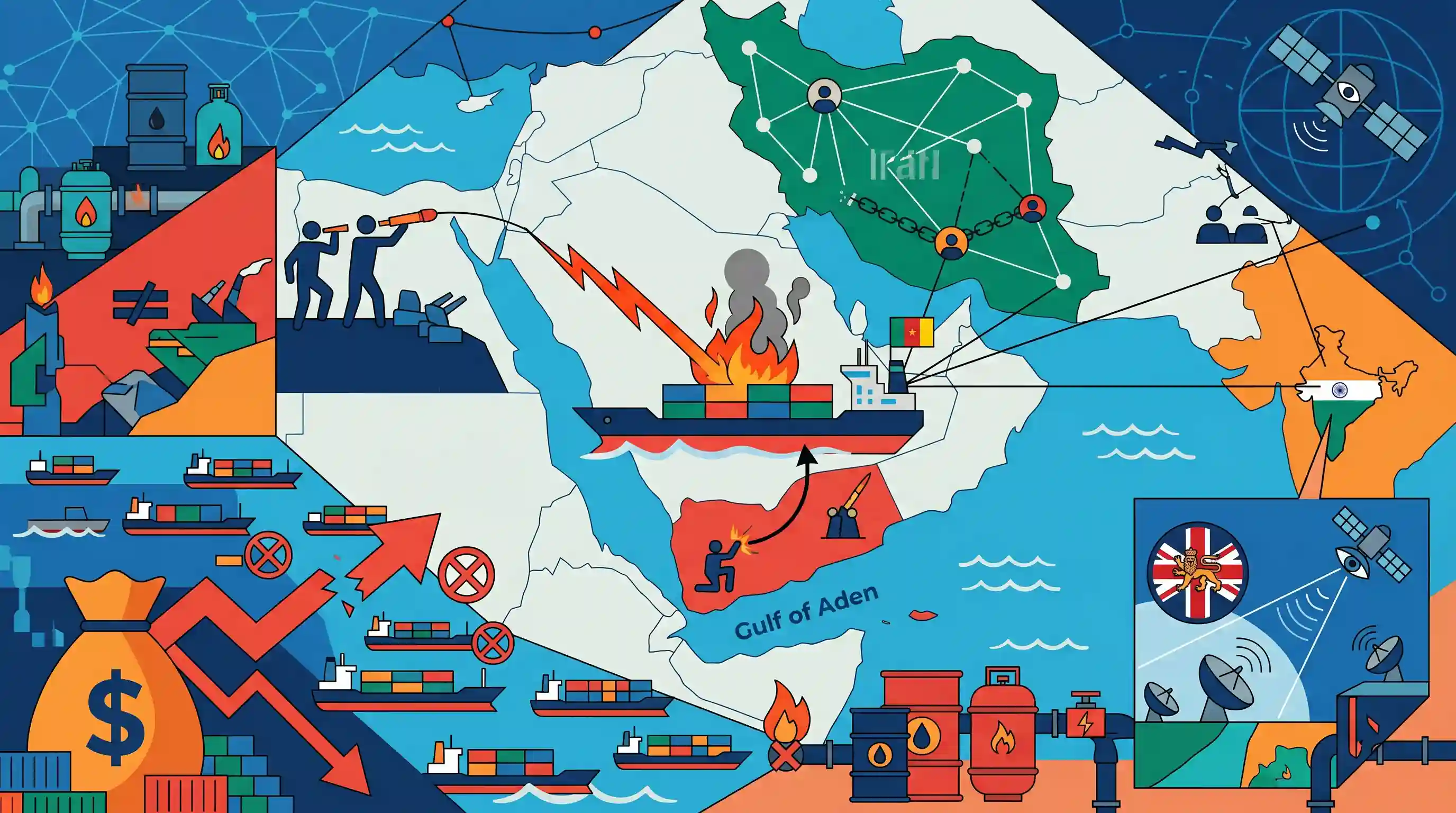
A British military monitoring center reported that a Cameroon-flagged ship, the Falcon, caught fire after being struck by an unidentified projectile off the coast of Yemen in the Gulf of Aden. The vessel, carrying liquefied petroleum gas and purportedly operated by Indian entities, is suspected to be part of an Iranian 'ghost fleet' designed to evade international sanctions. The incident highlights the continued threat posed by Houthi rebel attacks in the Red Sea, which have severely disrupted a crucial maritime corridor responsible for $1 trillion in global trade annually.
Key Points
- An unknown projectile struck the Cameroon-flagged LPG tanker Falcon, causing a fire in the Gulf of Aden off the coast of Yemen.
- The attack was reported by the United Kingdom Maritime Trade Operations (UKMTO) and aligns with the ongoing campaign of ship strikes by Houthi rebels in the region.
- The Falcon is suspected of operating within an Iranian 'ghost fleet' to bypass international sanctions, and reportedly has Indian owners and operators.
- Continuous attacks in the Red Sea corridor are forcing maritime traffic to avoid the critical Bab-el-Mandeb Strait, disrupting what was previously a $1 trillion annual global trade route.
Important Terms
United Kingdom Maritime Trade Operations (UKMTO)

A Royal Navy-led information center providing security alerts and coordination for merchant ships in the Indian Ocean, Red Sea, and Gulf of Aden to counter piracy and maritime threats.
UPSC context
GS Paper 3: Internal Security (Maritime Security). Tests understanding of international monitoring mechanisms and safety of global sea lanes of communication (SLOCs).
Houthi rebels
An Iran-aligned Zaydi Shia militant group in Yemen that controls large territories and conducts missile and drone attacks on international shipping to exert geopolitical pressure.
UPSC context
GS Paper 2: International Relations. Concerns Middle East geopolitics, non-state actors, and their impact on India’s energy security and trade via the Red Sea.
International sanctions
Coercive, non-military measures (economic, financial, or diplomatic) imposed by countries or international bodies to pressure states or entities into complying with international law or norms.
UPSC context
GS Paper 2: International Relations. Tests knowledge of tools of economic diplomacy and their effectiveness in global governance.
Ghost fleet (Shadow fleet)
A network of commercial vessels using deceptive practices, such as disabling tracking transponders (AIS) and 'flag hopping,' to transport sanctioned goods like Iranian or Russian oil.
UPSC context
GS Paper 3: Security & Economy. Relates to maritime law enforcement, money laundering, and illicit trade bypass mechanisms.
Gulf of Aden
A strategic arm of the Indian Ocean between Yemen and Somalia, connecting the Arabian Sea to the Red Sea via the Bab-el-Mandeb strait.
UPSC context
GS Paper 1: Geography. Vital chokepoint; tests knowledge of world mapping and maritime trade corridors.
Prelims Trap
The Bab-el-Mandeb Strait connects the Persian Gulf to the Gulf of Aden.
Bab-el-Mandeb connects the Red Sea to the Gulf of Aden. The Strait of Hormuz connects the Persian Gulf to the Gulf of Oman. UPSC routinely swaps these.
Static Concepts Connected
What are the key maritime chokepoints in the Middle East?
- Bab-el-Mandeb: Connects the Red Sea to the Gulf of Aden, situated between Yemen (Arabian Peninsula) and Djibouti/Eritrea (Horn of Africa).
- Strait of Hormuz: Connects the Persian Gulf to the Gulf of Oman, flanked by Iran, UAE, and Oman. Critical for crude oil transit.
- Suez Canal: Connects the Red Sea to the Mediterranean Sea through Egypt, bypassing the Cape of Good Hope route.
What constitutes a 'Ghost Fleet' (or Dark Fleet) in maritime trade?
- Definition: Vessels that deliberately obscure their ownership, flag state, and movements to evade international sanctions and transport embargoed goods like crude oil.
- Modus Operandi: Disabling Automatic Identification System (AIS) transponders, conducting illegal ship-to-ship (STS) transfers at sea, and engaging in frequent flag-hopping.
Cross-Topic Patterns
Ghost Fleets + Economic Sanctions evasiom
The rise of shadow fleets directly connects to Western sanctions on Iran and Russia, bypassing the SWIFT system, price caps, and Western maritime insurance mechanisms.
Red Sea Crisis + Core Inflation
Rerouting trade via the Cape of Good Hope inflates freight costs, directly impacting India's import bill and export competitiveness. This links geopolitical chokepoints to domestic macroeconomic inflation.

Map-based matching of Middle-East straits paired with sanctions-evasion tactics ('Ghost Fleets') is highly probable for Prelims 2026.
Linked PYQs · 4
Linked PYQs · 4
- 2023PrelimsGS1
Consider the following pairs: Area of conflict mentioned in news Country where it is located 1. Donbas : Syria 2. Kachin : Ethiopia 3. Tigray : North Yemen How many of the above pairs are correctly matched?
- 2023MainsGS2
‘Sea is an important Component of the Cosmos’ Discuss in the light of the above statement the role of the IMO (International Maritime Organisation) in protecting environment and enhancing maritime safety and security.
- 2025MainsGS2
"Energy security constitutes the dominant kingpin of India's foreign policy, and is linked with India's overarching influence in Middle Eastern countries.” How would you integrate energy security with India's foreign policy trajectories in the coming years?
- 2024MainsGS2
Discuss the geopolitical and geostrategic importance of Maldives for India with a focus on global trade and energy flows. Further also discuss how this relationship affects India's maritime security and regional stability amidst international competition ?
