British Foreign Secretary Visits India to Advance Free Trade Agreement
Source:Indian Express ↗
Why It Matters
The deepening strategic and economic ties between India and the UK are pivotal for India's foreign policy and global trade ambitions. Topics like Free Trade Agreements, maritime security in the volatile West Asian region, and technology and defense partnerships are highly relevant for the Mains examination, addressing issues of strategic autonomy and economic integration.
Summary
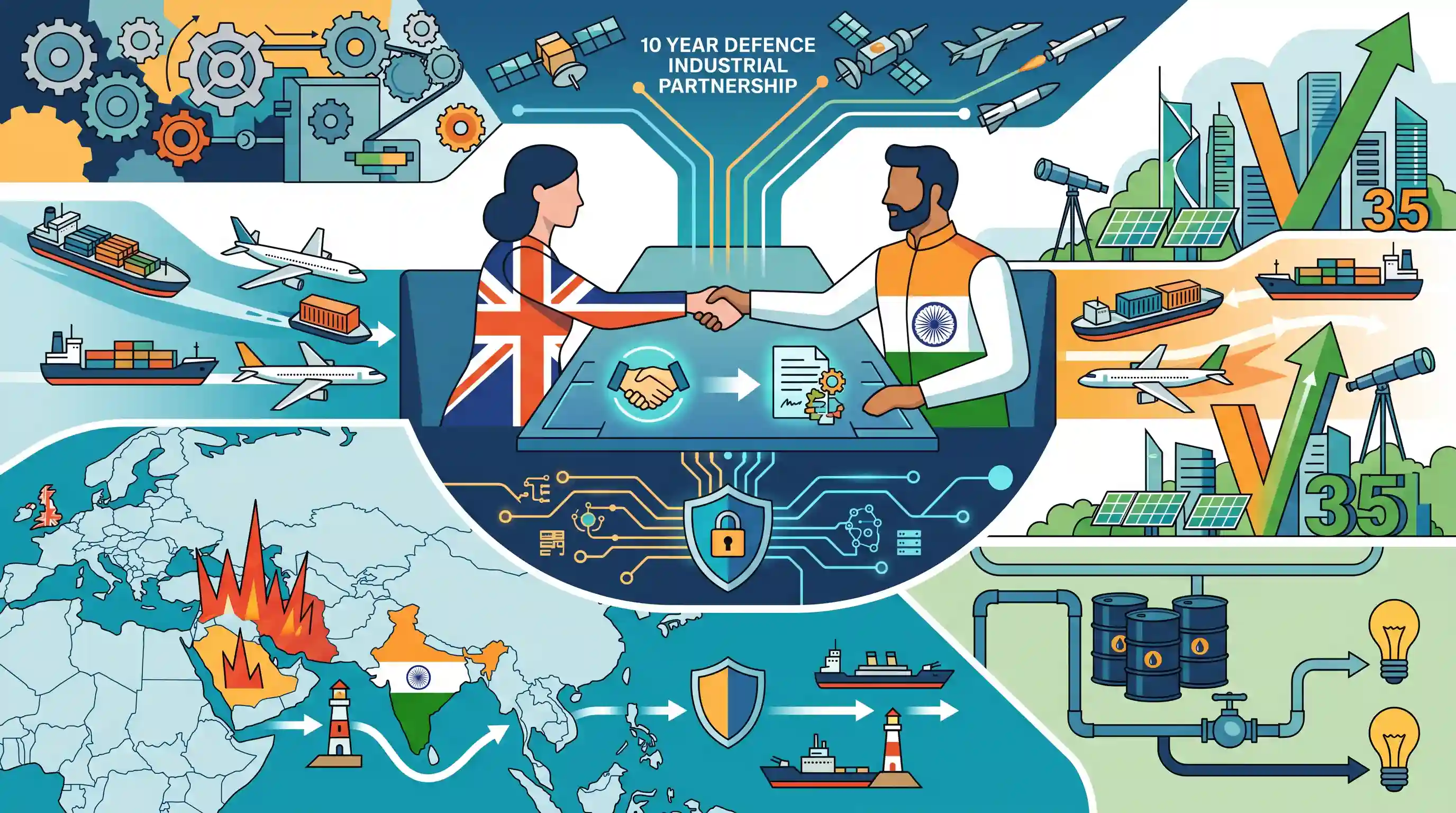
British Foreign Secretary Yvette Cooper is on her first official visit to India to hold high-level talks with Prime Minister Narendra Modi and External Affairs Minister S Jaishankar. A major focus of the diplomatic engagement is to advance the UK-India Free Trade Agreement (FTA), alongside reviewing the delivery of the UK-India Vision 2035. Amid ongoing conflicts in West Asia affecting energy and maritime security, the leaders will discuss strategies to ensure freedom of navigation and mitigate economic shocks. The partnership is further reinforced by commitments to a 10-year Defence Industrial Partnership and the Technology Security Initiative.
Key Points
- British Foreign Secretary Yvette Cooper is undertaking her first official visit to India to meet PM Narendra Modi and EAM S Jaishankar.
- The discussions will center on minimizing economic shocks from ongoing conflicts, ensuring global stability, and preserving freedom of navigation amidst disruptions in West Asia.
- Both sides aim to expedite the implementation of the landmark UK-India Free Trade Agreement signed in July 2025.
- The visit includes a formal review of the UK-India Vision 2035 and underscores growing cooperation through the Technology Security Initiative and a 10-year Defence Industrial Partnership.
Important Terms
UK-India Free Trade Agreement (FTA)

The Comprehensive Economic and Trade Agreement (CETA) aimed at doubling bilateral trade to $100 billion by 2030 through tariff reductions on goods like textiles and scotch whisky.
UPSC context
GS Paper 2: Bilateral agreements. Tests knowledge of post-Brexit trade diversification and India's shift toward Western FTAs.
Technology Security Initiative (TSI)
A strategic framework launched in 2024 to deepen collaboration in seven critical sectors, including semiconductors, AI, quantum computing, and critical minerals, overseen by both nations' National Security Advisors.
UPSC context
GS Paper 2 & 3: International Relations and Science & Tech. Focuses on high-tech diplomacy and technological resilience.
UK-India Vision 2035
A 10-year roadmap launched in 2025 (replacing Roadmap 2030) that outlines strategic goals across trade, technology, defense, climate, and education to guide bilateral ties until 2035.
UPSC context
GS Paper 2: Bilateral relations. The primary policy document governing India-UK cooperation and strategic milestones for the next decade.
10-year Defence Industrial Roadmap
A decade-long framework focused on moving bilateral defense ties from buyer-seller relations to joint research, co-design, and co-production of jet engines, electric propulsion, and maritime systems.
UPSC context
GS Paper 3: Internal Security and Defence. Tests knowledge of "Make in India" integration and strategic autonomy through co-development.
Indo-Pacific Oceans Initiative (IPOI)
An Indian-led initiative for a safe, secure, and stable maritime domain in the Indo-Pacific; the UK leads the pillar on maritime security and capacity building.
UPSC context
GS Paper 2: Regional groupings and maritime security. Relevant for India’s leadership in the Indian Ocean and Indo-Pacific convergence.
Prelims Trap
The Technology Security Initiative (TSI) is a flagship bilateral framework between India and the United States.
Aspirants often confuse bilateral tech initiatives. TSI is between India and the UK, whereas the India-US framework is iCET. UPSC frequently swaps partner nations in Prelims statements.
Static Concepts Connected
How do Comprehensive Economic Partnership Agreements (CEPA) differ from standard FTAs?
- Standard FTA: Primarily focuses on eliminating or reducing customs duties/tariffs on traded merchandise goods (positive/negative lists).
- CEPA/CECA: More expansive, integrating trade in services, investment, intellectual property, competition laws, and deep regulatory alignment.
How does UNCLOS define 'Freedom of Navigation' across maritime zones?
- Territorial Sea: Extends up to 12 nautical miles from the baseline; foreign vessels enjoy the right of 'innocent passage' if it doesn't threaten coastal security.
- Exclusive Economic Zone: Extends up to 200 nautical miles; coastal states exclusively control economic resources, but all states enjoy full freedom of navigation and overflight.
Cross-Topic Patterns
Red Sea Crisis & Global Inflation
Bilateral talks on West Asia shocks map directly to Red Sea shipping disruptions, rerouting via the Cape of Good Hope, and the resulting macroeconomic impacts like imported inflation.
Defense Co-production via Make in India
The 10-year Defence Industrial Partnership reflects India's broader strategic shift across multiple partners (like the US and France) from a buyer-seller dynamic to joint IP creation and tech transfers.

Expect a 'match-the-following' Prelims question pairing tech-security frameworks (iCET, TSI, TTC) with their partner regions (US, UK, EU).
Linked PYQs · 4
Linked PYQs · 4
- 2017MainsGS2
The question of India's Energy Security constitutes the most important part of India's economic progress. Analyze India's energy policy cooperation with West Asian countries.
- 2023MainsGS2
‘Sea is an important Component of the Cosmos’ Discuss in the light of the above statement the role of the IMO (International Maritime Organisation) in protecting environment and enhancing maritime safety and security.
- 2014MainsGS2
With respect to the South China sea, maritime territorial disputes and rising tension affirm the need for safeguarding maritime security to ensure freedom of navigation and over flight throughout the region. In this context, discuss the bilateral issues between India and China.
- 2020MainsGS2
The judicial systems in India and UK seem to be converging as well as diverging in recent times. Highlight the key points of convergence and divergence between the two nations in terms of their judicial practices.
