UK Electoral Reforms: Lowering Voting Age and Campaign Funding Rules
Source:The Hindu ↗
Why It Matters
The UK's proposed electoral changes serve as an excellent comparative case study for GS Paper 2 (Polity and Comparative Constitutions). It resonates with historical Indian electoral reforms (such as the 61st Amendment lowering the voting age to 18), ongoing debates regarding voter registration (like the Election Commission of India's SVEEP initiatives), and contemporary concerns surrounding transparent political funding and the prevention of foreign interference.
Summary
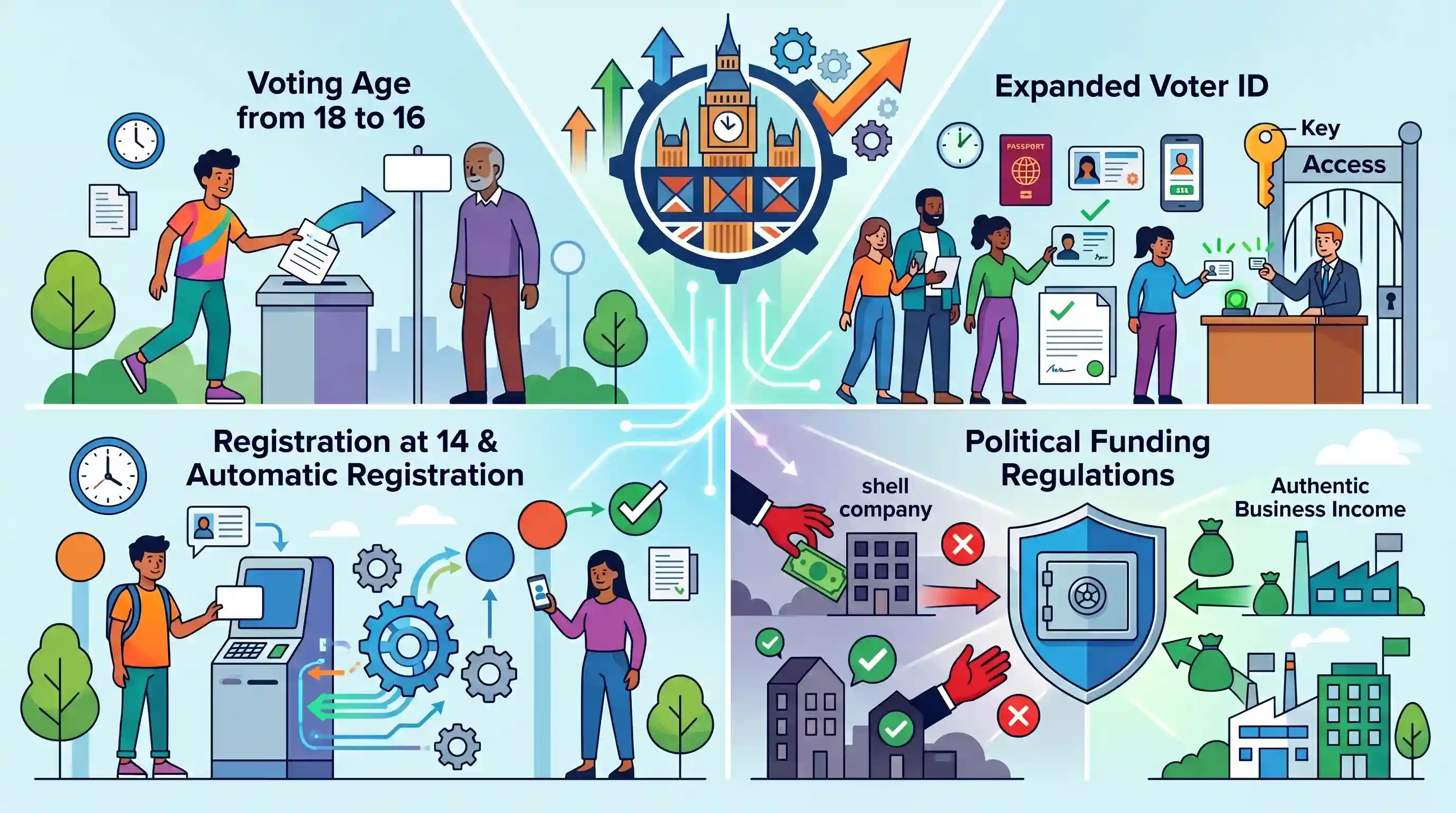
Britain's Labour government has introduced proposals for major electoral reforms, prominently featuring the lowering of the voting age from 18 to 16 to enhance youth democratic participation. The reforms also include lowering the voter registration age to 14 to pave the way for automatic registration and expanding acceptable voter ID documents to improve accessibility. Additionally, stringent regulations on political funding are being proposed to prevent foreign interference, including a ban on donations from shell companies and a requirement that corporate donations stem from authentic UK or Irish business income.
Key Points
- The UK government announced plans to lower the voting age from 18 to 16 to boost youth democratic participation, citing their economic contributions through taxes and work.
- Voter registration will begin at age 14 as part of a broader transition toward an automatic voter registration system.
- To curb foreign interference, new rules will ban political donations from shell companies and require funds to originate from businesses with genuine UK or Irish operations.
- The government intends to expand the list of valid voter IDs at polling booths, reversing stringent photo ID requirements enacted by the previous Conservative government.
Important Terms
61st Constitutional Amendment Act

Landmark 1988 Indian law that lowered the voting age for Lok Sabha and State Assembly elections from 21 to 18 years by amending Article 326.
UPSC context
GS Paper II - Polity; essential for topics on electoral reforms, youth empowerment, and universal adult suffrage.
Representation of the People Act, 1951
The primary Indian statute governing candidate qualifications, disqualifications, and the conduct of elections to Parliament and State Legislatures, ensuring free and fair democratic processes.
UPSC context
GS Paper II - Salient features of RPA; core to questions on disqualification of legislators and election management.
Labour Party
The current governing center-left political party in the United Kingdom, led by Keir Starmer, which proposed lowering the voting age to 16 to modernize democracy.
UPSC context
GS Paper II - Comparative Constitutions; relevant for studying parliamentary systems and electoral reform trends in major democracies.
Conservative Party
The main center-right opposition party in the UK, which argues that lowering the voting age to 16 is confusing due to legal inconsistencies regarding the age of majority.
UPSC context
GS Paper II - Comparative Constitutions; provides the counter-argument for democratic debates on franchise expansion and maturity requirements.
Prelims Trap
"Indian political parties are strictly barred from accepting any contributions from Indian subsidiaries of foreign companies."
Retrospective FCRA amendments (Finance Acts 2016 & 2018) altered the definition of 'foreign source', allowing Indian subsidiaries of foreign companies to donate within FEMA limits.
Static Concepts Connected
How is the voting age and right to vote constitutionally protected in India?
- Article 326: Article 326 guarantees elections to the Lok Sabha and State Legislative Assemblies based on universal adult suffrage.
- 61st Amendment: The 61st Constitutional Amendment Act (1988) amended Article 326 to lower the voting age from 21 to 18 years.
- Constitutional Right: The Supreme Court classifies the right to vote as a constitutional and statutory right (under RPA), not a Fundamental Right.
How does India regulate foreign funding and corporate donations to political parties?
- RPA 1951: Section 29B prohibits registered political parties from accepting any contributions from a 'foreign source' or a government company.
- FCRA Exemptions: Finance Acts (2016/2018) amended FCRA to allow Indian subsidiaries of foreign entities to donate if their foreign holding aligns with FEMA rules.
- Electoral Bonds Judgment: The Supreme Court recently struck down Finance Act 2017 amendments that permitted unlimited, opaque corporate funding to political parties.
Cross-Topic Patterns
Comparative electoral funding limits
The UK's ban on shell company donations mirrors India's recent Supreme Court Electoral Bonds judgment, highlighting a global democratic push to identify ultimate beneficial owners in political finance.
Demographic dividend & youth political agency
Lowering the voting age links to 'demographic dividend' debates (GS3); providing youth with early political agency is increasingly viewed as vital to securing their long-term economic participation and tax compliance.

Expect a 2026 prelims multi-statement Q comparing Indian (FCRA/RPA) and UK laws on foreign political funding and voting age.
Linked PYQs · 4
Linked PYQs · 4
- 2024MainsGS2
Examine the need for electoral reforms as suggested by various committees with particular reference to "one nation one election" principle.
- 2025MainsGS2
Discuss the 'corrupt practices' for the purpose of the Representation of the People Act, 1951. Analyze whether the increase in the assets of the legislators and/or their associates, disproportionate to their known sources of income, would constitute 'undue influence' and consequently a corrupt practice.
- 2017PrelimsGS1
Right to vote and to be elected in India is a
- 2020PrelimsGS1
Consider the following statements: 1. According to the Constitution of India, a person who is eligible to vote can be made a minister in a State for six months even if he/she is not a member of the Legislature of that State. 2. According to the Representation of People Act, 1951, a person convicted of a criminal offence and sentenced to imprisonment for five years is permanently disqualified from contesting an election even after his release from prison. Which of the statements given above is/are correct?
