UK and China bilateral talks and economic cooperation
Source:The Hindu ↗
Why It Matters
Demonstrates shifting geopolitical alignments and the impact of US protectionist policies, compelling traditional allies like the UK to pursue pragmatic economic relations with China despite ideological and human rights differences. This dynamic directly shapes global supply chains and trade frameworks, which has significant strategic implications for India's foreign policy.
Summary
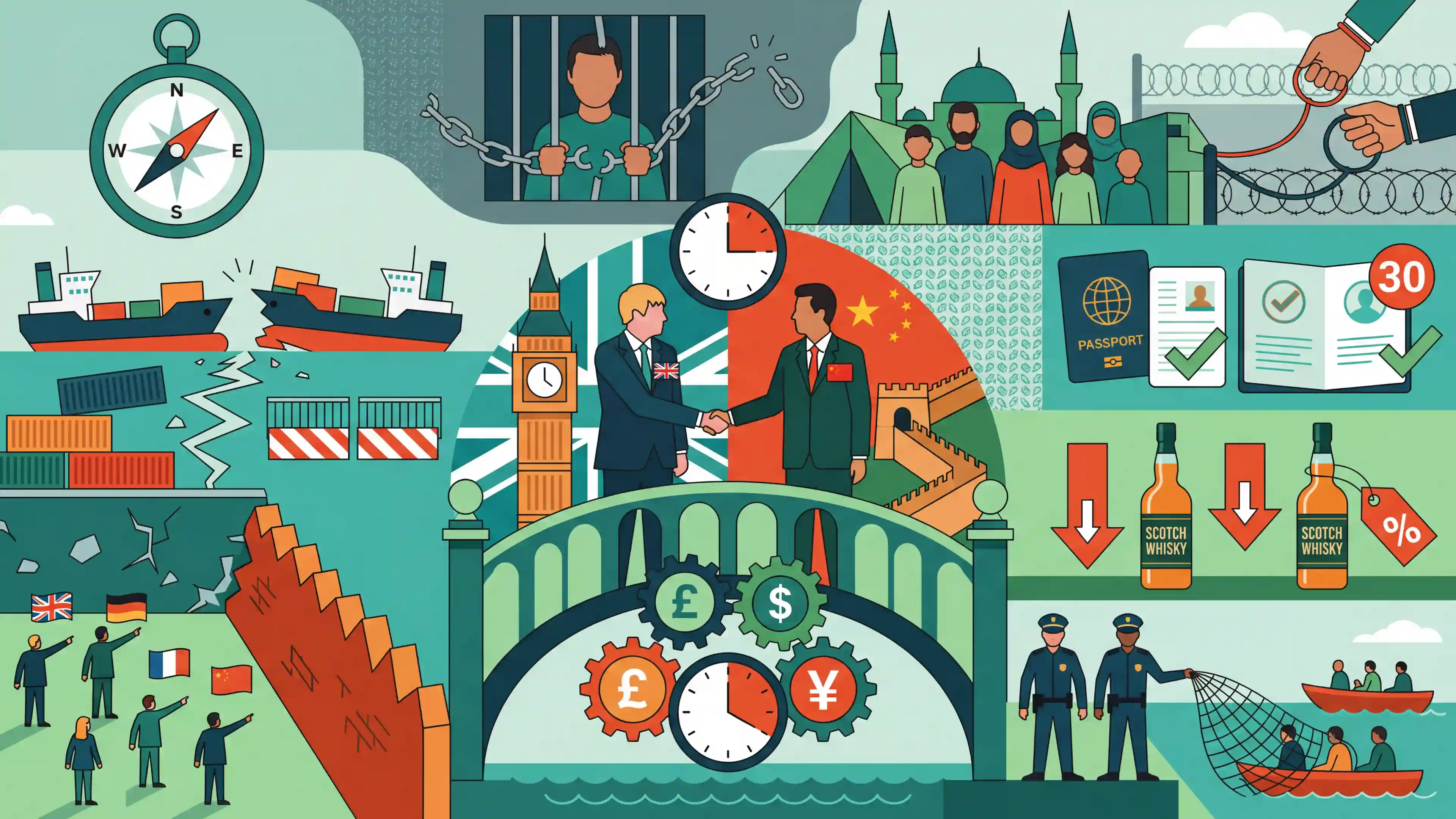
British Prime Minister Keir Starmer met with Chinese President Xi Jinping and Premier Li Qiang in Beijing, marking the first visit by a UK premier to China since 2018. The bilateral talks aimed to forge closer economic ties as the UK and other Western nations pivot towards China amidst an unpredictable trade landscape marked by US protectionism. Key agreements included visa-free travel for UK citizens visiting China for under 30 days, reduced tariffs on Scotch whisky, and cooperation to target migrant smuggling networks. Starmer also addressed sensitive human rights issues, bringing up the detention of Hong Kong pro-democracy figure Jimmy Lai and the treatment of Uyghurs in Xinjiang.
Key Points
- PM Keir Starmer’s visit to Beijing represents a strategic diplomatic shift for the UK, seeking stronger economic cooperation with China to offset the risks of US protectionism and potential tariff threats under Donald Trump.
- China announced visa-free travel for British passport holders for stays up to 30 days, alongside an agreement to lower Chinese tariffs on Scotch whisky from 10% to 5%.
- The two nations agreed to collaborate on disrupting the supply chains utilized by migrant smugglers and to strengthen the UK-China trade commission.
- Despite the focus on economic ties (highlighted by AstraZeneca's $15 billion investment in China), Starmer raised sensitive human rights issues, including the imprisonment of Hong Kong pro-democracy figure Jimmy Lai and the treatment of Uyghurs in Xinjiang.
- The meeting underscores a broader trend of Western allies pursuing pragmatic economic engagement with Beijing while managing underlying security, human rights, and geopolitical tensions.
Important Terms
NATO

A 32-member intergovernmental military alliance. In 2026, its members' pivot toward China reflected a reassessment of security and trade alliances amid unpredictable US protectionism and shifting global power dynamics.
UPSC context
GS II: Global Groupings. Analyzes how the policies of developed nations (USA) affect global alliances and international stability.
UK-China Trade Commission
A bilateral institutional mechanism strengthened during Prime Minister Keir Starmer’s 2026 visit to facilitate economic cooperation, improve market access, and resolve trade disputes between the United Kingdom and China.
UPSC context
GS II: Bilateral Relations. Focuses on institutional frameworks for managing trade and diplomacy between major global powers.
AstraZeneca
A UK-based multinational pharmaceutical firm that announced a $15 billion investment in China in 2026, symbolizing the "pragmatic" economic engagement between the two nations despite human rights and security tensions.
UPSC context
GS II/III: Economy and Foreign Policy. Tests understanding of Corporate Diplomacy and the intersection of global trade and national security.
Jimmy Lai
A British citizen and Hong Kong pro-democracy media tycoon whose detention under the National Security Law is a major diplomatic friction point in UK-China bilateral human rights dialogues.
UPSC context
GS II: International Relations. Examines the role of human rights, sovereignty, and the legal status of overseas citizens in diplomacy.
Comprehensive Strategic Partnership
The formal diplomatic framework agreed upon by the UK and China in 2026 to provide an institutional basis for a long-term, stable, and consistent bilateral relationship.
UPSC context
GS II: Bilateral Agreements. Crucial for understanding the hierarchy of diplomatic ties and their impact on global geopolitics.
Prelims Trap
"The UK and China signed a reciprocal visa-free travel agreement."
China has been offering *unilateral* visa waivers to several European countries to attract tourism and capital. It is not reciprocal for Chinese citizens visiting the UK.
Static Concepts Connected
What is the difference between 'Decoupling' and 'De-risking'?
- Decoupling: A complete severance of economic ties and supply chains between two major economies (e.g., US-China hardline approach).
- De-risking: Reducing strategic dependencies in critical sectors (minerals, high-tech) while maintaining broader, pragmatic trade relations (the approach favored by the EU and UK).
- India's Angle: India aims to capitalize on both strategies by positioning itself as a reliable manufacturing hub under the "China Plus One" framework.
What are the primary geopolitical flashpoints regarding China's human rights record?
- Xinjiang: Allegations of mass internment, forced labor, and cultural erasure of the Uyghur Muslim minority in the western region of Xinjiang.
- Hong Kong: The imposition of the National Security Law (2020), which critics argue dismantled the "One Country, Two Systems" framework and suppressed pro-democracy figures.
- Diplomatic Impact: Western nations frequently use these issues to justify targeted sanctions, though pragmatic economic engagement often supersedes them during domestic economic distress.
Cross-Topic Patterns
US Protectionism & Global Hedging
As the US signals indiscriminate tariffs, traditional allies like the UK are hedging by stabilizing ties with Beijing, undermining unified Western decoupling efforts and complicating India's strategic calculations.
China's Unilateral Visa Diplomacy
China is deploying unilateral visa-free entries to European nations to revive foreign investment, counter capital flight, and soften its geopolitical image amidst ongoing economic slowdowns.

Mains 2026: Analyze how US protectionism forces Western allies into pragmatic engagement with China, impacting India's China+1 goals.
Linked PYQs · 3
Linked PYQs · 3
- 2024MainsGS2
‘The West is fostering India as an alternative to reduce dependence on China's supply chain and as a strategic ally to counter China's political and economic dominance.’ Explain this statement with examples.
- 2025MainsGS3
What are the challenges before the Indian economy when the world is moving away from free trade and multilateralism to protectionism and bilateralism? How can these challenges be met?
- 2018MainsGS3
How would the recent phenomena of protectionism and currency manipulations in world trade affect macroeconomic stability of India?
