नाटो आर्कटिक रणनीति और महाशक्ति भू-राजनीतिक प्रतिस्पर्धा
स्रोत:इंडियन एक्सप्रेस ↗
क्यों मायने रखता है
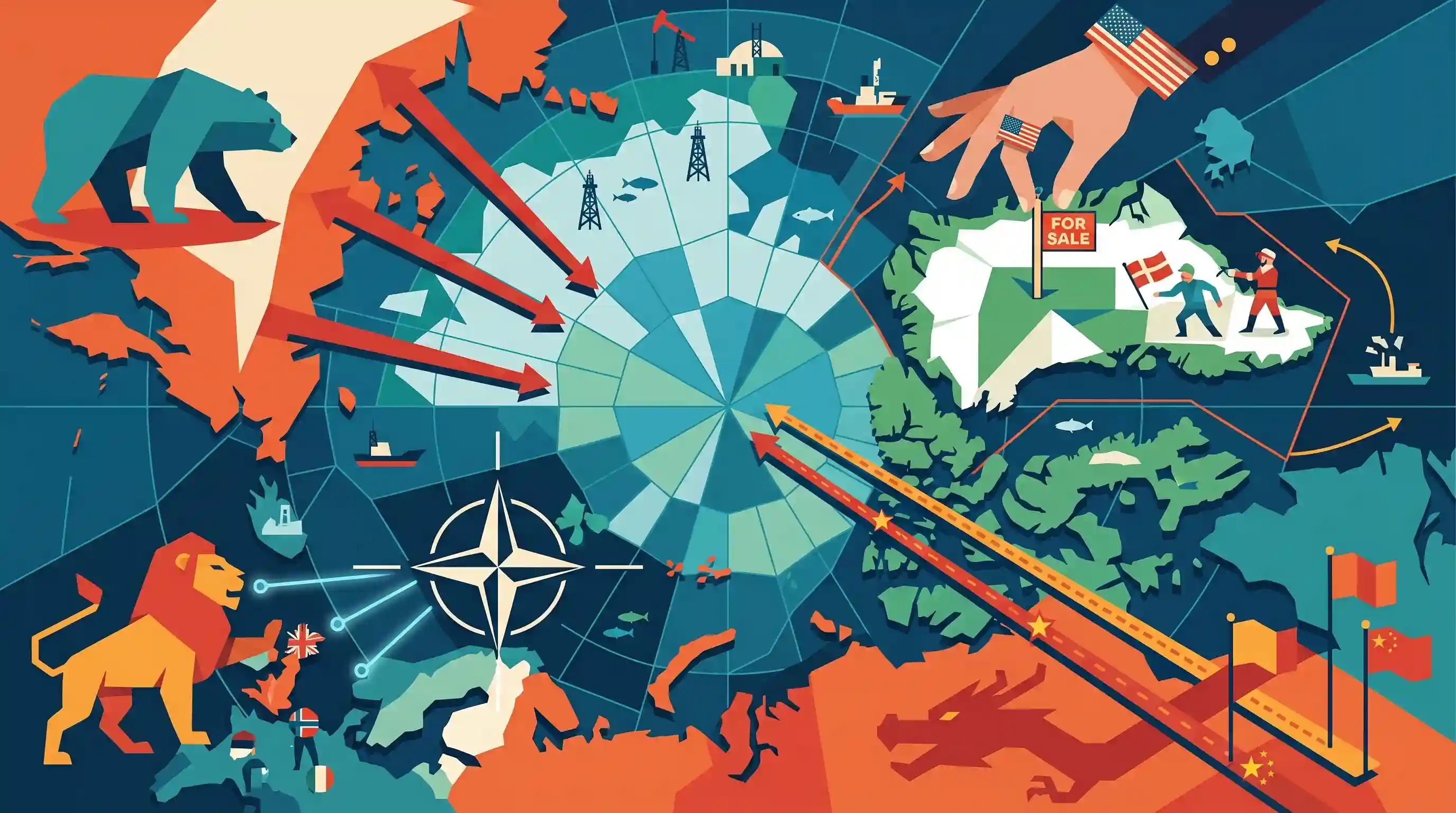
The Arctic region is rapidly emerging as a new theater for geopolitical rivalry due to climate change opening access to resources and trade routes. Understanding the maneuvers of global powers (US, Russia, China, UK) and alliances (NATO) in this region is critical for analyzing contemporary international relations and shifting security paradigms.
सारांश
Britain is engaged in discussions with NATO allies to bolster security and deterrence in the Arctic Circle against increasing competition from Russia and China. This strategic focus coincides with recent controversial statements by US President Donald Trump about potentially acquiring Greenland, a semi-autonomous Danish territory, to preempt Russian or Chinese expansion. The developments highlight the Arctic's growing geopolitical significance and the shifting dynamics of great power competition within the NATO framework.
मुख्य बिंदु
- ब्रिटेन, रूस और चीन से बढ़ते खतरों और प्रतिस्पर्धा का मुकाबला करने के लिए आर्कटिक में सुरक्षा बढ़ाने के तरीकों पर NATO सहयोगियों के साथ चर्चा कर रहा है।
- US President Donald Trump has proposed acquiring Greenland, a semi-autonomous region of NATO ally Denmark, to prevent its takeover by Russia or China.
- The UK agrees that the Arctic requires securing and effective deterrence against competitors, though it characterizes current NATO talks as standard practice rather than a direct response to Trump's statements.
- Political leaders in the UK have suggested deploying troops to Greenland under a joint command with Denmark to strengthen the NATO alliance and counter Russian influence.
महत्वपूर्ण शब्द
NATO

A 32-member intergovernmental military alliance established by the 1949 Washington Treaty. It operates on the principle of collective defense, where an attack on one member is considered an attack on all.
UPSC context
GS Paper 2 (International Relations); tests knowledge of global security architecture, collective defense (Article 5), and India's strategic partnerships with member nations.
Arctic Council
The preeminent intergovernmental forum (est. 1996) for cooperation among Arctic states and indigenous people. It focuses on sustainable development and environmental protection; India holds observer status since 2013.
UPSC context
GS Paper 2 (International Relations); important for India's Arctic Policy 2022 and research on the Arctic-Himalaya climate link affecting monsoons.
Northern Sea Route (NSR)
A shipping route along Russia's Arctic coast connecting the Atlantic and Pacific. Melting ice is making it a viable, shorter alternative to the Suez Canal for global trade and energy transport.
UPSC context
GS पेपर 1 (भूगोल) और GS पेपर 2; समुद्री व्यापार, भारत की ऊर्जा सुरक्षा और चेन्नई-व्लादिवोस्तोक समुद्री गलियारे (Chennai-Vladivostok Maritime Corridor) से संबंधित है।
Exclusive Economic Zone (EEZ)
A maritime zone extending up to 200 nautical miles from a coastal state's baseline, as defined by UNCLOS, granting exclusive rights to explore and exploit marine and energy resources.
UPSC context
GS Paper 1 (Geography) and GS Paper 2; tests understanding of UNCLOS, maritime resource sovereignty, and territorial disputes in resource-rich waters.
महाशक्ति प्रतिस्पर्धा
प्रमुख वैश्विक शक्तियों (अमेरिका, रूस और चीन) के बीच वैश्विक प्रभाव, संसाधनों पर नियंत्रण और सैन्य श्रेष्ठता के लिए रणनीतिक और भू-राजनीतिक प्रतिद्वंद्विता, विशेष रूप से आर्कटिक जैसे नए सुलभ क्षेत्रों में।
UPSC context
GS Paper 2 (International Relations); tests ability to analyze shifting global power dynamics, regional militarization, and India's "strategic autonomy" in a multipolar world.
प्रारंभिक ट्रैप
The Arctic Council oversees military security and dispute resolution among Arctic nations.
1996 की ओटावा घोषणा (Ottawa Declaration) स्पष्ट रूप से सैन्य और सुरक्षा मामलों को आर्कटिक काउंसिल (Arctic Council) के जनादेश से बाहर रखती है, और इसका पूरा ध्यान केवल पर्यावरण संरक्षण और वैज्ञानिक सहयोग पर केंद्रित है।
संबंधित अवधारणाएँ
आर्कटिक काउंसिल के मुख्य सदस्य कौन हैं और इसका जनादेश क्या है?
- Core Members: The 8 sovereign Arctic states: Canada, Denmark, Finland, Iceland, Norway, Russia, Sweden, and the United States.
- Restricted Mandate: Explicitly excludes military security; its forums are designed entirely for environmental protection, sustainable development, and scientific collaboration.
- India's Role: India holds Observer status (re-elected in 2019), conducting regional research primarily via the Himadri station in Svalbard, Norway.
What is the strategic importance of the GIUK gap?
- चोकपॉइंट स्थान: A vital oceanic chokepoint forming a line between Greenland, Iceland, and the United Kingdom in the northern Atlantic Ocean.
- Naval Containment: It remains critical for NATO forces to monitor and contain Russian submarines moving from Arctic bases into the open North Atlantic.
अंतर-विषय पैटर्न
पोलर सिल्क रोड और BRI
चीन अपने 'Polar Silk Road' को वैध बनाने के लिए 'Near-Arctic State' के दर्जे का दावा करता है, जो आर्कटिक समुद्री मार्गों को सीधे अपने 'Belt and Road Initiative' से जोड़ता है ताकि मलक्का जलडमरूमध्य (Malacca Strait) को बाईपास किया जा सके।
जलवायु-प्रेरित रणनीतिक प्रतिस्पर्धा
Accelerated sea-ice melting transforms the Arctic from an environmental focus into a geopolitical theater by unlocking the Northern Sea Route (NSR) and untapped critical minerals.

Expect a multi-statement prelims question linking the GIUK gap, Northern Sea Route, and the Arctic Council's strictly non-military mandate.
संबद्ध PYQ · 3
संबद्ध PYQ · 3
- 2011MainsGS2
As regards the increasing rates of melting of Arctic Sea ice, the interests of the Arctic Council nations may not coincide with those of the wider world." Explain.
- 2023MainsGS2
‘The expansion and strengthening of NATO and a stronger US-Europe strategic partnership works well for India.’ What is your opinion about this statement ? Give reasons and examples to support your answer.
- 2021MainsGS2
“The USA is facing an existential threat in the form of a China, that is much more challenging than the erstwhile Soviet Union.” Explain.
