Piprahwa Relics Repatriation and Cultural Heritage Diplomacy
Source:The Hindu ↗
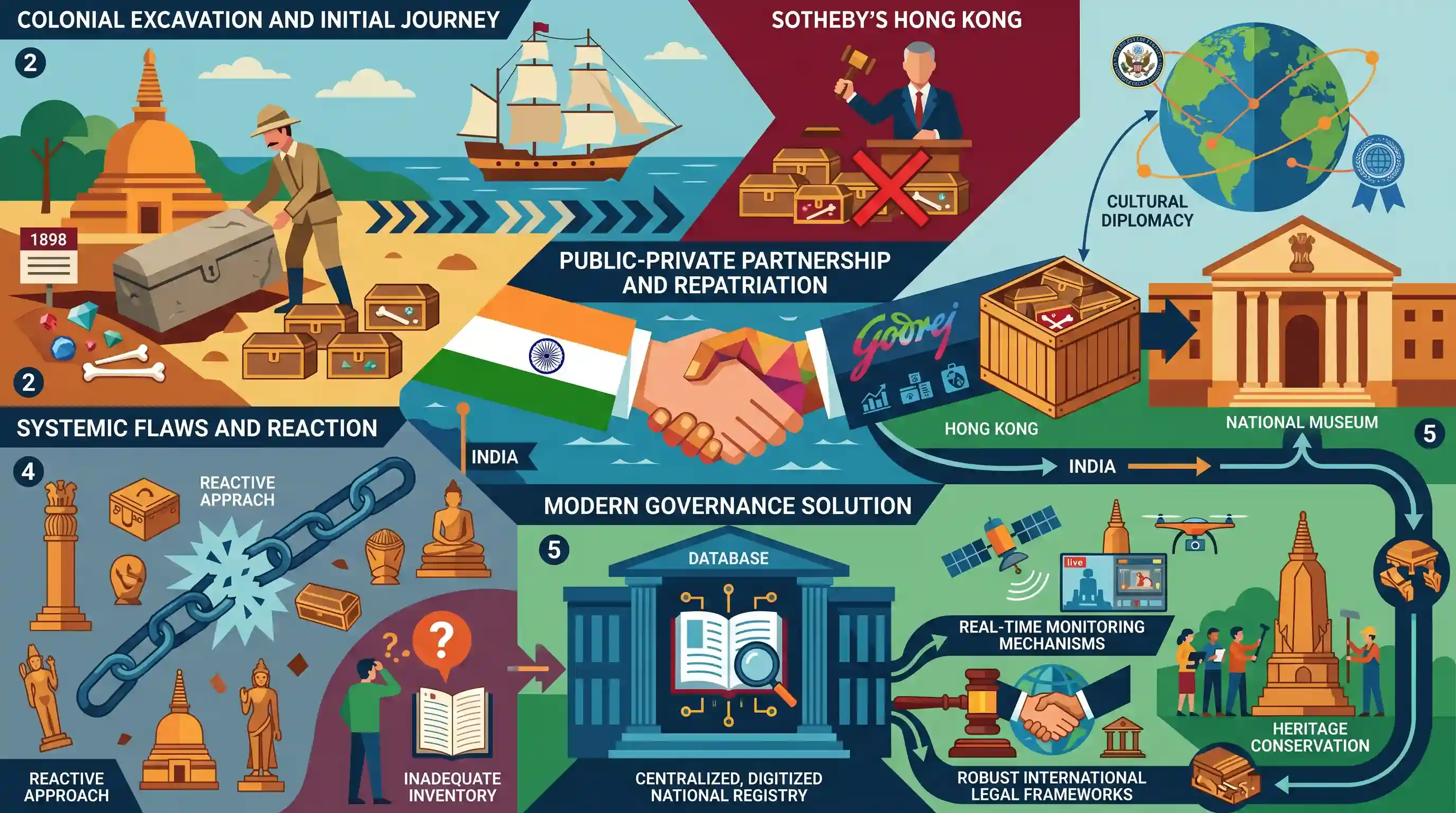
Why It Matters
The protection, conservation, and repatriation of Indian cultural heritage are central to GS1 (Art & Culture) and GS2 (International Relations/Cultural Diplomacy). The role of public-private partnerships in executing soft-power goals is a critical contemporary dimension of heritage management for UPSC aspirants.
Summary
The repatriation of the Piprahwa relics—remnants associated with Lord Buddha, excavated in 1898 in Uttar Pradesh and taken during the colonial era—represents a major achievement in India's cultural diplomacy. Following an attempt by Sotheby's to auction the artifacts in Hong Kong, the Indian government collaborated with the Godrej Industries Group in a public-private partnership to halt the sale and return the relics to the National Museum. While celebrating the return, the editorial highlights systemic flaws in India's reactive approach to safeguarding antiquities. It emphasizes the critical need for a centralized, digitized national registry of cultural assets, real-time monitoring mechanisms, and robust international legal frameworks to permanently prevent the commercialization of sacred heritage.
Key Points
- The repatriation of the Piprahwa relics, excavated in 1898 from a stupa in Uttar Pradesh and linked to Lord Buddha's mortal remains, highlights a successful use of cultural diplomacy and a public-private partnership.
- The artifacts were intended for auction by Sotheby's in Hong Kong, but intervention by the Indian government and negotiation by the Godrej Industries Group successfully brought them back to the National Museum.
- The episode exposes structural gaps in India's framework for heritage recovery, showing a reliance on reactive measures and diplomatic pressure rather than institutional safety nets.
- The editorial advocates for an integrated digital registry of cultural assets, proactive global tracking, and the establishment of binding international legal norms against commercializing sacred relics.
Important Terms
Piprahwa Relics

Ancient Buddhist artifacts discovered in 1898 at a stupa in Uttar Pradesh, including bone fragments and jewels, identifying the site as ancient Kapilavastu.
UPSC context
GS Paper I (Art and Culture/Ancient History); tests knowledge of early Buddhism, archaeological sites, and recent repatriation efforts.
Antiquities and Art Treasures Act, 1972
Central legislation regulating the trade, export, and preservation of objects older than 100 years (antiquities) to protect India's cultural heritage from illegal trafficking.
UPSC context
GS Paper II (Governance/Laws); tests understanding of the legal framework for heritage conservation and administrative challenges in preventing smuggling.
Cultural Diplomacy
The use of cultural exchanges, heritage, and soft power to strengthen international relations; in India, it increasingly includes reclaiming looted artifacts.
UPSC context
GS Paper II (International Relations); tests knowledge of soft power strategies and India's civilisational influence in global forums.
UNESCO 1970 Convention
An international treaty prohibiting the illicit import, export, and transfer of cultural property, providing the primary legal basis for the global return of heritage.
UPSC context
GS Paper II (International Institutions); tests awareness of global legal frameworks that support India's claims for repatriating artifacts.
National Museum
India's premier cultural institution in New Delhi, acting as the primary custodian for significant national treasures, including repatriated antiquities and sacred Buddhist relics.
UPSC context
GS Paper I (Indian Culture); tests knowledge of key institutions responsible for the preservation and display of historical artifacts.
Godrej Industries Group
A private Indian conglomerate that utilized a Public-Private Partnership (PPP) model to acquire and repatriate the Piprahwa relics from an international auction house.
UPSC context
GS Paper II (Governance); highlights the role of private actors and PPP models in achieving national cultural objectives.
Prelims Trap
The UNESCO 1970 Convention legally compels auction houses to return all antiquities taken from India during the British colonial era.
The 1970 Convention is generally not retroactive. Pre-1970 removals, like the 1898 Piprahwa excavation, rely primarily on bilateral diplomatic pressure, not international legal compulsion.
Static Concepts Connected
Who received the original eight shares of Lord Buddha's relics?
- Sakyas: They enshrined their share at Kapilavastu (often identified with the modern-day Piprahwa stupa in Uttar Pradesh).
- Ajatashatru: The King of Magadha enshrined his share of the mortal remains in a stupa built at Rajagriha.
- Licchavis & Mallas: The Licchavis of Vaishali and Mallas of Kushinagar/Pava also received shares, forming part of the original eight Drona Stupas.
How does Indian law define and protect antiquities?
- Legal Definition: Under the Antiquities and Art Treasures Act of 1972, objects over 100 years old (and manuscripts over 75 years old) are legally classified as antiquities.
- Export Ban: There is a strict prohibition on the export of antiquities by anyone other than the Central Government or its authorized agencies.
- National Registry: The National Mission on Monuments and Antiquities (NMMA) maintains a digitized national register to track heritage assets and prevent illicit trafficking.
Cross-Topic Patterns
Corporate PPPs in Cultural Heritage
Corporate interventions, like Godrej negotiating with Sotheby's, highlight the growing role of Public-Private Partnerships and CSR funds in cultural diplomacy and heritage repatriation.
Buddhism as Diplomatic Soft Power
India frequently deploys Buddhist relics (like sending the Kapilavastu relics to Sri Lanka or Mongolia) to bolster its 'Act East' policy and project soft power across Asia.

Buddhism questions in 2026 will likely shift from philosophy to the geographical mapping of original relic stupas (Piprahwa, Rajagriha).
Linked PYQs · 3
Linked PYQs · 3
- 2023PrelimsGS1
With reference to ancient India, consider the following statements: 1. The concept of Stupa is Buddhist in origin. 2. Stupa was generally a repository of relics. 3. Stupa was a votive and commemorative structure in Buddhist tradition. How many of the statements given above are correct?
- 2016MainsGS1
Early Buddhist Stupa-art, while depicting folk motifs and narratives successfully expounds Buddhist ideals. Elucidate.
- 2018MainsGS1
Safeguarding the Indian art heritage is the need of the moment. Discuss.
