Women Rights Groups Demand Unconditional Passage of Reservation Bill
Source:The Hindu ↗
Why It Matters
The article highlights the active role of civil society in shaping legislative outcomes, directly connecting to UPSC themes on NGOs and representation. It underlines the structural debates surrounding the Nari Shakti Vandan Adhiniyam, specifically its linkage with the Census and Delimitation, and raises important intersectional concerns regarding the political representation of marginalized groups (OBCs, LGBTQIA+) across all tiers of the legislature.
Summary
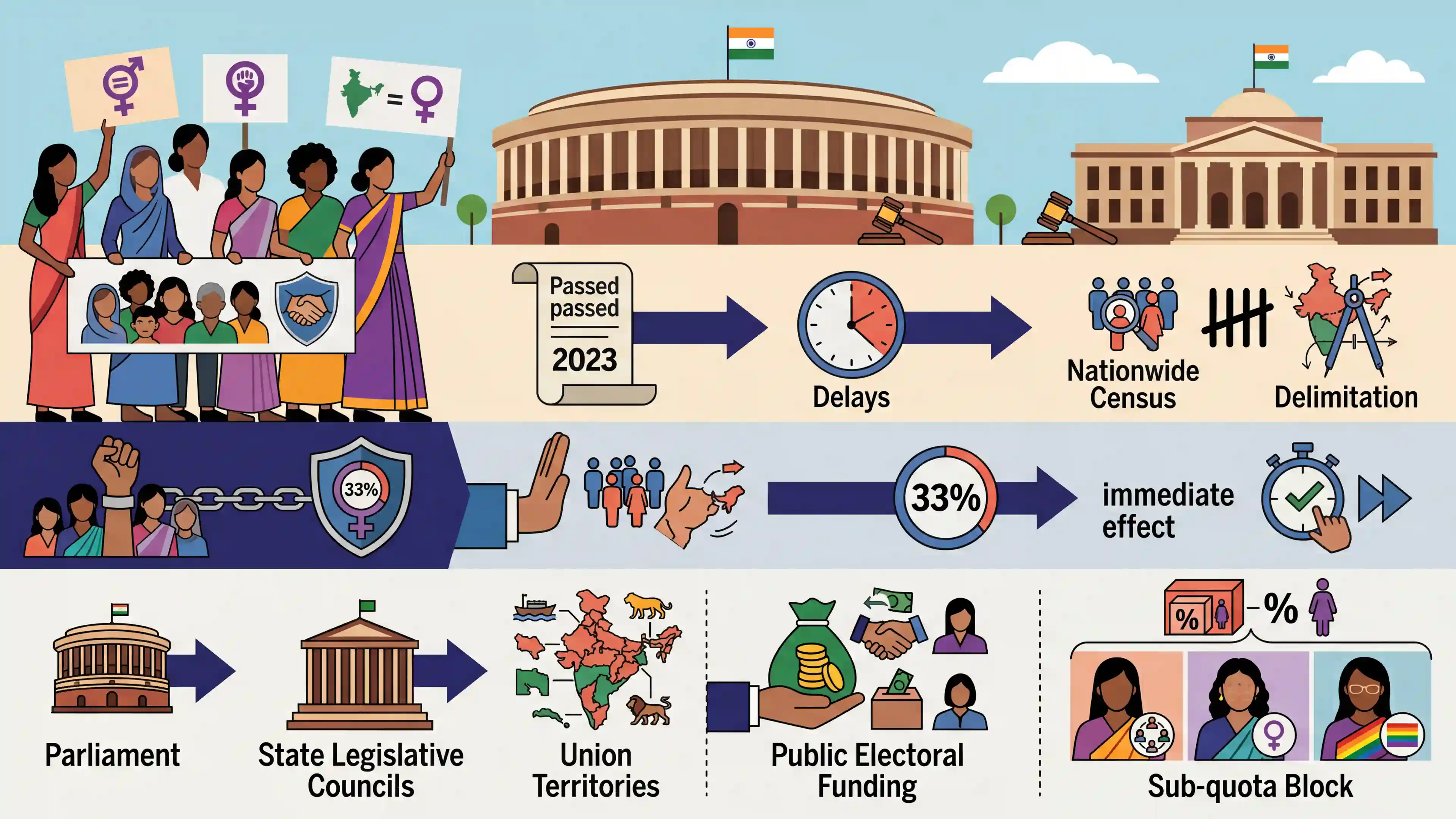
The National Coalition for Women's Reservation, an umbrella body of various civil society organizations, has urged the Union government to implement the women's reservation bill during the Monsoon Session without any preconditions. Under the Nari Shakti Vandan Adhiniyam passed in 2023, the 33% quota for women in the Lok Sabha and State Assemblies is contingent on the completion of a nationwide Census and a subsequent delimitation exercise. The coalition demands the removal of these contingencies for immediate effect. Furthermore, they seek to extend the reservation to the Rajya Sabha, State Legislative Councils, and Union Territories, while also advocating for public electoral funding and specific sub-quotas to ensure the representation of marginalized groups, including OBCs, Dalits, and the LGBTQIA+ community.
Key Points
- The National Coalition for Women's Reservation demands the unconditional passage and immediate implementation of the women's reservation bill.
- Implementation of the Nari Shakti Vandan Adhiniyam (2023) is currently contingent on the completion of the next Census and a subsequent delimitation exercise, which activists oppose.
- The coalition advocates for extending the 33% reservation to the Rajya Sabha, State Legislative Councils, and Union Territories.
- Activists propose a public funding mechanism to support candidates from marginalized backgrounds, along with sub-quotas for OBCs, Dalits, disabled individuals, minorities, and the LGBTQIA+ community to ensure equitable representation.
Important Terms
Nari Shakti Vandan Adhiniyam 2023

Officially the 106th Constitutional Amendment Act (2023), it mandates 33% reservation for women in the Lok Sabha, State Legislative Assemblies, and the Delhi Legislative Assembly.
UPSC context
GS Paper II (Governance, Constitution); tests knowledge of landmark legislation for gender parity and political representation.
Delimitation Exercise
The process of redrawing boundaries of territorial constituencies based on population data; under the 2023 Act, it is a prerequisite for implementing the women's quota.
UPSC context
GS Paper II (Elections, Parliament); tests understanding of constitutional mechanisms linking demographic data to legislative seats.
National Coalition for Women's Reservation
A coalition of civil society organizations and activists advocating for immediate implementation of women's quotas without the conditions of a fresh Census or delimitation.
UPSC context
GS Paper II (Pressure Groups); exemplifies the role of informal associations in influencing the legislative process.
Sub-quota (Intersectional Representation)
A secondary reservation within an existing quota; specifically, the demand to allocate seats for OBC, Dalit, and LGBTQIA+ women within the 33% general women's reservation.
UPSC context
GS Paper II (Social Justice); evaluations critical analysis of inclusive representation for marginalized groups.
Lok Sabha and State Assemblies
The directly elected lower houses of Parliament and State Legislatures, where seats are currently mandated for reservation under the Nari Shakti Vandan Adhiniyam.
UPSC context
GS Paper II (Legislatures); tests foundational knowledge of legislative structures where reservation is constitutionally applicable.
Rajya Sabha and Legislative Councils
The upper houses of Parliament and certain states, which are excluded from the current 33% reservation mandate, a point of contention for rights bodies.
UPSC context
GS Paper II (Structure of Parliament); highlights distinctions between directly and indirectly elected houses regarding affirmative action.
Prelims Trap
"The 106th Amendment guarantees 33% reservation for women in all Houses of Parliament and State Legislatures."
The 106th CAA explicitly applies only to the directly elected Lower Houses (Lok Sabha, State Assemblies, Delhi). It does NOT extend to the Rajya Sabha or State Legislative Councils.
Static Concepts Connected
Why is the Women's Reservation Bill tied to the Delimitation exercise?
- Article 82 Freeze: Article 82 requires constituency readjustment after each Census. The current seat allocations are frozen until the first Census post-2026 (84th Amendment).
- Constituency Identification: The Delimitation Commission will need to redraw constituency boundaries and identify specific seats to be reserved for women on a rotational basis before the quota can be operationalized.
How are seats reserved for marginalized communities in Parliament currently?
- SC/ST Constitutional Mandate: Articles 330 and 332 provide for the reservation of seats for Scheduled Castes and Scheduled Tribes in the Lok Sabha and State Legislative Assemblies, proportional to their population.
- Absence of OBC Quota: There is no constitutional provision for reserving seats for Other Backward Classes (OBCs) in the Lok Sabha or State Assemblies, distinguishing them from local body elections.
- Upper House Exclusions: Upper houses (Rajya Sabha and State Legislative Councils) have indirect elections via proportional representation and do not have any SC/ST reservations.
Cross-Topic Patterns
Electoral Reforms & State Funding
The demand for public electoral funding to help marginalized groups echoes the 1998 Indrajit Gupta Committee recommendations on State funding of elections to ensure a level playing field.
PRI Precedent vs. Parliament Quotas
While the 106th CAA delays quotas at the national level, the 73rd and 74th Amendments immediately mandated 33% (often expanded to 50% by States) for women in local governance without census caveats.

Expect a 2026 Prelims question testing the exact scope of the 106th CAA, specifically its exclusion of the Rajya Sabha and OBC sub-quotas.
Linked PYQs · 2
Linked PYQs · 2
- 2023MainsGS2
Discuss the contribution of civil society groups for women's effective and meaningful participation and representation in state legislatures in India.
- 2024PrelimsGS1
How many Delimitation Commissions have been constituted by the Government of India till December 2023?
